







Question: Problem 9-3 (Level 2) The irreversible gas-phase reaction A+R is being carried out in a fixed-bed catalytic reactor that operates as an ideal PFR. The
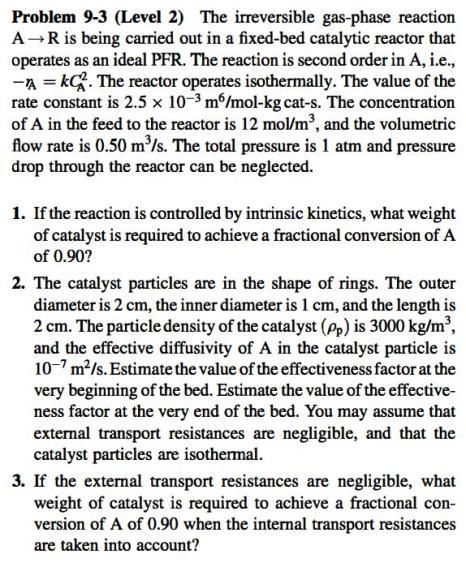
Problem 9-3 (Level 2) The irreversible gas-phase reaction A+R is being carried out in a fixed-bed catalytic reactor that operates as an ideal PFR. The reaction is second order in A, i.e., - A = k. The reactor operates isothermally. The value of the rate constant is 2.5 x 10⁻³ m/mol-kg cat-s. The concentration of A in the feed to the reactor is 12 mol/m, and the volumetric flow rate is 0.50 m/s. The total pressure is 1 atm and pressure drop through the reactor can be neglected. 1. If the reaction is controlled by intrinsic kinetics, what weight of catalyst is required to achieve a fractional conversion of A of 0.90? 2. The catalyst particles are in the shape of rings. The outer diameter is 2 cm, the inner diameter is 1 cm, and the length is 2 cm. The particle density of the catalyst (Ap) is 3000 kg/m, and the effective diffusivity of A in the catalyst particle is 10-m-/s. Estimate the value of the effectiveness factor at the very beginning of the bed. Estimate the value of the effective- ness factor at the very end of the bed. You may assume that external transport resistances are negligible, and that the catalyst particles are isothermal. 3. If the external transport resistances are negligible, what weight of catalyst is required to achieve a fractional con- version of A of 0.90 when the internal transport resistances are taken into account
Step by Step Solution
There are 3 Steps involved in it

Get step-by-step solutions from verified subject matter experts
 Study Help