







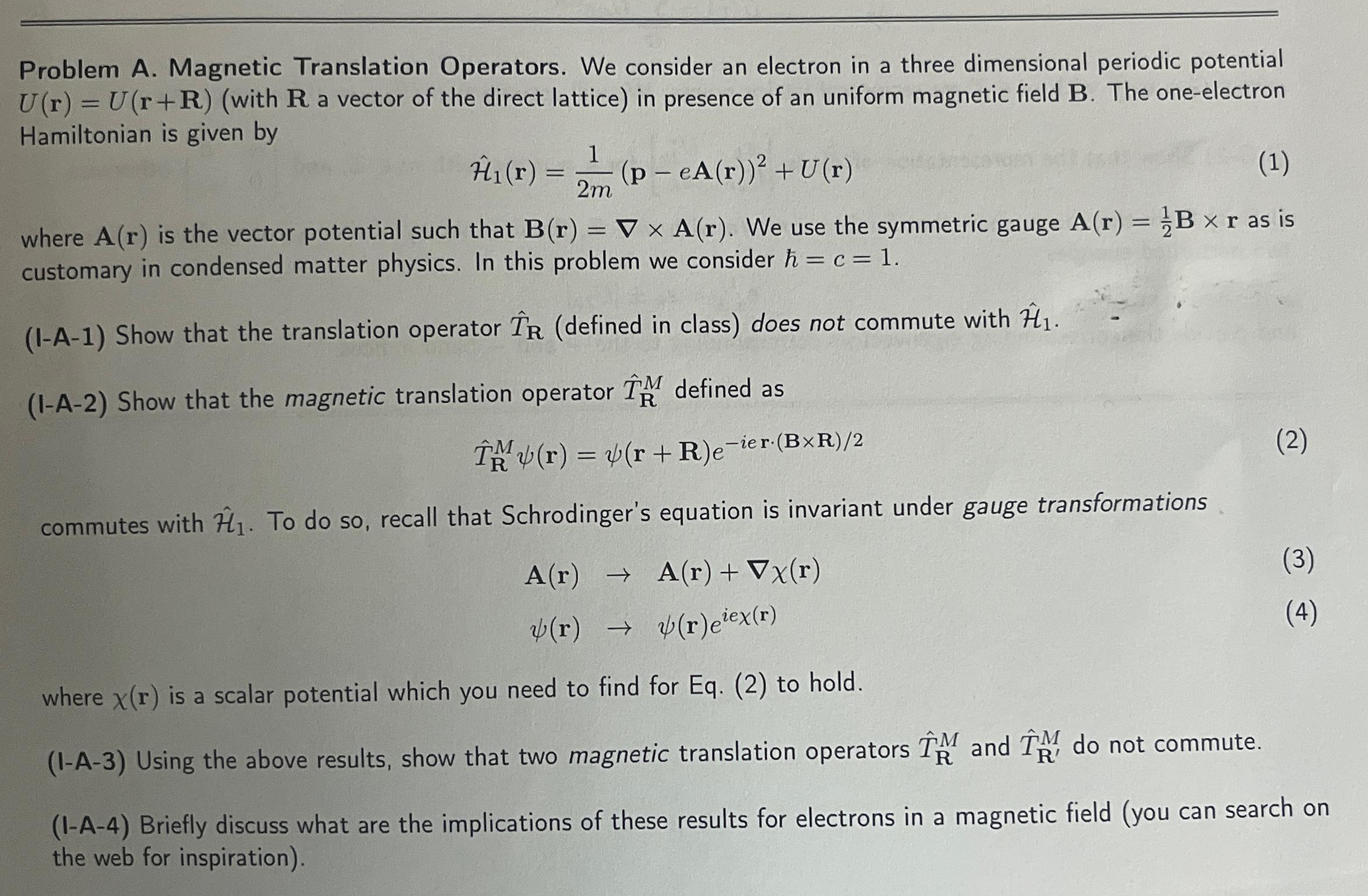
Question: Problem A . Magnetic Translation Operators. We consider an electron in a three dimensional periodic potential U ( r ) = U ( r +
Problem A Magnetic Translation Operators. We consider an electron in a three dimensional periodic potential with a vector of the direct lattice in presence of an uniform magnetic field The oneelectron Hamiltonian is given by
hat
where is the vector potential such that grad We use the symmetric gauge as is customary in condensed matter physics. In this problem we consider
IA Show that the translation operator hatdefined in class does not commute with hat
IA Show that the magnetic translation operator hat defined as
hat
commutes with hat To do so recall that Schrodinger's equation is invariant under gauge transformations
grad
where is a scalar potential which you need to find for Eq to hold.
IA Using the above results, show that two magnetic translation operators hat and hat do not commute.
IA Briefly discuss what are the implications of these results for electrons in a magnetic field you can search on the web for inspiration
Step by Step Solution
There are 3 Steps involved in it
1 Expert Approved Answer
Step: 1 Unlock

Question Has Been Solved by an Expert!
Get step-by-step solutions from verified subject matter experts
Step: 2 Unlock
Step: 3 Unlock
 Study Help