







Question: PROBLEM BACKGROUND Earlier this semester we learned that the most common paint-stripping solvent methylene chloride CH2Cl2 was recently banned for this use due to its
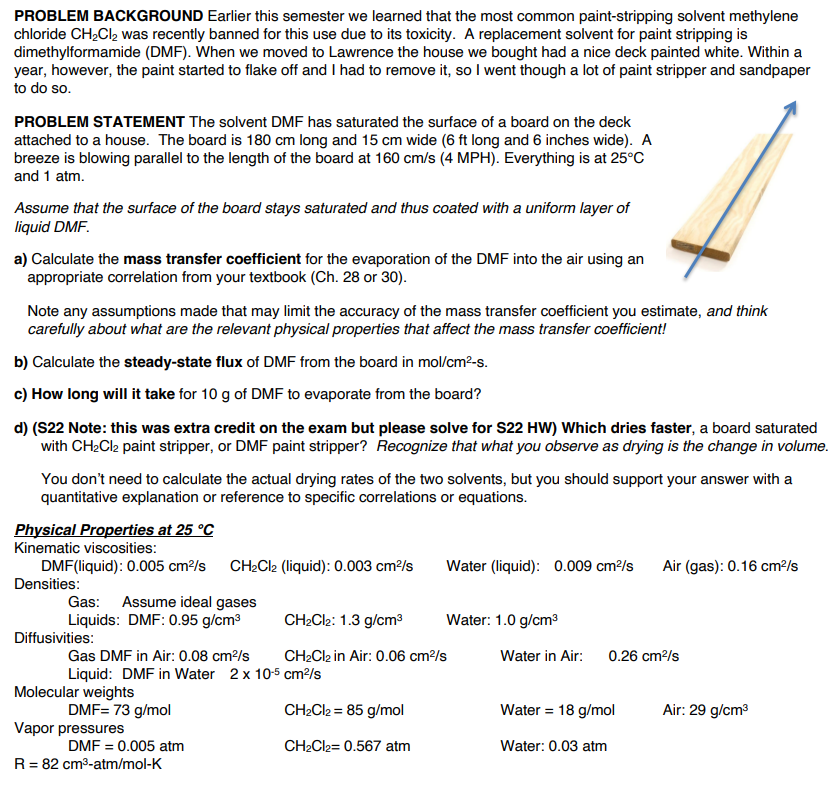
PROBLEM BACKGROUND Earlier this semester we learned that the most common paint-stripping solvent methylene chloride CH2Cl2 was recently banned for this use due to its toxicity. A replacement solvent for paint stripping is dimethylformamide (DMF). When we moved to Lawrence the house we bought had a nice deck painted white. Within a year, however, the paint started to flake off and I had to remove it, so I went though a lot of paint stripper and sandpaper to do so. PROBLEM STATEMENT The solvent DMF has saturated the surface of a board on the deck attached to a house. The board is 180 cm long and 15 cm wide (6 ft long and 6 inches wide). A breeze is blowing parallel to the length of the board at 160 cm/s (4 MPH). Everything is at 25C and 1 atm. Assume that the surface of the board stays saturated and thus coated with a uniform layer of liquid DMF. a) Calculate the mass transfer coefficient for the evaporation of the DMF into the air using an appropriate correlation from your textbook (Ch. 28 or 30). Note any assumptions made that may limit the accuracy of the mass transfer coefficient you estimate, and think carefully about what are the relevant physical properties that affect the mass transfer coefficient! b) Calculate the steady-state flux of DMF from the board in mol/cm2-s. c) How long will it take for 10 g of DMF to evaporate from the board? d) (S22 Note: this was extra credit on the exam but please solve for S22 HW) Which dries faster, a board saturated with CH2Cl2 paint stripper, or DMF paint stripper? Recognize that what you observe as drying is the change in volume. You don't need to calculate the actual drying rates of the two solvents, but you should support your answer with a quantitative explanation or reference to specific correlations or equations. Physical Properties at 25 C Kinematic viscosities: DMF(liquid): 0.005 cm2/s CH2Cl2 (liquid): 0.003 cm2/s Water (liquid): 0.009 cm2/s Air (gas): 0.16 cm/s Densities: Gas: Assume ideal gases Liquids: DMF: 0.95 g/cm3 CH2Cl2: 1.3 g/cm3 Water: 1.0 g/cm3 Diffusivities: Gas DMF in Air: 0.08 cm2/s CH2Cl2 in Air: 0.06 cm2/s Water in Air: 0.26 cm/s Liquid: DMF in Water 2 x 105 cm/s Molecular weights DMF= 73 g/mol CH2Cl2 = 85 g/mol Water = 18 g/mol Air: 29 g/cm Vapor pressures DMF = 0.005 atm CH2Cl2= 0.567 atm Water: 0.03 atm R = 82 cm3-atm/mol-K
Step by Step Solution
There are 3 Steps involved in it

Get step-by-step solutions from verified subject matter experts
 Study Help