







Question: Problem: Bank Transaction Create assembly program to analyze a series of bank transactions. Each transaction can be either a deposit ( positive amount ) or
Problem: Bank Transaction
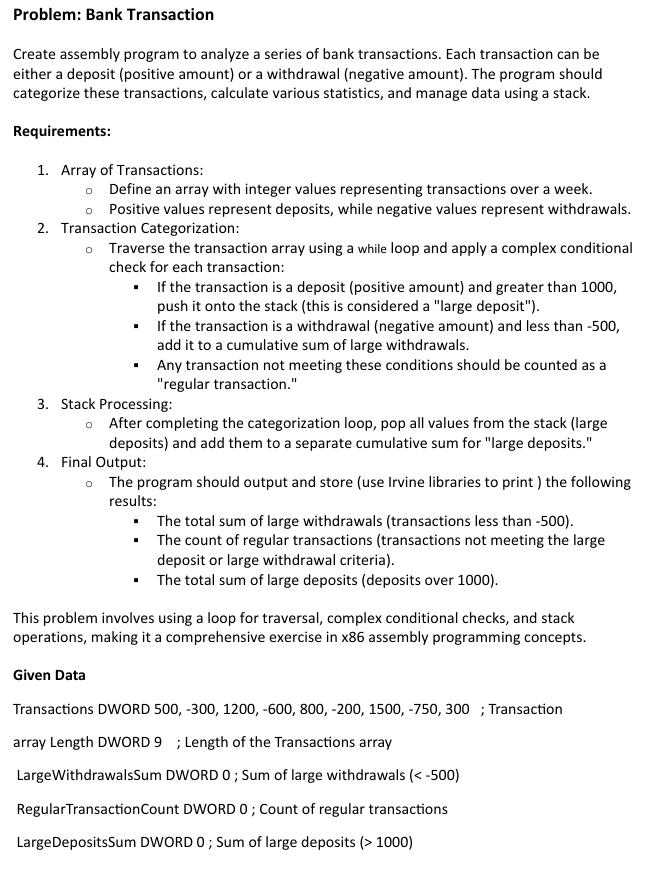
Create assembly program to analyze a series of bank transactions. Each transaction can be either a deposit positive amount or a withdrawal negative amount The program should categorize these transactions, calculate various statistics, and manage data using a stack.
Requirements:
Array of Transactions:
Define an array with integer values representing transactions over a week.
Positive values represent deposits, while negative values represent withdrawals.
Transaction Categorization:
Traverse the transaction array using a while loop and apply a complex conditional check for each transaction:
If the transaction is a deposit positive amount and greater than push it onto the stack this is considered a "large deposit"
If the transaction is a withdrawal negative amount and less than add it to a cumulative sum of large withdrawals.
Any transaction not meeting these conditions should be counted as a "regular transaction."
Stack Processing:
After completing the categorization loop, pop all values from the stack large deposits and add them to a separate cumulative sum for "large deposits."
Final Output:
The program should output and store use Irvine libraries to print the following results:
The total sum of large withdrawals transactions less than
The count of regular transactions transactions not meeting the large deposit or large withdrawal criteria
The total sum of large deposits deposits over
This problem involves using a loop for traversal, complex conditional checks, and stack operations, making it a comprehensive exercise in times assembly programming concepts.
Given Data
Transactions DWORD ; Transaction
array Length DWORD ; Length of the Transactions array
LargeWithdrawalsSum DWORD ; Sum of large withdrawals
RegularTransactionCount DWORD ; Count of regular transactions
LargeDepositsSum DWORD ; Sum of large deposits
Step by Step Solution
There are 3 Steps involved in it
1 Expert Approved Answer
Step: 1 Unlock

Question Has Been Solved by an Expert!
Get step-by-step solutions from verified subject matter experts
Step: 2 Unlock
Step: 3 Unlock
 Study Help