







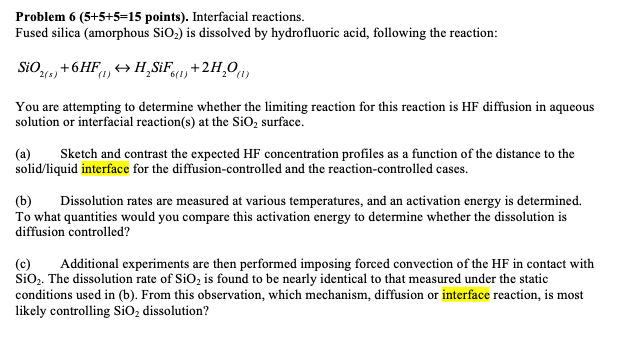
Question: Problem points ) . Interfacial reactions. Fused silica ( amorphous S i O 2 ) is dissolved by hydrofluoric acid, following the reaction: S i
Problem points Interfacial reactions.
Fused silica amorphous is dissolved by hydrofluoric acid, following the reaction:
You are attempting to determine whether the limiting reaction for this reaction is HF diffusion in aqueous
solution or interfacial reactions at the surface.
a Sketch and contrast the expected concentration profiles as a function of the distance to the
solidliquid interface for the diffusioncontrolled and the reactioncontrolled cases.
b Dissolution rates are measured at various temperatures, and an activation energy is determined.
To what quantities would you compare this activation energy to determine whether the dissolution is
diffusion controlled?
c Additional experiments are then performed imposing forced convection of the HF in contact with
The dissolution rate of is found to be nearly identical to that measured under the static
conditions used in b From this observation, which mechanism, diffusion or interface reaction, is most
likely controlling dissolution?
Step by Step Solution
There are 3 Steps involved in it
1 Expert Approved Answer
Step: 1 Unlock

Question Has Been Solved by an Expert!
Get step-by-step solutions from verified subject matter experts
Step: 2 Unlock
Step: 3 Unlock
 Study Help