







Question: Problem Scenario A - Model Prediction and Analysis An isothermal constant-volume batch reactor was used to carry out multiple runs of the liquid-phase reaction (results
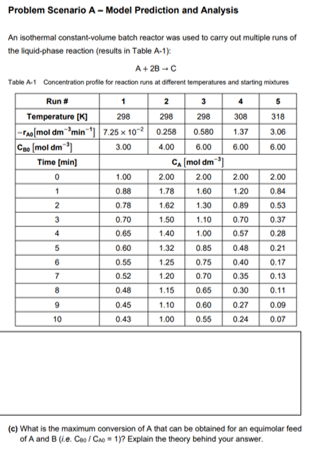
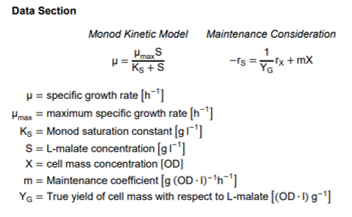
Problem Scenario A - Model Prediction and Analysis An isothermal constant-volume batch reactor was used to carry out multiple runs of the liquid-phase reaction (results in Table A-1) A+ 28C Table A1 Concentration profile for reaction runs at different temperatures and starting matures Run # 1 2 3 4 5 Temperature [K] 298 298 298 308 318 -moldmmin" 7.25 x 10 0.258 0.580 1.37 3.06 Cromol dm' 3.00 4.00 6.00 6.00 6.00 Time [min CA (moldm') 0 1.00 2.00 2.00 2.00 2.00 1 0.88 1.78 1.60 1.20 0.84 2 0.78 1.62 1.30 0.89 0.53 3 0.70 1.50 1.10 0.70 0.37 4 0.65 1.40 1.00 0.57 0.28 5 0.60 1.32 0.85 0.48 0.21 6 0.55 1.25 0.75 0.40 0.17 7 0.52 1.20 0.70 0.35 0.13 8 0.48 1.15 0.65 0.30 0.11 9 0.45 1.10 0.60 0.27 0.09 10 0.43 1.00 0.55 0.24 0.07 (c) What is the maximum conversion of that can be obtained for an equimolar feed of A and B (ie. Cao Cao 1/2 Explain the theory behind your answer. Maars Ks+S Data Section Monod Kinetic Model Maintenance Consideration -Is Yo'x+mx Px mX u = specific growth rate [n") max = maximum specific growth rate [h=') Ks = Monod saturation constant [gr'] SEL-malate concentration [gr] X = cell mass concentration (OD) m = Maintenance coefficient [g (OD - 1)-th-'] Yo = True yield of cell mass with respect to L-malate (COD-1 g=
Step by Step Solution
There are 3 Steps involved in it

Get step-by-step solutions from verified subject matter experts
 Study Help