Question: PROBLEM SOLVING APPLICATION CASE (PSAC) Group Forms to Amp Up Research Malo drug companies and nonprofit research groups d never put aside fierce competition and
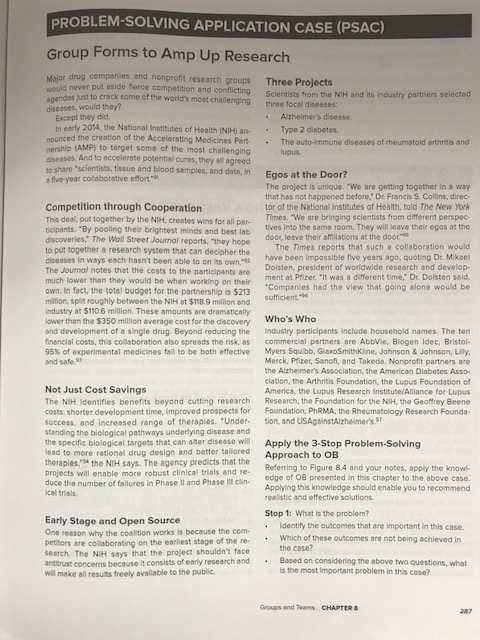
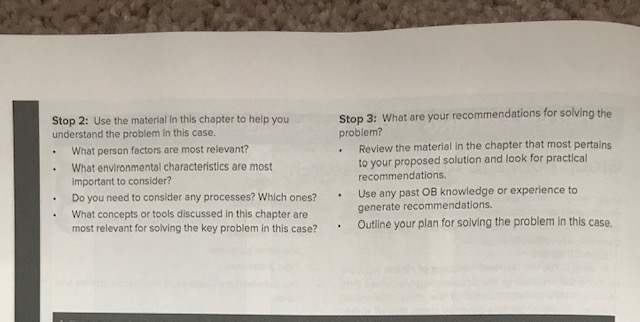
PROBLEM SOLVING APPLICATION CASE (PSAC) Group Forms to Amp Up Research Malo drug companies and nonprofit research groups d never put aside fierce competition and conflicting alust to crack some of the world's most challenging diseases, would they? Except they did. In early 2014, the National Institutes of Health (NIHI . ounced the creation of the Accelerating Medicines Part Bersho (AMP) to target some of the most challenging diseases. And to accelerate potential cures, they all agreed The scientists, tissue and blood samples, and data, in a five-year collaborative effort Three Projects Scientists from the NIH and its industry partners selected three focal diseases Alzheimer's disease. . Type 2 diabetes . The autoimmune diseases of rheumatoid arthritis and lupus Competition through Cooperation This deal, put together by the NIH, creates wins for all par cipants. "By pooling their brightest minds and best lab discoveries." The Wall Street Journal reports, they hope to put together a research system that can decipher the diseases in ways each hasn't been able to on its own.2 The Journal notes that the costs to the participants are much lower than they would be when working on their own. In fact, the total budget for the partnership is $213 million, split roughly between the NIH at $118.9 million and Industry at $110.6 million. These amounts are dramatically lower than the $350 million average cost for the discovery and development of a single drug. Beyond reducing the financial costs, this collaboration also spreads the risk as 95% of experimental medicines fail to be both effective and safe 90 Fans at the Door? The prolect is unique. "We are getting together in a way that has not happened before," De Francis S. Collins, direc tor of the National Institutes of Health, told The New York Times. "We are bringing scientists from different perspec- tives into the same room. They will leave their egos at the door leave their allations at the door The Times reports that such a collaboration would have been Impossible five years ago, quoting Dr. Mikael Dolsten, president of worldwide research and develop- ment at Pfizer. "It was a different time," Dr. Dolsten said. Companies had the view that going alone would be sufficient Who's Who industry participants include household names. The ten commercial partners are AbbVie, Biogen Idec, Bristol Myers Squibb, GlaxoSmithKline, Johnson & Johnson, Lily Merck, Prizer, Sanofi, and Takeda Nonprofit partners are the Alzheimer's Association, the American Diabetes Asso- ciation, the Arthritis Foundation, the Lupus Foundation of America, the Lupus Research Institute/Alliance for Lupus Research, the Foundation for the NIH, the Geoffrey Beene Foundation, PhRMA, the Rheumatology Research Founda- tion, and USAgainst Alzheimer's Not Just Cost Savings The NIH Identifies benefits beyond cutting research costs: shorter development time, improved prospects for Success, and increased range of therapies. "Under standing the biological pathways underlying disease and the specific biological targets that can alter disease will lead to more rational drug design and better tailored therapies the NIH says. The agency predicts that the projects will enable more robust clinical trials and re- duce the number of failures in Phasell and Phase IIl clin Ical trials Apply the 3-Stop Problem Solving Approach to OB Referring to figure 8.4 and your notes, apply the knowl edge of OB presented in this chapter to the above case. Applying this knowledge should enable you to recommend realistic and effective solutions Early Stage and Open Source One reason why the coalition works is because the com- petitors are collaborating on the earliest stage of the re- Search. The NIH says that the project shouldn't face antitrust concerns because it consists of early research and Will make all results freely available to the public. Stop 1: What is the problem? Identify the outcomes that are important in this case. . Which of these outcomes are not being achieved in the case? . Based on considering the above two questions, what is the most important problem in this case? Groups and Teams CHAPTER Stop 2: Use the material in this chapter to help you understand the problem in this case. What person factors are most relevant? What environmental characteristics are most Important to consider? Do you need to consider any processes? Which ones? What concepts or tools discussed in this chapter are most relevant for solving the key problem in this case? Stop 3: What are your recommendations for solving the problem? Review the material in the chapter that most pertains to your proposed solution and look for practical recommendations. . Use any past OB knowledge or experience to generate recommendations. . Outline your plan for solving the problem in this case









 Study Help