







Question: problem. The numbers inside the chart represent cost per unit (25) a) Draw a network representation for this problem b) Find the solution that minimizes
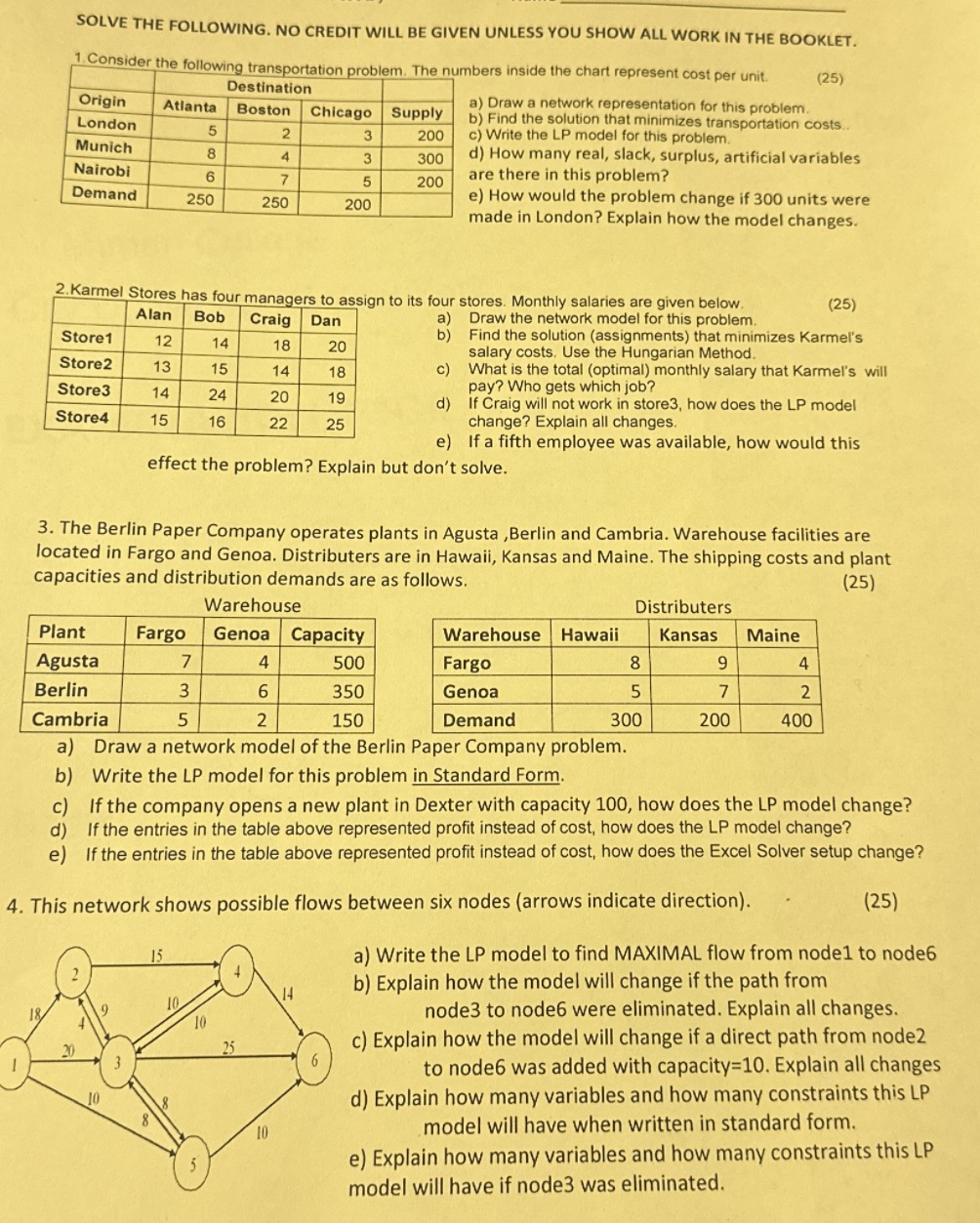
problem. The numbers inside the chart represent cost per unit (25) a) Draw a network representation for this problem b) Find the solution that minimizes transportation costs c) Wirite the LP model for this problem:. d) How many real, slack, surplus, artificial variables are there in this problem? e) How would the problem change if 300 units were made in London? Explain how the model changes. gers to assign to its four stores. Monthly salaries are given below. (25) Draw the network model for this problem. b) Find the solution (assignments) that minimizes Karmel's salary costs. Use the Hungarian Method. c) What is the total (optimal) monthly salary that Karmel's will pay? Who gets which job? d) If Craig will not work in store3, how does the LP model change? Explain all changes. e) If a fifth employee was available, how would this effect the problem? Explain but don't solve. Store1 3. The Berlin Paper Company operates plants in Agusta ,Berlin and Cambria. Warehouse facilities are located in Fargo and Genoa. Distributers are in Hawaii, Kansas and Maine. The shipping costs and plant capacities and distribution demands are as follows. (25) Warehouse Distributers Genoa | Capacity | | Warehouse | Hawaii | Kansas | Maine | jiagusta ([T Al a7 Wisool){iFargot - ol I e Rs o (A iBerlin- {5 35 6] 7" 350 il'Genca |l i ENED G/ T SN Demand | 300 200| 400 a) Draw a network model of the Berlin Paper Company problem. b) Write the LP model for this problem in Standard Form. If the company opens a new plant in Dexter with capacity 100, how does the LP model change? c) d) If the entries in the table above represented profit instead of cost, how does the LP model change? e) If the entries in the table above represented profit instead of cost, how does the Excel Solver setup change? 4. This network shows possible flows between six nodes (arrows indicate direction). (25) a) Write the LP model to find MAXIMAL flow from nodel to node6 b) Explain how the model will change if the path from node3 to node6 were eliminated. Explain all changes. ) Explain how the model will change if a direct path from node2 to node6 was added with capacity=10. Explain all changes d) Explain how many variables and how many constraints this LP model will have when written in standard form. e) Explain how many variables and how many constraints this LP model will have if node3 was eliminated
Step by Step Solution
There are 3 Steps involved in it

Get step-by-step solutions from verified subject matter experts
 Study Help