





Question: Process Capability Analysis Before quality can be built into a product, it is necessary to verify that the selected production process is capable of performing
Process Capability Analysis Before quality can be

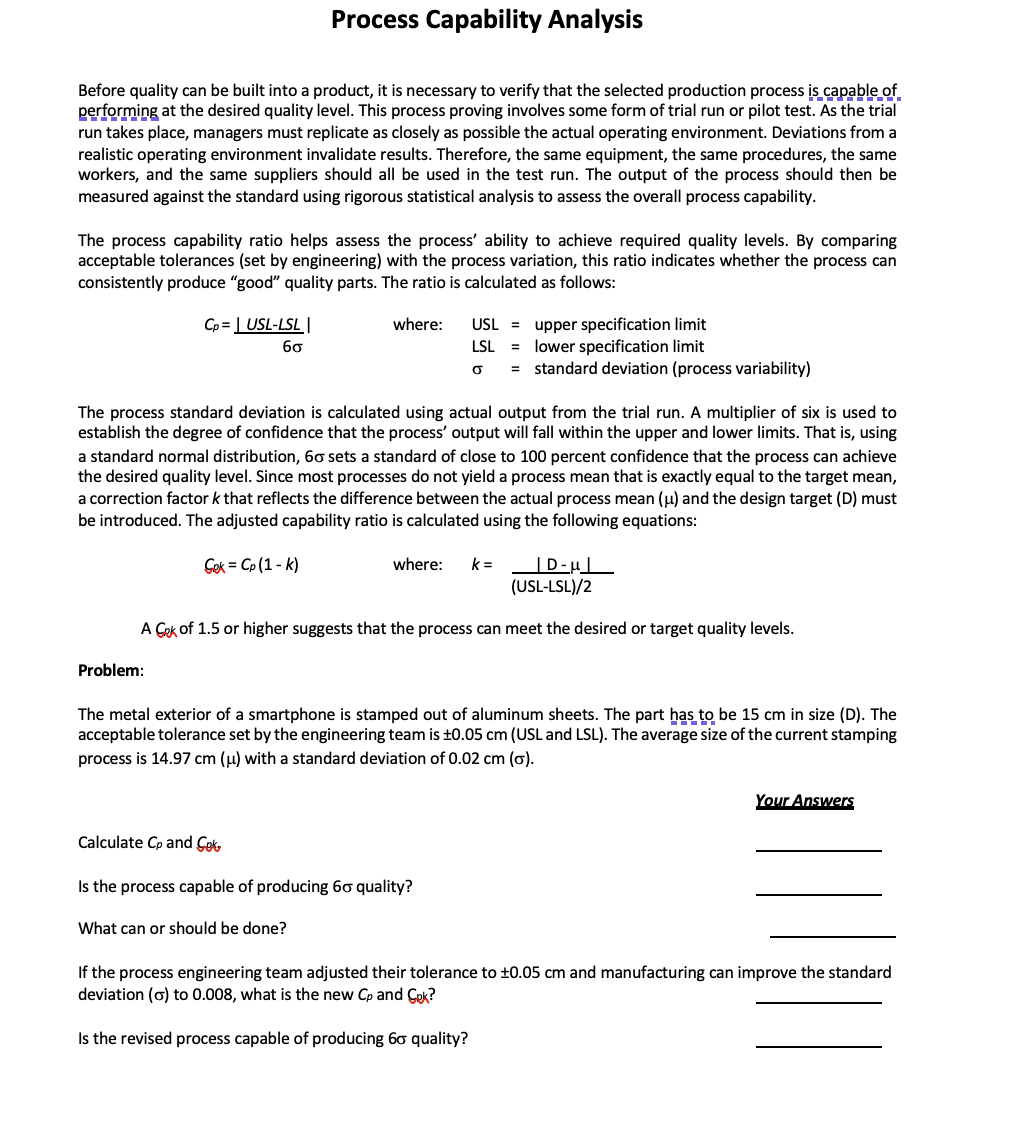
Process Capability Analysis Before quality can be built into a product, it is necessary to verify that the selected production process is capable of performing at the desired quality level. This process proving involves some form of trial run or pilot test. As the trial run takes place, managers must replicate as closely as possible the actual operating environment. Deviations from a realistic operating environment invalidate results. Therefore, the same equipment, the same procedures, the same workers, and the same suppliers should all be used in the test run. The output of the process should then be measured against the standard using rigorous statistical analysis to assess the overall process capability. The process capability ratio helps assess the process' ability to achieve required quality levels. By comparing acceptable tolerances (set by engineering) with the process variation, this ratio indicates whether the process can consistently produce "good" quality parts. The ratio is calculated as follows: Cp=USL-LSL6where:USLLSL=standarddeviation(processvariability)=upperspecificationlimit=lowerspecificationlimit The process standard deviation is calculated using actual output from the trial run. A multiplier of six is used to establish the degree of confidence that the process' output will fall within the upper and lower limits. That is, using a standard normal distribution, 6 sets a standard of close to 100 percent confidence that the process can achieve the desired quality level. Since most processes do not yield a process mean that is exactly equal to the target mean, a correction factor k that reflects the difference between the actual process mean ( ) and the design target (D) must be introduced. The adjusted capability ratio is calculated using the following equations: A Cnk of 1.5 or higher suggests that the process can meet the desired or target quality levels. Problem: The metal exterior of a smartphone is stamped out of aluminum sheets. The part has to be 15cm in size (D). The acceptable tolerance set by the engineering team is 0.05cm (USL and LSL). The average size of the current stamping process is 14.97cm() with a standard deviation of 0.02cm(). Your Answers Calculate Cp and C0k Is the process capable of producing 6 quality? What can or should be done? If the process engineering team adjusted their tolerance to 0.05cm and manufacturing can improve the standard Is the revised process capable of producing 6 quality

Step by Step Solution

There are 3 Steps involved in it

1 Expert Approved Answer
Step: 1 Unlock blur-text-image

Question Has Been Solved by an Expert!

Get step-by-step solutions from verified subject matter experts

Step: 2 Unlock
Step: 3 Unlock

Students Have Also Explored These Related General Management Questions!