







Question: Product notation. In case this hasn't come up in your classes yet, given {a,..., an} CR we use the following notation: n IIaaa an
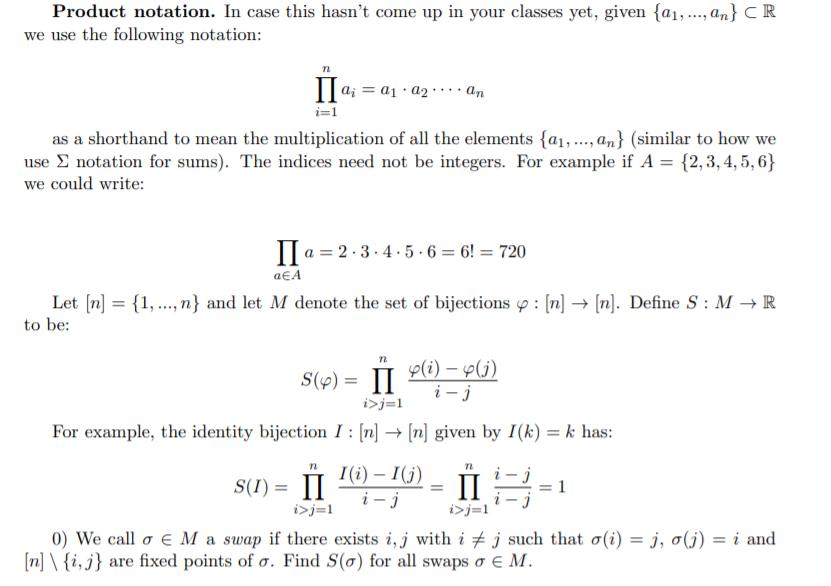
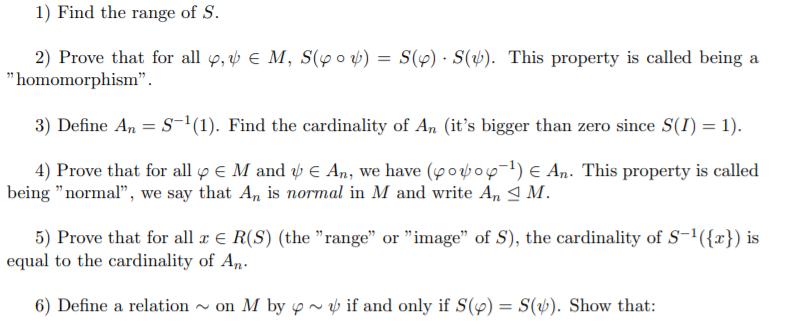
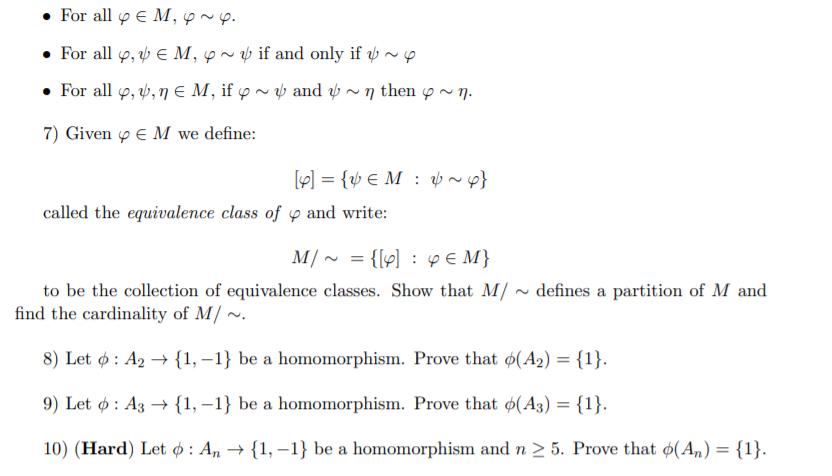
Product notation. In case this hasn't come up in your classes yet, given {a,..., an} CR we use the following notation: n IIaaa an as a shorthand to mean the multiplication of all the elements {a,..., an} (similar to how we use notation for sums). The indices need not be integers. For example if A = {2,3,4,5,6} we could write: a=2.3.4.5.6= 6! = 720 a A = Let [n] {1,..,n} and let M denote the set of bijections : [n] [n]. Define S : M R to be: n S(p) = II i>j=1 For example, the identity bijection I: [n] [n] given by I(k)= k has: S(I) = n II i>j=1 4(i) 4(j) i-j I(i)-I(j) i-j n 113- i>j=1 1 0) We callo E M a swap if there exists i, j with i # j such that o(i) = j, o(j) = i and [n]\ {i, j} are fixed points of o. Find S(o) for all swaps M. 1) Find the range of S. 2) Prove that for all , M, S(po) = S(p) S(). This property is called being a "homomorphism". 3) Define An= S-(1). Find the cardinality of An (it's bigger than zero since S(I) = 1). 4) Prove that for all y M and An, we have (poop-) An. This property is called being "normal", we say that An is normal in M and write A, M. 5) Prove that for all x R(S) (the "range" or "image" of S), the cardinality of S-({x}) is equal to the cardinality of An 6) Define a relation on M by ~ if and only if S(p) = S(). Show that: . For all M, p~ p. For all , M, ~ if and only if ~ For all ,,ne M, if 7) Given M we define: and ~n then ~n. [4] = {EM: 4~6} called the equivalence class of and write: M/~= {[4] PEM} : to be the collection of equivalence classes. Show that M/ find the cardinality of M/~. 8) Let : A {1, -1} be a homomorphism. Prove that (A) = {1}. 9) Let : A3 {1, -1} be a homomorphism. Prove that (A3) = {1}. 10) (Hard) Let : An {1,-1} be a homomorphism and n 25. Prove that o(An) = {1}. 2 defines a partition of M and
Step by Step Solution
3.47 Rating (160 Votes )
There are 3 Steps involved in it
lets continue with the solutions for the given questions 0 Find Ssigma for all swaps M We already know that a swap is a bijection such that there exis... View full answer

Get step-by-step solutions from verified subject matter experts
 Study Help