







Question: Programming Exercise 2-2 Unit programming exercises are posted on BrightSpace and are designed to provide you with the opportunity to practice the skills discussed in
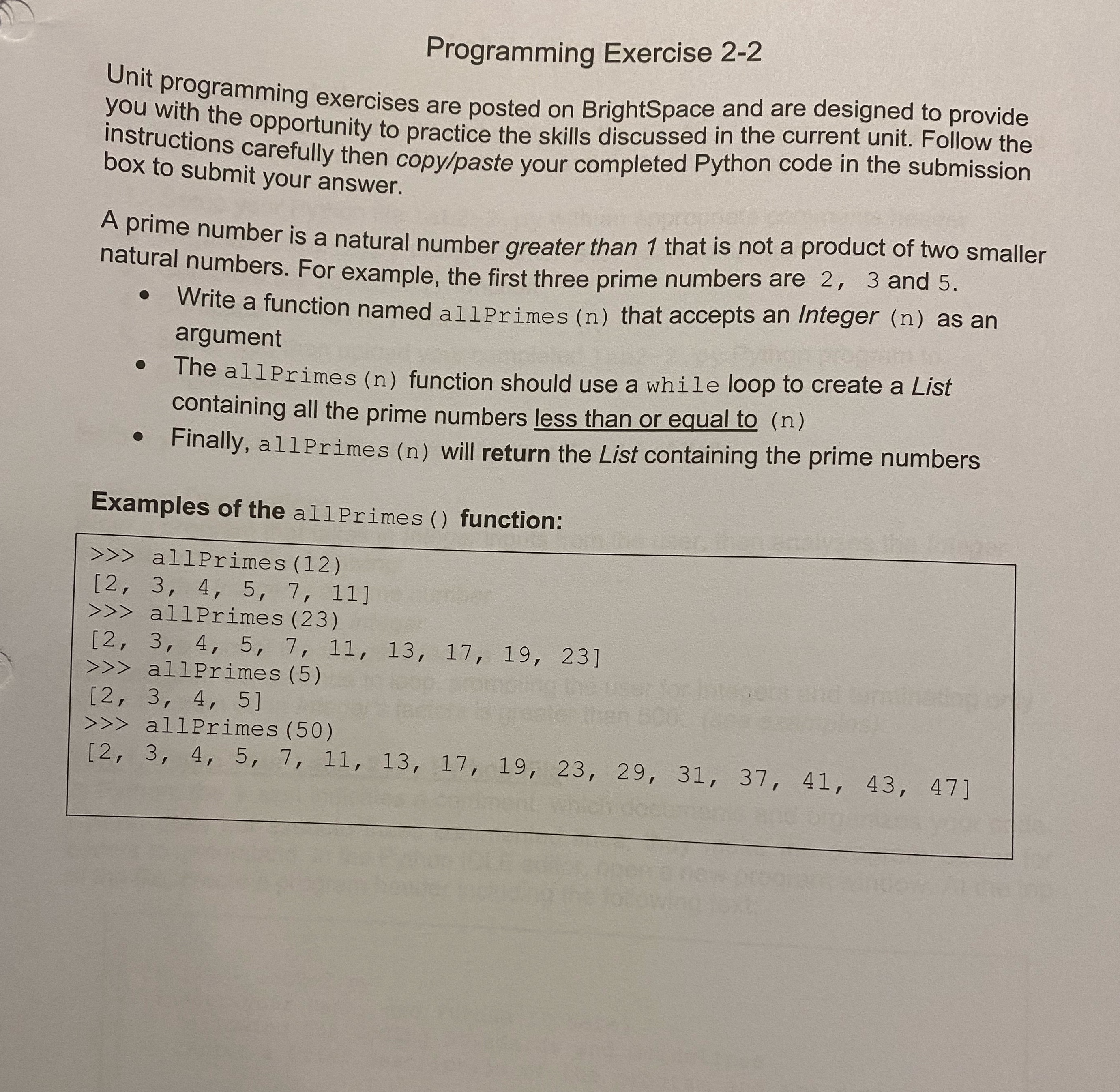
Programming Exercise 2-2 Unit programming exercises are posted on BrightSpace and are designed to provide you with the opportunity to practice the skills discussed in the current unit. Follow the instructions carefully then copy/paste your completed Python code in the submission box to submit your answer. A prime number is a natural number greater than 1 that is not a product of two smaller natural numbers. For example, the first three prime numbers are 2, 3 and 5. . Write a function named allprimes (n) that accepts an Integer (n) as an argument . The allPrimes (n) function should use a while loop to create a List containing all the prime numbers less than or equal to (n) . Finally, allPrimes (n) will return the List containing the prime numbers Examples of the allPrimes () function: > > > allPrimes (12) [2, 3, 4, 5, 7, 11] > > > allPrimes (23) [2, 3, 4, 5, 7, 11, 13, 17, 19, 23] > > > allPrimes (5) [2, 3, 4, 5] > > > allPrimes (50) [2, 3, 4, 5, 7, 11, 13, 17, 19, 23, 29, 31, 37, 41, 43, 47]
Step by Step Solution
There are 3 Steps involved in it

Get step-by-step solutions from verified subject matter experts
 Study Help