







Question: Programs for embedded devices are often written in assembly language. Some embedded processors have limited instructions, like MARIE. Create a MARIE program which determines
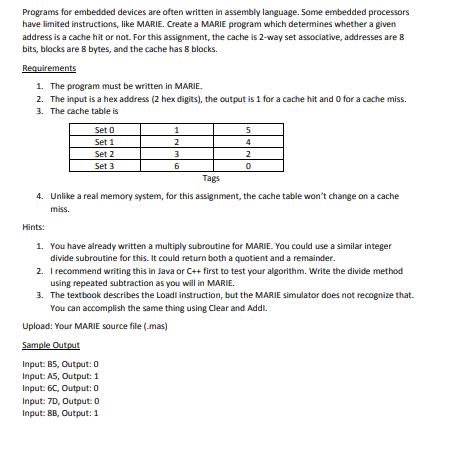
Programs for embedded devices are often written in assembly language. Some embedded processors have limited instructions, like MARIE. Create a MARIE program which determines whether a given address is a cache hit or not. For this assignment, the cache is 2-way set associative, addresses are 8 bits, blocks are 8 bytes, and the cache has 8 blocks. Requirements 1. The program must be written in MARIE. 2. The input is a hex address (2 hex digits), the output is 1 for a cache hit and 0 for a cache miss. 3. The cache table is Set 0 Set 1 Set 2 Set 3 1 2 3 6 5 4 2 0 Tags 4. Unlike a real memory system, for this assignment, the cache table won't change on a cache miss. Hints: 1. You have already written a multiply subroutine for MARIE. You could use a similar integer divide subroutine for this. It could return both a quotient and a remainder. Input: 85, Output: 0 Input: A5, Output: 1 Input: 6C, Output: 0 Input: 7D, Output: 0 Input: 8B, Output: 1 2. I recommend writing this in Java or C++ first to test your algorithm. Write the divide method using repeated subtraction as you will in MARIE. 3. The textbook describes the Loadl instruction, but the MARIE simulator does not recognize that. You can accomplish the same thing using Clear and Addl. Upload: Your MARIE source file (.mas) Sample Output
Step by Step Solution
3.44 Rating (173 Votes )
There are 3 Steps involved in it
SOLUTION Its a 2way set associative cache The address can be splitted as TagSet numberOffset Since t... View full answer

Get step-by-step solutions from verified subject matter experts
 Study Help