Question: Project Scheduling 30 points g. Develop an estimated duration and identify the immediate predecessors 5 points h. Using a project start time of 0 and
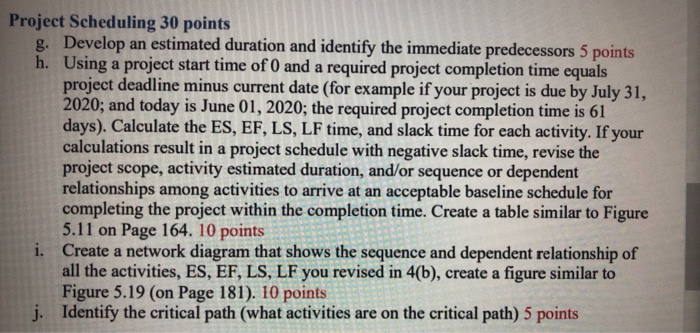
Project Scheduling 30 points g. Develop an estimated duration and identify the immediate predecessors 5 points h. Using a project start time of 0 and a required project completion time equals project deadline minus current date (for example if your project is due by July 31, 2020; and today is June 01, 2020; the required project completion time is 61 days). Calculate the ES, EF, LS, LF time, and slack time for each activity. If your calculations result in a project schedule with negative slack time, revise the project scope, activity estimated duration, and/or sequence or dependent relationships among activities to arrive at an acceptable baseline schedule for completing the project within the completion time. Create a table similar to Figure 5.11 on Page 164. 10 points i. Create a network diagram that shows the sequence and dependent relationship of all the activities, ES, EF, LS, LF you revised in 4(b), create a figure similar to Figure 5.19 (on Page 181). 10 points j. Identify the critical path (what activities are on the critical path) 5 points Project Scheduling 30 points g. Develop an estimated duration and identify the immediate predecessors 5 points h. Using a project start time of 0 and a required project completion time equals project deadline minus current date (for example if your project is due by July 31, 2020; and today is June 01, 2020; the required project completion time is 61 days). Calculate the ES, EF, LS, LF time, and slack time for each activity. If your calculations result in a project schedule with negative slack time, revise the project scope, activity estimated duration, and/or sequence or dependent relationships among activities to arrive at an acceptable baseline schedule for completing the project within the completion time. Create a table similar to Figure 5.11 on Page 164. 10 points i. Create a network diagram that shows the sequence and dependent relationship of all the activities, ES, EF, LS, LF you revised in 4(b), create a figure similar to Figure 5.19 (on Page 181). 10 points j. Identify the critical path (what activities are on the critical path) 5 points









 Study Help