Question: PROJECT SIMULATION 1 Managerial Financial Analysis & Strategic Planning BACKGROUND: Do corporate firms survive in the long-run? While the sheer size and scope of some
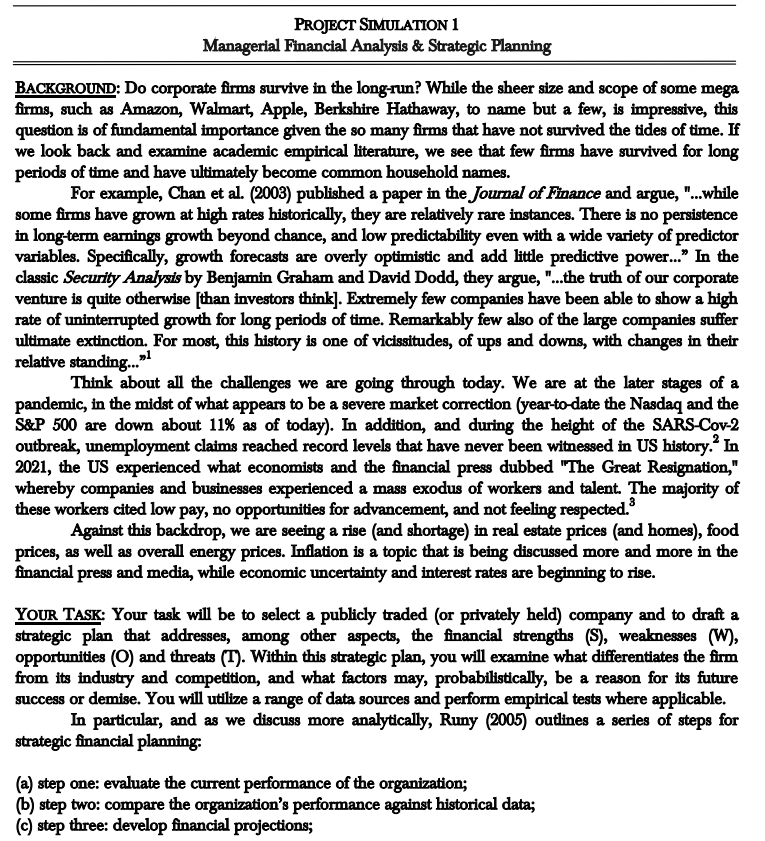
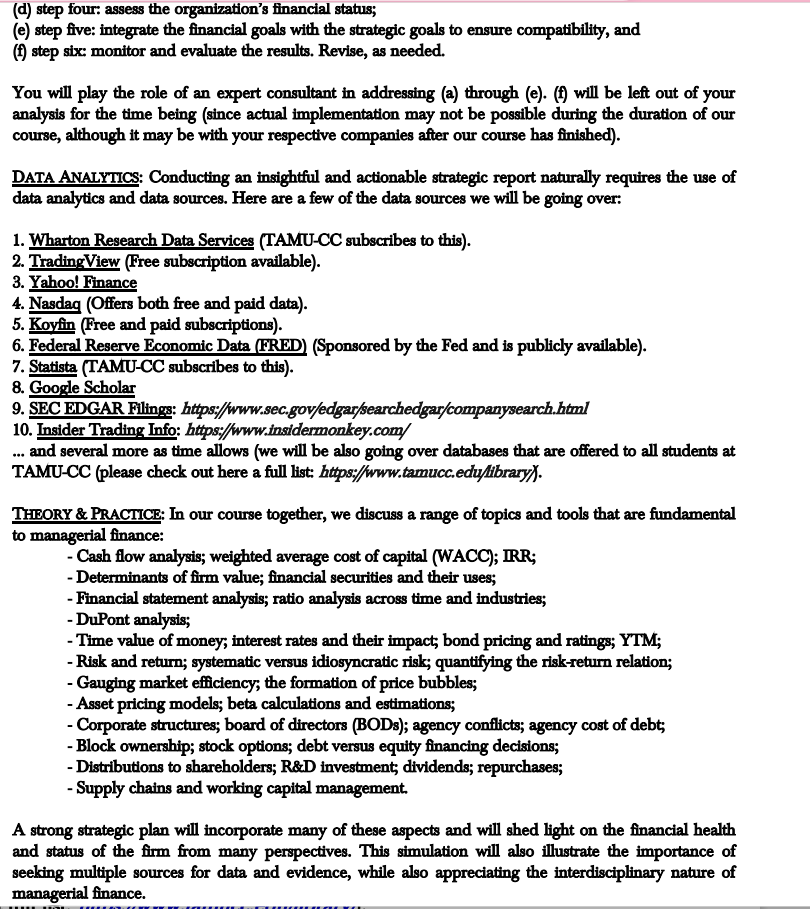
PROJECT SIMULATION 1 Managerial Financial Analysis & Strategic Planning BACKGROUND: Do corporate firms survive in the long-run? While the sheer size and scope of some mega firms, such as Amazon, Walmart, Apple, Berkshire Hathaway, to name but a few, is impressive, this question is of fundamental importance given the so many firms that have not survived the tides of time. If we look back and examine academic empirical literature, we see that few firms have survived for long periods of time and have ultimately become common household names. For example, Chan et al. (2003) published a paper in the Journal of Finance and argue, "...while some firms have grown at high rates historically, they are relatively rare instances. There is no persistence in long-term earnings growth beyond chance, and low predictability even with a wide variety of predictor variables. Specifically, growth forecasts are overly optimistic and add little predictive power..." In the classic Security Analysis by Benjamin Graham and David Dodd, they argue, "...the truth of our corporate venture is quite otherwise [than investors think]. Extremely few companies have been able to show a high rate of uninterrupted growth for long periods of time. Remarkably few also of the large companies suffer ultimate extinction. For most, this history is one of vicissitudes, of ups and downs, with changes in their relative standing..." Think about all the challenges we are going through today. We are at the later stages of a pandemic, in the midst of what appears to be a severe market correction (year-to-date the Nasdaq and the S&P 500 are down about 11% as of today). In addition, and during the height of the SARS-Cov-2 outbreak, unemployment claims reached record levels that have never been witnessed in US history." In 2021, the US experienced what economists and the financial press dubbed "The Great Resignation," whereby companies and businesses experienced a mass exodus of workers and talent. The majority of these workers cited low pay, no opportunities for advancement, and not feeling respected." Against this backdrop, we are seeing a rise (and shortage) in real estate prices (and homes), food prices, as well as overall energy prices. Inflation is a topic that is being discussed more and more in the financial press and media, while economic uncertainty and interest rates are beginning to rise. YOUR TASK: Your task will be to select a publicly traded (or privately held) company and to draft a strategic plan that addresses, among other aspects, the financial strengths (S), weaknesses (W), opportunities (O) and threats (T). Within this strategic plan, you will examine what differentiates the firm from its industry and competition, and what factors may, probabilistically, be a reason for its future success or demise. You will utilize a range of data sources and perform empirical tests where applicable. In particular, and as we discuss more analytically, Runy (2005) outlines a series of steps for strategic financial planning: (a) step one: evaluate the current performance of the organization; (b) step two: compare the organization's performance against historical data; (c) step three: develop financial projections;(d) step four: assess the organization's financial status; (e) step five: integrate the financial goals with the strategic goals to ensure compatibility, and (f) step six: monitor and evaluate the results. Revise, as needed. You will play the role of an expert consultant in addressing (a) through (e). (f) will be left out of your analysis for the time being (since actual implementation may not be possible during the duration of our course, although it may be with your respective companies after our course has finished). DATA ANALYTICS: Conducting an insightful and actionable strategic report naturally requires the use of data analytics and data sources. Here are a few of the data sources we will be going over: 1. Wharton Research Data Services (TAMU-CC subscribes to this). 2. TradingView (Free subscription available). 3. Yahoo! Finance 5. Koyfin (Free and paid subscriptions). 6. Federal Reserve Economic Data (FRED) (Sponsored by the Fed and is publicly available). 7. Statista (TAMU-CC subscribes to this). 8. Google Scholar 9. SEC EDGAR HFilings: https;/iwww.sec.gov/edgarSearchedgar/companysearch.html 10. Insider Trading Info: https;/Avww.insidermonkey.cony/ ... and several more as time allows (we will be also going over databases that are offered to all students at TAMU-CC (please check out here a full list: https;/ivww.tamucc.edy/fibrary). THEORY & PRACTICE: In our course together, we discuss a range of topics and tools that are fundamental to managerial finance: - Cash flow analysis; weighted average cost of capital (WACC); IRR; - Determinants of firm value; financial securities and their uses; - Financial statement analysis; ratio analysis across time and industries; - DuPont analysis; - Time value of money; interest rates and their impact; bond pricing and ratings; YIM; - Risk and return; systematic versus idiosyncratic risk; quantifying the risk-return relation; - Ganging market efficiency; the formation of price bubbles; - Asset pricing models; beta calculations and estimations; - Corporate structures; board of directors (BODs); agency conflicts; agency cost of debt; - Block ownership; stock options; debt versus equity financing decisions; - Distributions to shareholders; R&D investment; dividends; repurchases; - Supply chains and working capital management. A strong strategic plan will incorporate many of these aspects and will shed light on the financial health and status of the firm from many perspectives. This simulation will also illustrate the importance of seeking multiple sources for data and evidence, while also appreciating the interdisciplinary nature of nmnagea.lnanoe
Step by Step Solution
There are 3 Steps involved in it
1 Expert Approved Answer
Step: 1 Unlock
Question Has Been Solved by an Expert!
Get step-by-step solutions from verified subject matter experts
Step: 2 Unlock
Step: 3 Unlock
Students Have Also Explored These Related Finance Questions!









 Study Help