







Question: PROLOG Here is a DFA and its transitions: startnode(s1). finalnode(s4). transition(s1, a, s2). transition(s2, a, s2). transition(s3, a, s1). transition(s2, b, s1). transition(s3, b, s4).
PROLOG
Here is a DFA and its transitions:
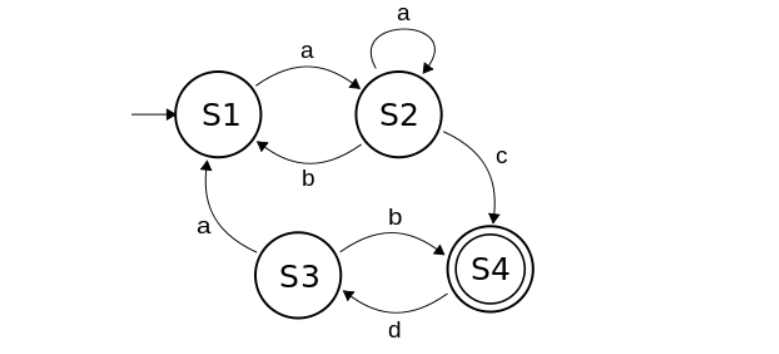
startnode(s1). finalnode(s4). transition(s1, a, s2). transition(s2, a, s2). transition(s3, a, s1). transition(s2, b, s1). transition(s3, b, s4). transition(s2, c, s4). transition(s4, d, s3).
Create a predicate in Prolog, parse_all(L, C), where L is a list of lists, that checks how many of these are accepted by the DFA and returns the number of the accepted lists. I am providing the predicate that checks if a list is accepted by the DFA (legal transitions from startnode to finalnode).
parse(L) :- startnode(S), trans(S,L). trans(X,[A|B]) :- transition(X,A,Y), trans(Y,B). trans(X,[]) :- finalnode(X).
Examples:
?-parse_all([[a,c],[a,c,c],[a,a,c]],).
=2;
false
?-parse_all([[a,b],[a,c,c],[a,a,c,b]],X).
X=0;
false
I hope it is clear. It's very important. I will upvote if it is correct.
a a Si S2 b a b S3 S4 d
Step by Step Solution
There are 3 Steps involved in it

Get step-by-step solutions from verified subject matter experts
 Study Help