







Question: Prompt We will analyze the data to answer the second research question: Which of the drugs (if either) delayed the recurrence of depression longer relative
Prompt
We will analyze the data to answer the second research question: Which of the drugs (if either) delayed the recurrence of depression longer relative to the placebo?
In the previous lab-preparation activity, we identified Treat as the explanatory variable and Time as the response variable. We also determined that we will analyze the data using side-by-side boxplots and descriptive statistics (i.e. 5-number summaries since the graphs are boxplots).
Make graphs and tables.
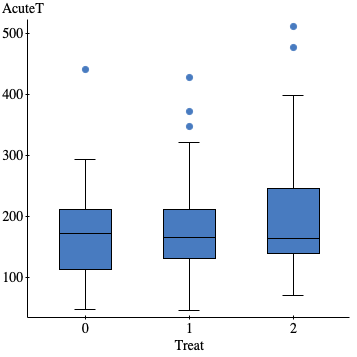
Summary statistics for AcuteT: Group by: Treat
| Treat | n | Median | Min | Max | Q1 | Q3 |
|---|---|---|---|---|---|---|
| 0 | 37 | 173 | 48 | 441 | 114 | 211 |
| 1 | 38 | 166.5 | 47 | 428 | 131 | 212 |
| 2 | 34 | 163.5 | 70 | 512 | 140 | 246 |
- Analyze the data: Compare the distributions for the treatment groups as demonstrated in Unit 2. For example, compare medians and intervals of typical values. Describe the shape and any outliers. Be sure to write your comparisons so the reader can understand the context of the numbers. For example, don't just say the median is 30; instead, say something like this: on average patients taking the placebo relapsed in 30 days (Q2=30 days).
- Draw a conclusion : What can we conclude from your analysis? Did one drug successfully delay a relapse of depression better than the others? What evidence supports your conclusion?
- Summarize your conclusions in response to both research questions: In this lab you compared three treatments (two drugs and the placebo) using two different variables. In Part 1 you compared whether or not a relapse into depression occurred for each of the two drugs and the placebo. In Part 2 you compared the length of time until the next relapse for the two drugs and the placebo. What can you conclude in light of both analyses? Is one treatment better than the other? How does the data support your conclusion?
Acute 500+ 4001 300 200 100 0 2 1 Treat
Step by Step Solution
There are 3 Steps involved in it
1 Expert Approved Answer
Step: 1 Unlock

Question Has Been Solved by an Expert!
Get step-by-step solutions from verified subject matter experts
Step: 2 Unlock
Step: 3 Unlock
 Study Help