Question: Purpose To assess your ability to use the knowledge from Chapter 10 readings to complete this activity Action Plan Read the case of Toyota given
Purpose
To assess your ability to use the knowledge from Chapter 10 readings to complete this activity
Action Plan
Read the case of Toyota given under Product Safety (pg. 367). Do you think the steps taken by Toyota were correct? If you were responsible for Toyota, what steps would you have taken?
- Read the question given above. You need to answer based on your own understanding of the case. Copy-paste answers from online and other sources will not be accepted.
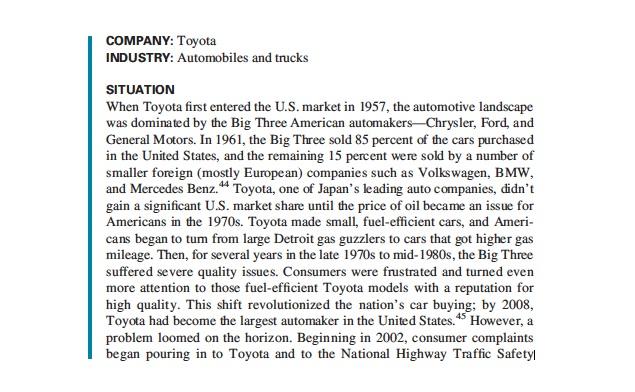
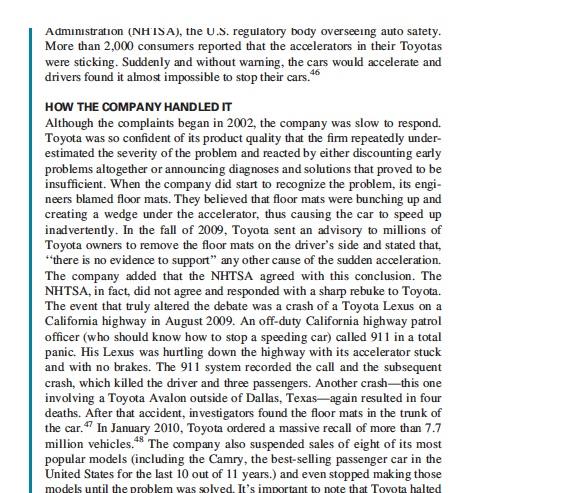
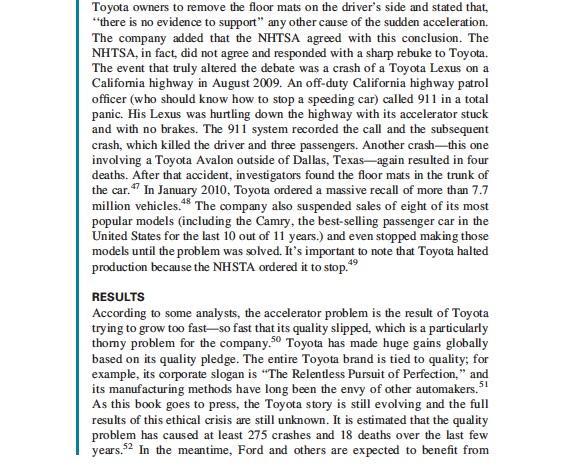
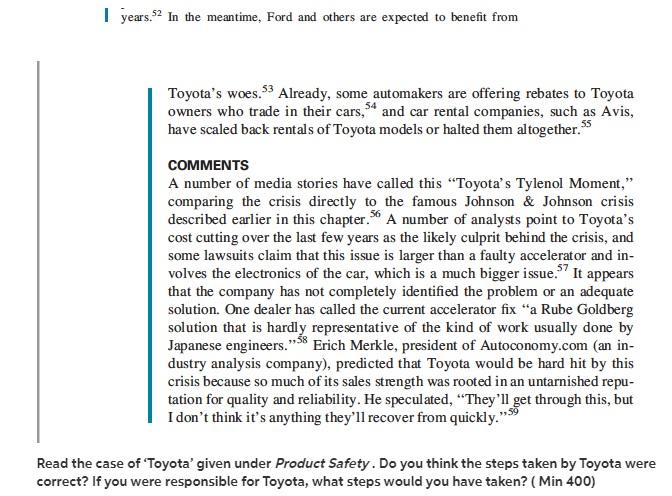
COMPANY: Toyota INDUSTRY: Automobiles and trucks SITUATION When Toyota first entered the U.S. market in 1957, the automotive landscape was dominated by the Big Three American automakers-Chrysler, Ford, and General Motors. In 1961, the Big Three sold 85 percent of the cars purchased in the United States, and the remaining 15 percent were sold by a number of smaller foreign (mostly European) companies such as Volkswagen, BMW, and Mercedes Benz.44 Toyota, one of Japan's leading auto companies, didn't gain a significant U.S. market share until the price of oil became an issue for Americans in the 1970s. Toyota made small, fuel-efficient cars, and Ameri- cans began to tum from large Detroit gas guzzlers to cars that got higher gas mileage. Then, for several years in the late 1970s to mid-1980s, the Big Three suffered severe quality issues. Consumers were frustrated and turned even more attention to those fuel-efficient Toyota models with a reputation for high quality. This shift revolutionized the nation's car buying; by 2008, Toyota had become the largest automaker in the United States. However, a problem loomed on the horizon. Beginning in 2002, consumer complaints began pouring in to Toyota and to the National Highway Traffic Safety Administration (NHISA), the U.S. regulatory body overseeing auto satety. More than 2,000 consumers reported that the accelerators in their Toyotas were sticking. Suddenly and without warning, the cars would accelerate and drivers found it almost impossible to stop their cars.46 HOW THE COMPANY HANDLED IT Although the complaints began in 2002, the company was slow to respond. Toyota was so confident of its product quality that the firm repeatedly under- estimated the severity of the problem and reacted by either discounting early problems altogether or announcing diagnoses and solutions that proved to be insufficient. When the company did start to recognize the problem, its engi- neers blamed floor mats. They believed that floor mats were bunching up and creating a wedge under the accelerator, thus causing the car to speed up inadvertently. In the fall of 2009, Toyota sent an advisory to millions of Toyota owners to remove the floor mats on the driver's side and stated that, **there is no evidence to support" any other cause of the sudden acceleration. The company added that the NHTSA agreed with this conclusion. The NHTSA, in fact, did not agree and responded with a sharp rebuke to Toyota. The event that truly altered the debate was a crash of a Toyota Lexus on a Califomia highway in August 2009. An off-duty California highway patrol officer (who should know how to stop a speeding car) called 911 in a total panic. His Lexus was hurtling down the highway with its accelerator stuck and with no brakes. The 911 system recorded the call and the subsequent crash, which killed the driver and three passengers. Another crash-this one involving a Toyota Avalon outside of Dallas, Texas-again resulted in four deaths. After that accident, investigators found the floor mats in the trunk of the car." In January 2010, Toyota ordered a massive recall of more than 7.7 million vehicles. The company also suspended sales of eight of its most popular models (including the Camry, the best-selling passenger car in the United States for the last 10 out of 11 years.) and even stopped making those models until the problem was solved. It's important to note that Toyota halted Toyota owners to remove the floor mats on the driver's side and stated that, *there is no evidence to support" any other cause of the sudden acceleration. The company added that the NHTSA agreed with this conclusion. The NHTSA, in fact, did not agree and responded with a sharp rebuke to Toyota. The event that truly altered the debate was a crash of a Toyota Lexus on a Califomia highway in August 2009. An off-duty California highway patrol officer (who should know how to stop a speeding car) called 911 in a total panic. His Lexus was hurtling down the highway with its accelerator stuck and with no brakes. The 911 system recorded the call and the subsequent crash, which killed the driver and three passengers. Another crashthis one involving a Toyota Avalon outside of Dallas, Texasagain resulted in four deaths. After that accident, investigators found the floor mats in the trunk of the car." In January 2010, Toyota ordered a massive recall of more than 7.7 million vehicles. The company also suspended sales of eight of its most popular models (including the Camry, the best-selling passenger car in the United States for the last 10 out of 11 years.) and even stopped making those models until the problem was solved. It's important to note that Toyota halted production because the NHSTA ordered it to stop.99 RESULTS According to some analysts, the accelerator problem is the result of Toyota trying to grow too fast-so fast that its quality slipped, which is a particularly thomy problem for the company.50 Toyota has made huge gains globally based on its quality pledge. The entire Toyota brand is tied to quality; for example, its corporate slogan is "The Relentless Pursuit of Perfection," and its manufacturing methods have long been the envy of other automakers." As this book goes to press, the Toyota story is still evolving and the full results of this ethical crisis are still unknown. It is estimated that the quality problem has caused at least 275 crashes and 18 deaths over the last few years.52 In the meantime, Ford and others are expected to benefit from I years.S2 In the meantime, Ford and others are expected to benefit from Toyota's woes.53 Already, some automakers are offering rebates to Toyota owners who trade in their cars, and car rental companies, such as Avis, have scaled back rentals of Toyota models or halted them altogether. COMMENTS A number of media stories have called this "Toyota's Tylenol Moment." comparing the crisis directly to the famous Johnson & Johnson crisis described earlier in this chapter." A number of analysts point to Toyota's cost cutting over the last few years as the likely culprit behind the crisis, and some lawsuits claim that this issue is larger than a faulty accelerator and in- volves the electronics of the car, which is a much bigger issue." It appears that the company has not completely identified the problem or an adequate solution. One dealer has called the current accelerator fix "a Rube Goldberg solution that is hardly representative of the kind of work usually done by Japanese engineers."** Erich Merkle, president of Autoconomy.com (an in- dustry analysis company), predicted that Toyota would be hard hit by this crisis because so much of its sales strength was rooted in an untarnished repu- tation for quality and reliability. He speculated, "They'll get through this, but I don't think it's anything they'll recover from quickly."S9 Read the case of Toyota' given under Product Safety. Do you think the steps taken by Toyota were correct? If you were responsible for Toyota, what steps would you have taken? ( Min 400)









 Study Help