







Question: python 3.6 Recursion gives us another pathway to solving tasks; you might think of it as an alternative to loops (they are equally as powerful,
python 3.6
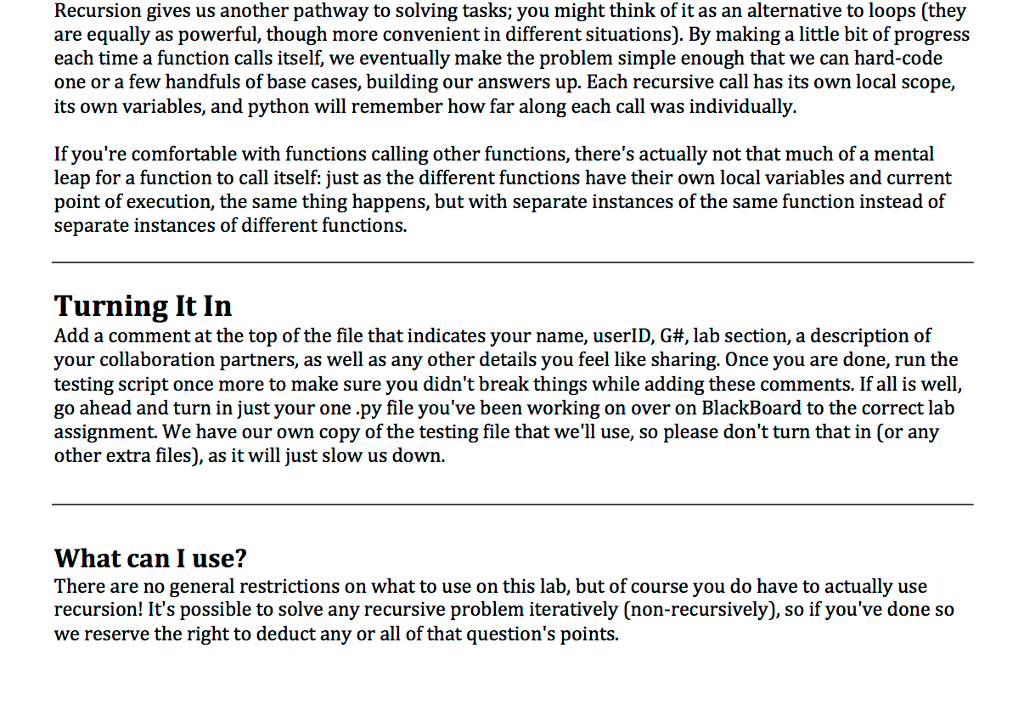
Recursion gives us another pathway to solving tasks; you might think of it as an alternative to loops (they are equally as powerful, though more convenient in different situations). By making a little bit of progress each time a function calls itself, we eventually make the problem simple enough that we can hard-code one or a few handfuls of base cases, building our answers up. Each recursive call has its own local scope, its own variables, and python will remember how far along each call was individually. If you're comfortable with functions calling other functions, there's actually not that much of a mental leap for a function to call itself: just as the different functions have their own local variables and current point of execution, the same thing happens, but with separate instances of the same function instead of separate instances of different functions. Turning It In Add a comment at the top of the file that indicates your name, userID, G, lab section, a description of your collaboration partners, as well as any other details you feel like sharing. Once you are done, testing script once more to make sure you didn't break things while adding these comments. If all is well, go ahead and turn in just your one .py file you've been working on over on BlackBoard to the correct lab assignment We have our own copy of the testing file that we'll use, so please don't turn that in (or any other extra files), as it will just slow us down. What can I use? There are no general restrictions on what to use on this lab, but of course you do have to actually use recursion! It's possible to solve any recursive problem iteratively (non-recursively), so if you've done so we reserve the right to deduct any or all of that question's points
Step by Step Solution
There are 3 Steps involved in it

Get step-by-step solutions from verified subject matter experts
 Study Help