







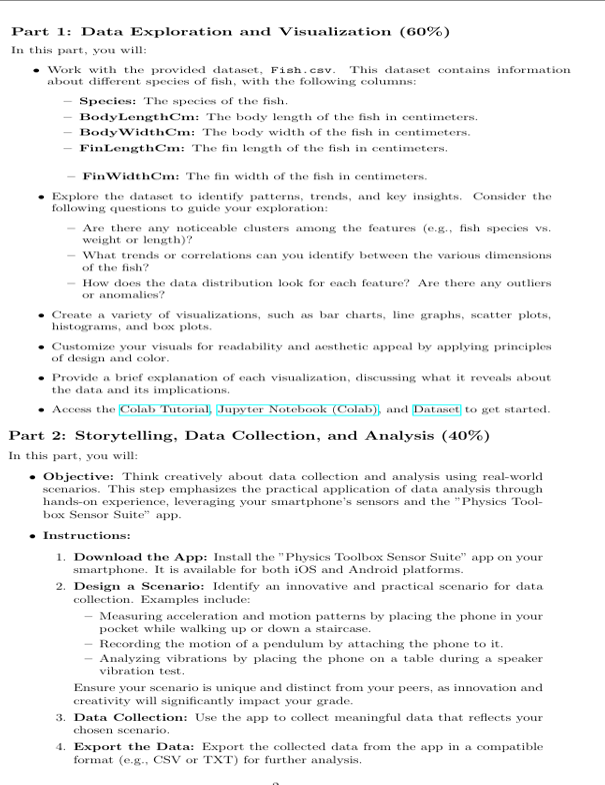
Question: Python Data Visualizations Part 1 : Data Exploration and Visualization ( 6 0 % ) In this part, you will: Work with the provided dataset,
Python Data Visualizations
Part : Data Exploration and Visualization
In this part, you will:
Work with the provided dataset, Fish.csv This dataset contains information
about different species of fish, with the following columns:
Species: The species of the fish.
BodyLengthCm: The body length of the fish in centimeters.
BodyWidthCm: The body width of the fish in centimeters.
FinLengthCm: The fin length of the fish in centimeters.
FinWidthCm: The fin width of the fish in centimeters.
Explore the dataset to identify patterns, trends, and key insights. Consider the
following questions to guide your exploration:
Are there any noticeable clusters among the features eg fish species vs
weight or length
What trends or correlations can you identify between the various dimensions
of the fish?
How does the data distribution look for each feature? Are there any outliers
or anomalies?
Create a variety of visualizations, such as bar charts, line graphs, scatter plots,
histograms, and box plots.
Customize your visuals for readability and aosthetic appeal by applying principles
of design and color.
Provide a bricf explanation of each visualization, discussing what it reveals about
the data and its implications.
Access the
Part : Storytelling, Data Collection, and Analysis
In this part, you will:
Objective: Think creatively about data collection and analysis using realworld
scenarios. This step emphasizes the practical application of data analysis through
handson experience, leveraging your smartphone's sensors and the "Physics Tool
box Sensor Suite" app.
Instructions:
Download the App: Install the "Physics Toolbox Sensor Suite" app on your
smartphone. It is available for both iOS and Android platforms.
Design a Scenario: Identify an innovative and practical scenario for data
collection. Examples include:
Measuring acceleration and motion patterns by placing the phone in your
pocket while walking up or down a staircase.
Recording the motion of a pendulum by attaching the phone to it
Analyzing vibrations by placing the phone on a table during a speaker
vibration test.
Ensure your scenario is unique and distinct from your peers, as innovation and
creativity will significantly impact your grade.
Data Collection: Use the app to collect meaningful data that reflects your
chosen scenario.
Export the Data: Export the collected data from the app in a compatible
format eg CSV or TXT for further analysis.
Step by Step Solution
There are 3 Steps involved in it
1 Expert Approved Answer
Step: 1 Unlock

Question Has Been Solved by an Expert!
Get step-by-step solutions from verified subject matter experts
Step: 2 Unlock
Step: 3 Unlock
 Study Help