







Question: PYTHON DO NOT FORGET TO ADD THE GRAPH AND A MEMO You have been hired by the secretive 7T-society to analyze a new strategy for
PYTHON DO NOT FORGET TO ADD THE GRAPH AND A MEMO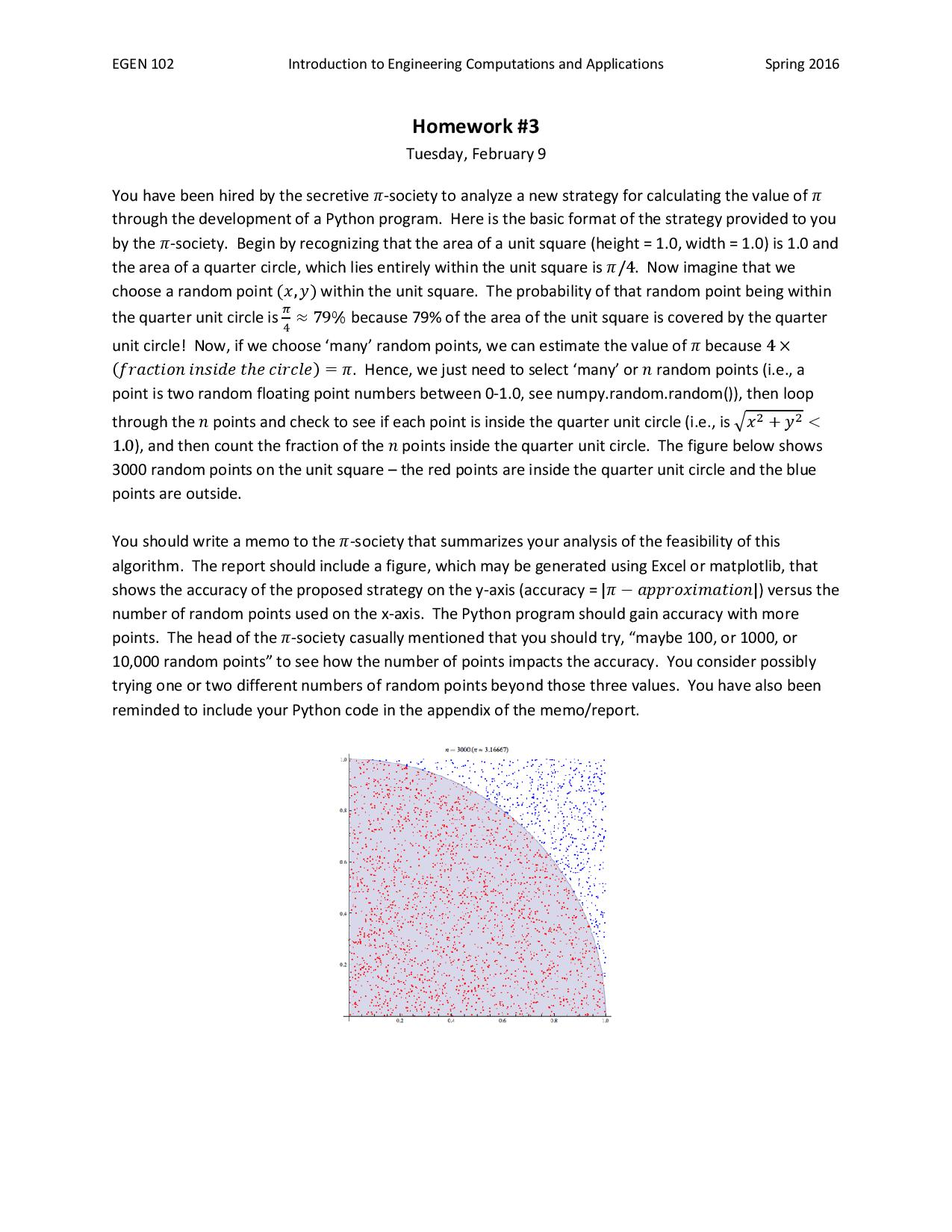
You have been hired by the secretive 7T-society to analyze a new strategy for calculating the value of n through the development of a Python program. Here is the basic format of the strategy provided to you by the 7T-society. Begin by recognizing that the area of a unit square (height = 1.0, width = 1.0) is 1.0 and the area of a quarter circle, which lies entirely within the unit square is n/A. Now imagine that we choose a random point (x,y) within the unit square. The probability of that random point being within the quarter unit circle is pi/4 79% because 79% of the area of the unit square is covered by the quarter unit circle! Now, if we choose 'many' random points, we can estimate the value of n because 4 x (fraction inside the circle) = n. Hence, we just need to select 'many' orn random points (i.e., a point is two random floating point numbers between 0-1.0, see numpy.random.random()), then loop through the n points and check to see if each point is inside the quarter unit circle (i.e., is and then count the fraction of the n points inside the quarter unit circle. The figure below shows 3000 random points on the unit square - the red points are inside the quarter unit circle and the blue points are outside. You should write a memo to the n-society that summarizes your analysis of the feasibility of this algorithm. The report should include a figure, which may be generated using Excel or matplotlib, that shows the accuracy of the proposed strategy on the y-axis (accuracy = |pi - approximation|) versus the number of random points used on the x-axis. The Python program should gain accuracy with more points. The head of the pi-society casually mentioned that you should try, "maybe 100, or 1000, or 10,000 random points" to see how the number of points impacts the accuracy. You consider possibly trying one or two different numbers of random points beyond those three values. You have also been reminded to include your Python code in the appendix of the memo/report. You have been hired by the secretive 7T-society to analyze a new strategy for calculating the value of n through the development of a Python program. Here is the basic format of the strategy provided to you by the 7T-society. Begin by recognizing that the area of a unit square (height = 1.0, width = 1.0) is 1.0 and the area of a quarter circle, which lies entirely within the unit square is n/A. Now imagine that we choose a random point (x,y) within the unit square. The probability of that random point being within the quarter unit circle is pi/4 79% because 79% of the area of the unit square is covered by the quarter unit circle! Now, if we choose 'many' random points, we can estimate the value of n because 4 x (fraction inside the circle) = n. Hence, we just need to select 'many' orn random points (i.e., a point is two random floating point numbers between 0-1.0, see numpy.random.random()), then loop through the n points and check to see if each point is inside the quarter unit circle (i.e., is and then count the fraction of the n points inside the quarter unit circle. The figure below shows 3000 random points on the unit square - the red points are inside the quarter unit circle and the blue points are outside. You should write a memo to the n-society that summarizes your analysis of the feasibility of this algorithm. The report should include a figure, which may be generated using Excel or matplotlib, that shows the accuracy of the proposed strategy on the y-axis (accuracy = |pi - approximation|) versus the number of random points used on the x-axis. The Python program should gain accuracy with more points. The head of the pi-society casually mentioned that you should try, "maybe 100, or 1000, or 10,000 random points" to see how the number of points impacts the accuracy. You consider possibly trying one or two different numbers of random points beyond those three values. You have also been reminded to include your Python code in the appendix of the memo/report
Step by Step Solution
There are 3 Steps involved in it

Get step-by-step solutions from verified subject matter experts
 Study Help