







Question: python import numpy as np import matplotlib.pyplot as plt import scipy.integrate as spqd &matplotlib inline * Problem 2*. We can generalize the Fibonacci sequence so

 python
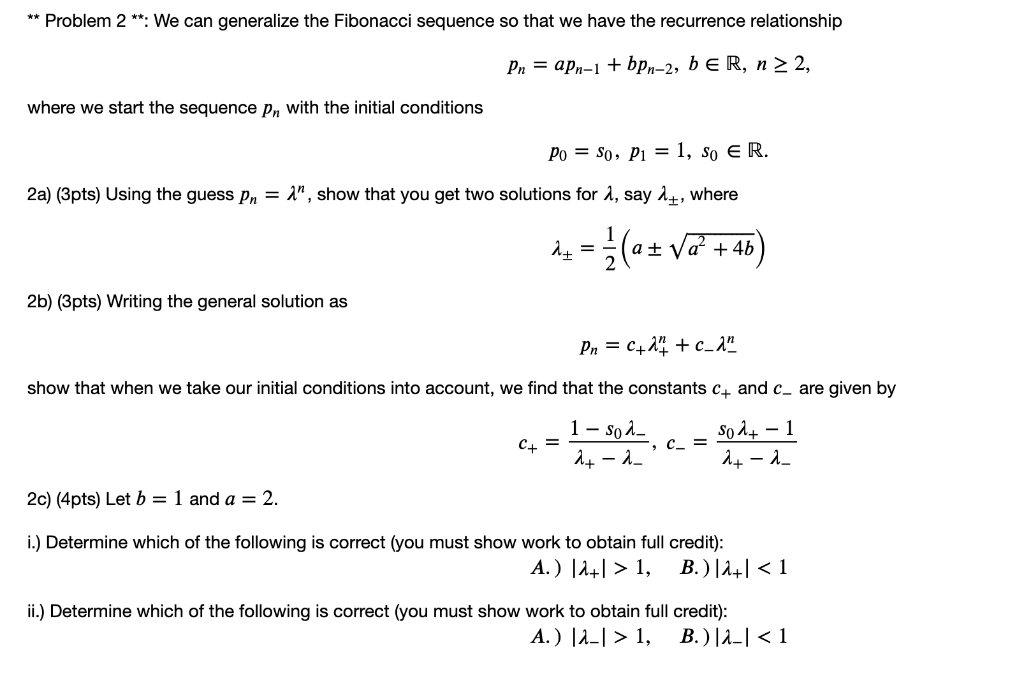
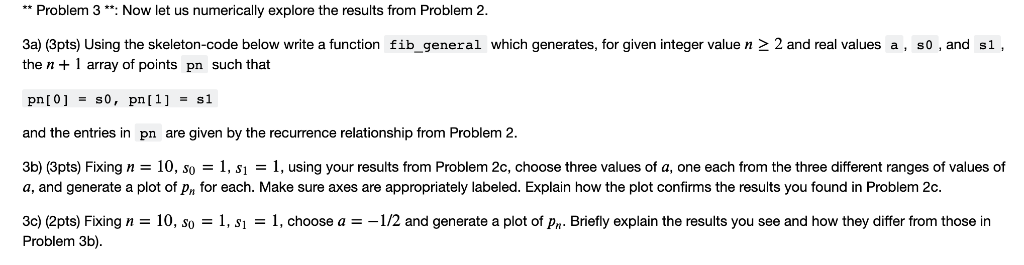
import numpy as np import matplotlib.pyplot as plt import scipy.integrate as spqd &matplotlib inline * Problem 2*. We can generalize the Fibonacci sequence so that we have the recurrence relationship where we start the sequence Pn with the initial conditions Po So. Pi-1, so ER 2a) (3pts) Using the guess Pn-X, show that you get two solutions for , say , where 2b) (3pts) Writing the general solution as show that when we take our initial conditions into account, we find that the constants c+ and c are given by 1-so , c-F 2c) (4pts) Let b 1 and a 2 i.) Determine which of the following is correct (you must show work to obtain full credit): ii) Determine which of the following is correct (you must show work to obtain full credit): *Problem 3 ": Now let us numerically explore the results from Problem 2. 2 and real values a , s0 , and s1 : 3a) (3pts) Using the skeleton-code below write a function fib-general which generates, for given integer value n the n1 array of points pn such that and the entries in pn are given by the recurrence relationship from Problem 2. 3b) (3pts) Fixing n 10, so = 1, s1 = 1, using your results from Problem 2c, choose three values of a, one each from the three different ranges of values of a, and generate a plot of P, for each. Make sure axes are appropriately labeled. Explain how the plot confirms the results you found in Problem 2c. 1/2 and generate a plot of P 3c 2pts Fixing n-10, so = 1, si-1, choose a = Problem 3b). Briefly explain the results you see and how they differ from those in import numpy as np import matplotlib.pyplot as plt import scipy.integrate as spqd &matplotlib inline * Problem 2*. We can generalize the Fibonacci sequence so that we have the recurrence relationship where we start the sequence Pn with the initial conditions Po So. Pi-1, so ER 2a) (3pts) Using the guess Pn-X, show that you get two solutions for , say , where 2b) (3pts) Writing the general solution as show that when we take our initial conditions into account, we find that the constants c+ and c are given by 1-so , c-F 2c) (4pts) Let b 1 and a 2 i.) Determine which of the following is correct (you must show work to obtain full credit): ii) Determine which of the following is correct (you must show work to obtain full credit): *Problem 3 ": Now let us numerically explore the results from Problem 2. 2 and real values a , s0 , and s1 : 3a) (3pts) Using the skeleton-code below write a function fib-general which generates, for given integer value n the n1 array of points pn such that and the entries in pn are given by the recurrence relationship from Problem 2. 3b) (3pts) Fixing n 10, so = 1, s1 = 1, using your results from Problem 2c, choose three values of a, one each from the three different ranges of values of a, and generate a plot of P, for each. Make sure axes are appropriately labeled. Explain how the plot confirms the results you found in Problem 2c. 1/2 and generate a plot of P 3c 2pts Fixing n-10, so = 1, si-1, choose a = Problem 3b). Briefly explain the results you see and how they differ from those in
Step by Step Solution
There are 3 Steps involved in it

Get step-by-step solutions from verified subject matter experts
 Study Help