







Question: Python Let Ist be a list of integers. We define prefix_sum(i) to be the sum of the first (i+1) elements of Ist. That is: prefix_sum(i)
Python
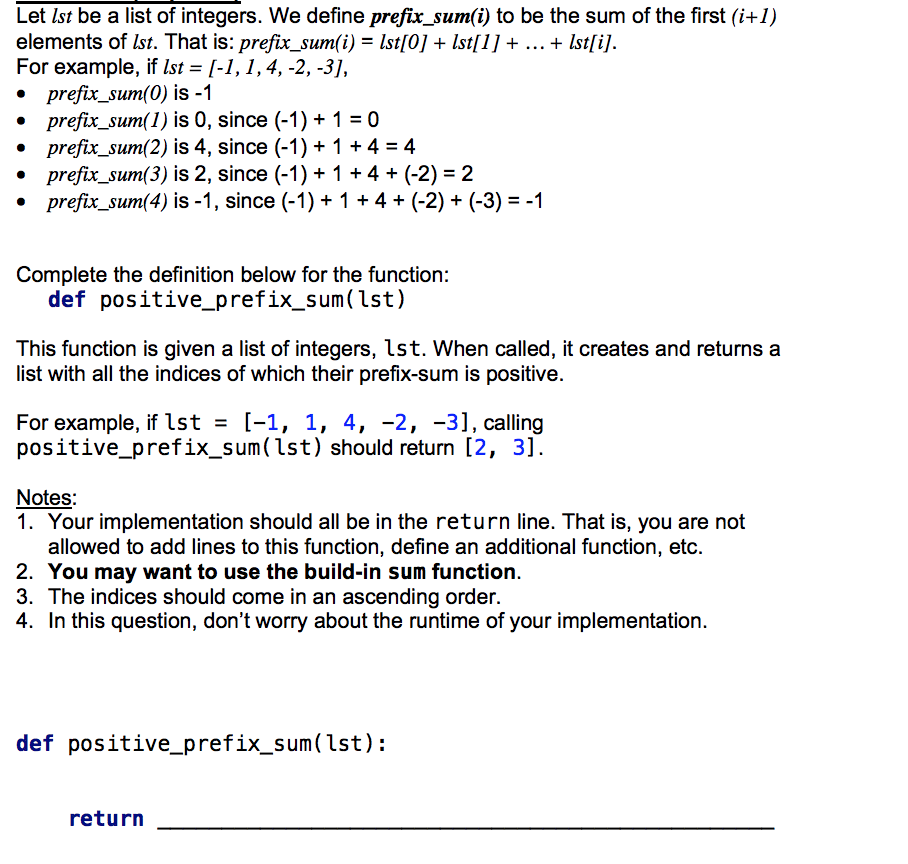
Let Ist be a list of integers. We define prefix_sum(i) to be the sum of the first (i+1) elements of Ist. That is: prefix_sum(i) Ist[01+Ist/1] + .sti. For example, if st [-1, 1, 4, -2,-31, . prefix_sum(0) is -1 prefix_sum(1) is 0, since (1) +10 . prefix_sum(2) is 4, since (-1)+1+4 4 . prefix_sum(3) is 2, since (1)+ 1+4 + (-2) 2 . prefix_sum(4) is -1, since (-1)+ 1+4+ (2)+ (-3)1 Complete the definition below for the function: def positive_prefix_sum(1st) This function is given a list of integers, lst. When called, it creates and returns a list with all the indices of which their prefix-sum is positive. For example, if lst- [-1, 1, 4, -2, -3], calling positive_prefix_sum(lst) should return [2, 31 Notes: 1. Your implementation should all be in the return line. That is, you are not allowed to add lines to this function, define an additional function, etc. 2. You may want to use the build-in sum function. 3. The indices should come in an ascending order. 4. In this question, don't worry about the runtime of your implementation. def positive_prefix_sum(lst): return
Step by Step Solution
There are 3 Steps involved in it

Get step-by-step solutions from verified subject matter experts
 Study Help