







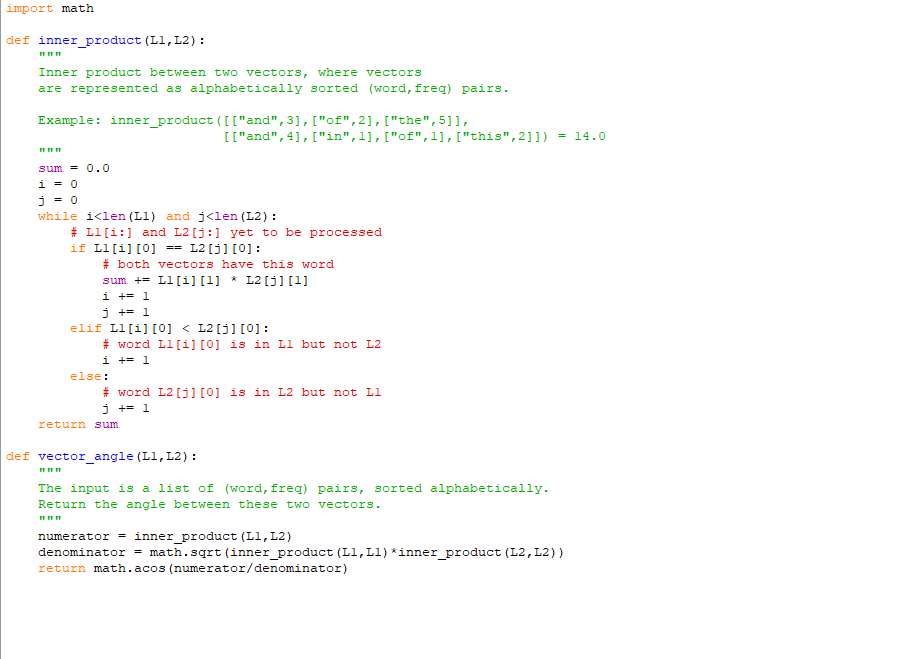
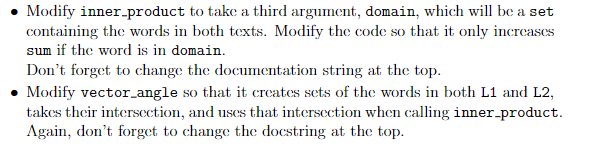
Question: Python: Modifying inner_product function to include domain, modifying Vector_angle to include intersection. import math def inner_product(L1,L2): Inner product between two vectors, where vectors are
Python: Modifying inner_product function to include domain, modifying Vector_angle to include intersection.
import math
def inner_product(L1,L2): """ Inner product between two vectors, where vectors are represented as alphabetically sorted (word,freq) pairs.
Example: inner_product([["and",3],["of",2],["the",5]], [["and",4],["in",1],["of",1],["this",2]]) = 14.0 """ sum = 0.0 i = 0 j = 0 while i def vector_angle(L1,L2): """ The input is a list of (word,freq) pairs, sorted alphabetically. Return the angle between these two vectors. """ numerator = inner_product(L1,L2) denominator = math.sqrt(inner_product(L1,L1)*inner_product(L2,L2)) return math.acos(numerator/denominator)
Step by Step Solution
There are 3 Steps involved in it

Get step-by-step solutions from verified subject matter experts
 Study Help