







Question: (Python) Need help in two functions def inversionCount_Merge(L, R, arr): def inversionCount_MergeSort(array): Please see the comment on the code. Note: iinversionCount_MergeSort(array): using Divide and conquer
(Python) Need help in two functions
def inversionCount_Merge(L, R, arr):
def inversionCount_MergeSort(array):
Please see the comment on the code.
Note: iinversionCount_MergeSort(array): using Divide and conquer approach only.
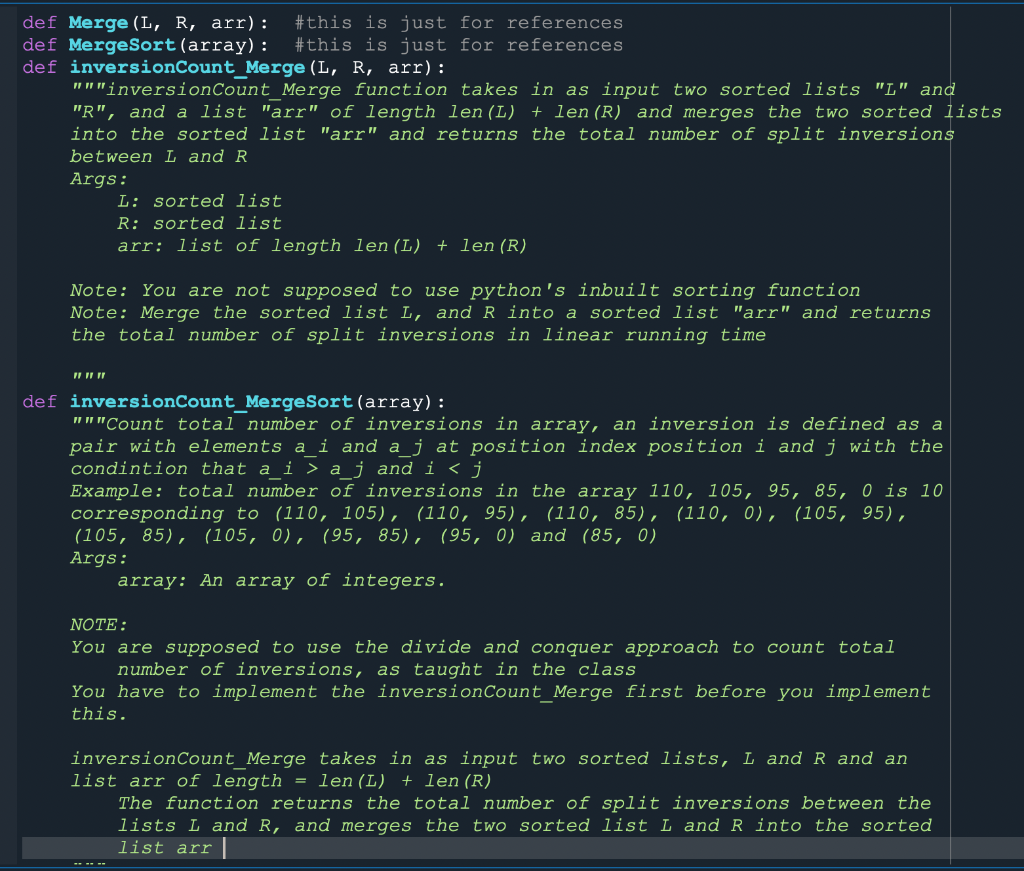
def Merge (L, R, arr): #this is just for references def MergeSort(array) : #this is just for references def inversionCount_Merge (L, R, arr) : """inversionCount_Merge function takes in as input two sorted lists "L" and "R", and a list "arr" of length len(L) + len(R) and merges the two sorted lists into the sorted list "arr" and returns the total number of split inversions between Land R Args: L: sorted list R: sorted list arr: list of length len (L) + len(R) Note: You are not supposed to use python's inbuilt sorting function Note: Merge the sorted list L, and R into a sorted list "arr" and returns the total number of split inversions in linear running time def inversionCount_MergeSort(array) : "" "Count total number of inversions in array, an inversion is defined as a pair with elements a_i and a j at position index position i and j with the condintion that a_i > aj and i
Step by Step Solution
There are 3 Steps involved in it

Get step-by-step solutions from verified subject matter experts
 Study Help