







Question: Python Using the code below 1 . adjust parameters to improve accuracy and a discussion on the activities you performed and results. 2 . Generate
Python
Using the code below
adjust parameters to improve accuracy and a discussion on the activities you performed and results.
Generate a Tensorboard and produce graphics that show various improvements that you were able to gain. Loss and Accuracy for train and validation for example.
#Load the libraries Load them all here not sprinkled throughout the notebook.
import pandas as pd
import numpy as np
from sklearn.modelselection import traintestsplit
from sklearn.preprocessing import StandardScaler
import matplotlib.pyplot as plt
import seaborn as sns
from sklearn.pipeline import Pipeline
from sklearn.decomposition import PCA
from sklearn.preprocessing import OneHotEncoder
from sklearn.modelselection import GridSearchCV
from sklearn.metrics import accuracyscore, confusionmatrix, classificationreport, recallscore, precisionscore, fscore
import warnings
warnings.filterwarningsignore #ignore warnings
loadext tensorboard
import tensorflow as tf
from tensorflow.keras.callbacks import EarlyStopping
from tensorflow.keras.optimizers import Adam, Nadam, RMSprop
mnist tfkeras.datasets.mnist
xtrain, ytrainxtest, ytest mnist.loaddata
from google.colab import drive
drive.mountcontentdrive
dfmnisttrain pdreadcsvcontentdriveMyDriveColab Notebooksdatamnisttrain.csv
dfmnisttest pdreadcsvcontentdriveMyDriveColab Notebooksdatamnisttest.csv
Model Development
batchsize
numclasses
epochs
inputshape
optimizer Adamlearningrate
logdir "logsfit # Adjust the directory as needed
tensorboardcallback tfkeras.callbacks.TensorBoardlogdirlogdir, histogramfreq
model tfkeras.models.Sequential
tfkeras.layers.ConvD padding'same', activation'relu', inputshapeinputshape
tfkeras.layers.ConvD padding'same', activation'relu'
tfkeras.layers.MaxPoolD
tfkeras.layers.Dropout
tfkeras.layers.ConvD padding'same', activation'relu'
tfkeras.layers.ConvD padding'same', activation'relu'
tfkeras.layers.MaxPoolDstrides
tfkeras.layers.Dropout
tfkeras.layers.Flatten
tfkeras.layers.Dense activation'relu'
tfkeras.layers.Dropout
tfkeras.layers.Densenumclasses, activation'softmax'
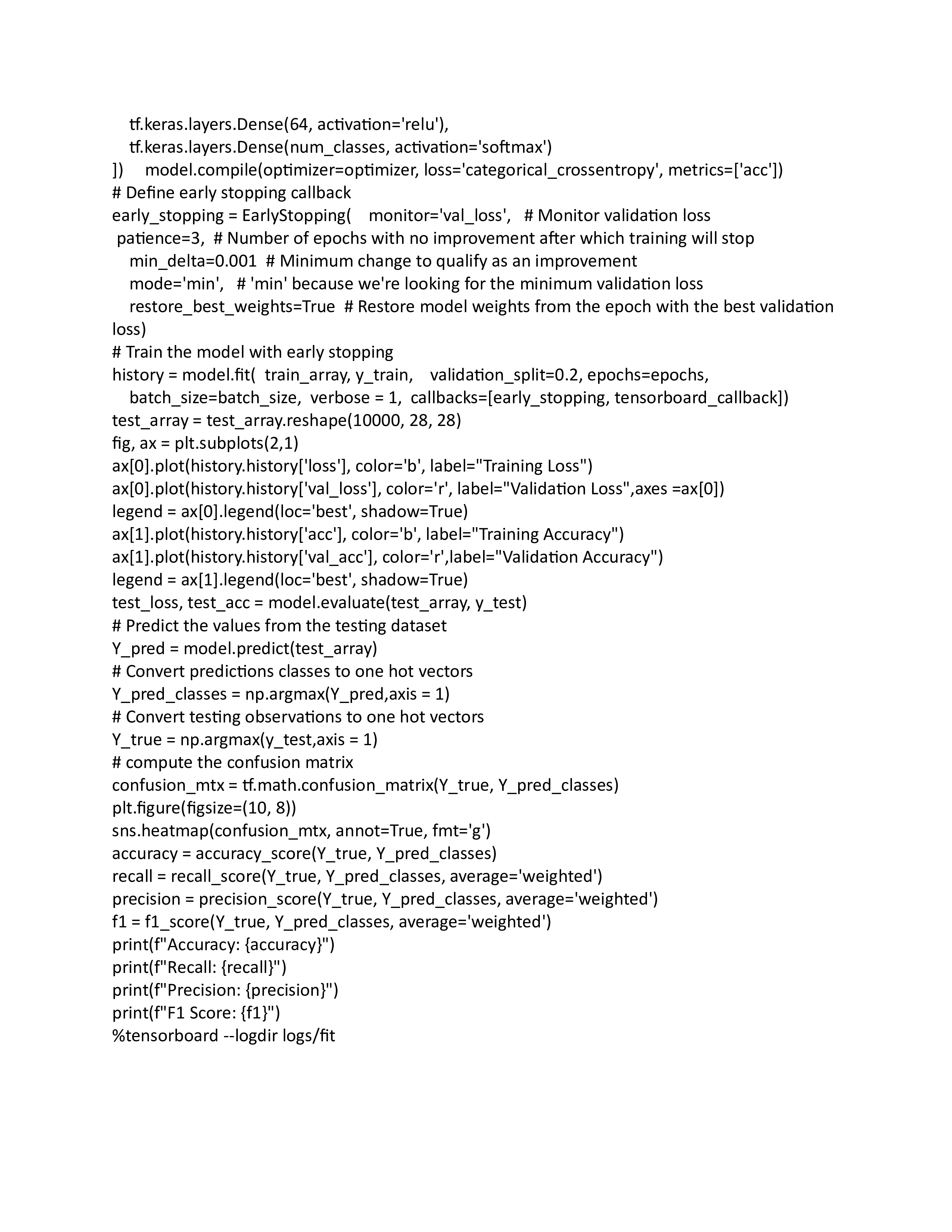
model.compileoptimizeroptimizer, loss'categoricalcrossentropy', metricsacc
# Define early stopping callback
earlystopping EarlyStopping
monitor'valloss', # Monitor validation loss
patience # Number of epochs with no improvement after which training will stop
mindelta # Minimum change to qualify as an improvement
mode'min', # 'min' because we're looking for the minimum validation loss
restorebestweightsTrue # Restore model weights from the epoch with the best validation loss
from sys import version
# Train the model with early stopping
history model.fit
trainarray, ytrain,
validationsplit
epochsepochs,
batchsizebatchsize,
verbose
callbacksearlystopping, tensorboardcallback
fig, ax pltsubplots
axplothistoryhistoryloss colorb label"Training Loss"
axplothistoryhistoryvalloss' colorr label"Validation Loss",axes ax
legend axlegendloc'best', shadowTrue
axplothistoryhistoryacc colorb label"Training Accuracy"
axplothistoryhistoryvalacc' colorrlabel"Validation Accuracy"
legend axlegendloc'best', shadowTrue
testloss, testacc model.evaluatetestarray, ytest
# Predict the values from the testing dataset
Ypred model.predicttestarray
# Convert predictions classes to one hot vectors
Ypredclasses npargmaxYpred,axis
# Convert testing observations to one hot vectors
Ytrue npargmaxytest,axis
# compute the confusion matrix
confusionmtx tfmath.confusionmatrixYtrue, Ypredclasses
pltfigurefigsize
snsheatmapconfusionmtx annotTrue, fmtg
accuracy accuracyscoreYtrue, Ypredclasses
recall recallscoreYtrue, Ypredclasses, average'weighted'
precision precisionscoreYtrue, Ypredclasses, average'weighted'
f fscoreYtrue, Ypredclasses, average'weighted'
printfAccuracy: accuracy
printfRecall: recall
printfPrecision: precision
printfF Score: f
tensorboard logdir logsfit
batchsize
numclasses
epochs
trainarray trainarray.reshape
optimizer Adamlearningrate
logdir "logsfit # Adjust the directory as needed
tensorboardcallback tfkeras.callbacks.TensorBoardlogdirlogdir, histogramfreq
The code is continued on the image
Step by Step Solution
There are 3 Steps involved in it
1 Expert Approved Answer
Step: 1 Unlock

Question Has Been Solved by an Expert!
Get step-by-step solutions from verified subject matter experts
Step: 2 Unlock
Step: 3 Unlock
 Study Help