







Question: Python Vertex Cover Problem Algorithm 2- INPUT: A graph G (V,E) OUTPUT: A vertex cover in G that is at most twice the size of
Python Vertex Cover Problem
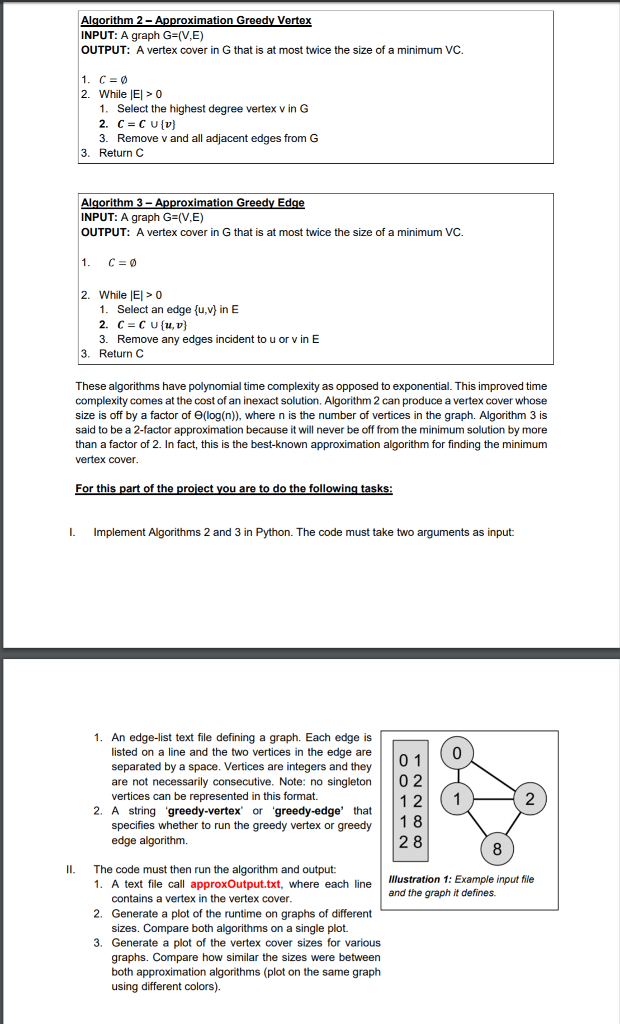
Algorithm 2- INPUT: A graph G (V,E) OUTPUT: A vertex cover in G that is at most twice the size of a minimum VC roximation Greedy Vertex 2. While El 0 1. Select the highest degree vet v in G 2, C = C u {v) 3. Remove v and all adjacent edges from G 3. Return C ximation INPUT: A graph G (VE) OUTPUT: A vertex cover in G that is at most twice the size of a minimum VC. 2. While IEI> 0 1. Select an edge fu,vy in E 2. C-Cu(u,v) 3. Remove any edges incident to u or v in E 3. Return C These algorithms have polynomial time complexity as opposed to exponential. This improved time complexity comes at the cost of an inexact solution. Algorithm 2 can produce a vertex cover whose size is off by a factor of (log(n), where n is the number of vertices in the graph. Algorithm 3 is said to be a 2-factor approximation because it will never be off from the minimum solution by more than a factor of 2. In fact, this is the best-known approximation algorithm for finding the minimum vertex cover this llowing task . Implement Algorithms 2 and 3 in Python. The code must take two arguments as input 1. An edge-list text file defining a graph. Each edge is 0 listed on a line and the two vertices in the edge are separated by a space. Vertices are integers and they are not necessarily consecutive. Note: no singleton 02 vertices can be represented in this format. 12 1 2 2. A string greedy-vertex or greedy-edge' that greedy specifies whether to run the greedy vertex or edge algorithm. 2 8 8 I The code must then run the algorithm and output: Illustration 1: Example input file and the graph it defines. 1. A text file call approxOutput.txt, where 2. Generate a plot of the runtime on graphs of different 3. Generate a plot of the vertex cover sizes for various contains a vertex in the vertex cover sizes. Compare both algorithms on a single plot. graphs. Compare how similar the sizes were between both approximation algorithms (plot on the same graph using different colors). Algorithm 2- INPUT: A graph G (V,E) OUTPUT: A vertex cover in G that is at most twice the size of a minimum VC roximation Greedy Vertex 2. While El 0 1. Select the highest degree vet v in G 2, C = C u {v) 3. Remove v and all adjacent edges from G 3. Return C ximation INPUT: A graph G (VE) OUTPUT: A vertex cover in G that is at most twice the size of a minimum VC. 2. While IEI> 0 1. Select an edge fu,vy in E 2. C-Cu(u,v) 3. Remove any edges incident to u or v in E 3. Return C These algorithms have polynomial time complexity as opposed to exponential. This improved time complexity comes at the cost of an inexact solution. Algorithm 2 can produce a vertex cover whose size is off by a factor of (log(n), where n is the number of vertices in the graph. Algorithm 3 is said to be a 2-factor approximation because it will never be off from the minimum solution by more than a factor of 2. In fact, this is the best-known approximation algorithm for finding the minimum vertex cover this llowing task . Implement Algorithms 2 and 3 in Python. The code must take two arguments as input 1. An edge-list text file defining a graph. Each edge is 0 listed on a line and the two vertices in the edge are separated by a space. Vertices are integers and they are not necessarily consecutive. Note: no singleton 02 vertices can be represented in this format. 12 1 2 2. A string greedy-vertex or greedy-edge' that greedy specifies whether to run the greedy vertex or edge algorithm. 2 8 8 I The code must then run the algorithm and output: Illustration 1: Example input file and the graph it defines. 1. A text file call approxOutput.txt, where 2. Generate a plot of the runtime on graphs of different 3. Generate a plot of the vertex cover sizes for various contains a vertex in the vertex cover sizes. Compare both algorithms on a single plot. graphs. Compare how similar the sizes were between both approximation algorithms (plot on the same graph using different colors)
Step by Step Solution
There are 3 Steps involved in it

Get step-by-step solutions from verified subject matter experts
 Study Help