







Question: Python would probably be the easiest but if you use a different language please clarify. ALGORITHM 93 GENERAL ORDER ARITHMETIC MiLlaRD H. PErSTEIN Control Data
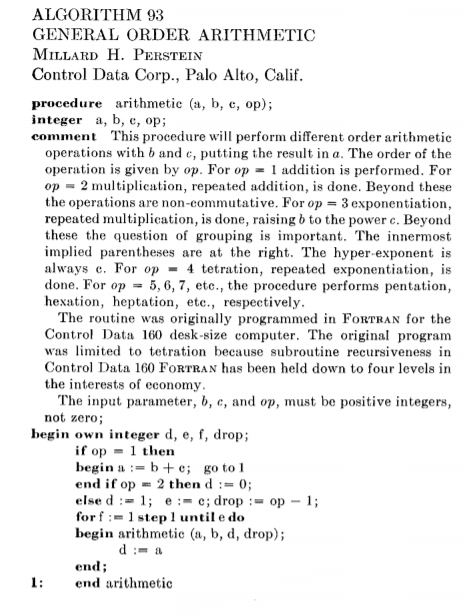
Python would probably be the easiest but if you use a different language please clarify.
ALGORITHM 93 GENERAL ORDER ARITHMETIC MiLlaRD H. PErSTEIN Control Data Corp., Palo Alto, Calif procedure arithmetic (a, b, c, op); integer a, b, c, op; comment This procedure will perform different order arithmetic operations with b and e, putting the result in a. The order of the operation is given by op. For 1 addition is performed. For op2 multiplication, repeated addition, is done. Beyond these the operations are non-commutative. For op-3exponentiation, repeated multiplication, is done, raising b to the power c. Beyond these the question of grouping is important. The innermost implied parentheses are at the right. The hyper exponent is always c. For op -4 tetration, repeated exponentiation, is done. For op5, 6,7, etc., the procedure performs pentation, hexation, heptation, etc., respectively The routine was originally programmed in FORTRAN for the Control Data 160 desk-size computer. The original program was limited to tetration because subroutine recursiveness in Control Data 160 FORTRAN has been held down to four levels in the interests of economy The input parameter, b, c, and op, must be positive integers, not zero begin own integer d, e, f, drop; if op 1 then begin a:-b+ e; go to 1 end if op = 2 then d := 0; else d e-e; drop:-op forf step1 uni e do begin arithmetic (a, b, d, drop); 1; end arithmetic
Step by Step Solution
There are 3 Steps involved in it

Get step-by-step solutions from verified subject matter experts
 Study Help