







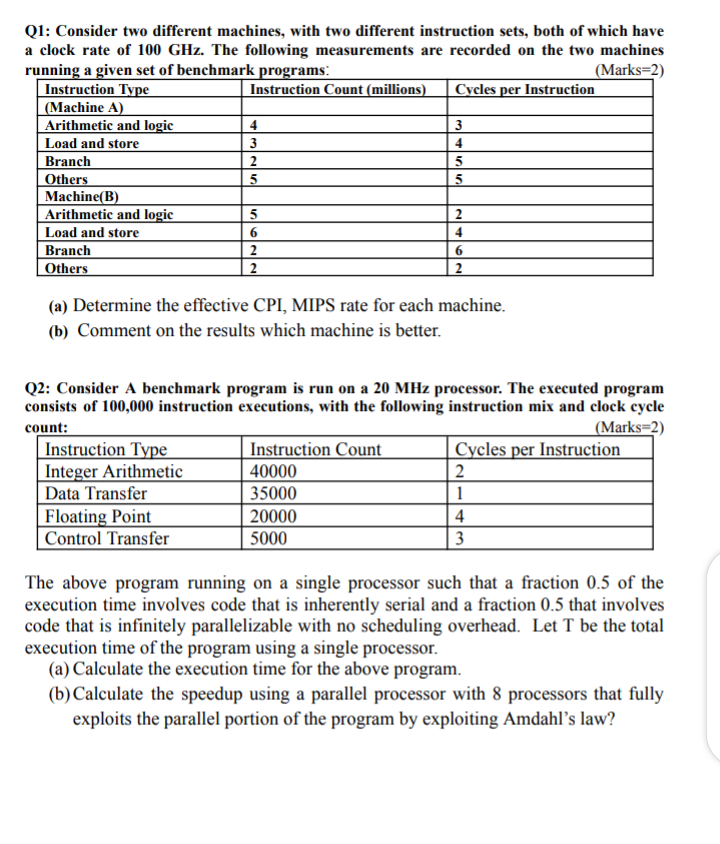
Question: Q 1 : Consider two different machines, with two different instruction sets, both of which have a clock rate of 1 0 0 GHz .
Q: Consider two different machines, with two different instruction sets, both of which have a clock rate of GHz The following measurements are recorded on the two machines running a given set of benchmark programs:
Marks
tableInstruction Type,Instruction Count millionsCycles per InstructionMachine AArithmetic and logic,Load and store,BranchOthersMachineBArithmetic and logic,Load and store,BranchOthers
a Determine the effective CPI, MIPS rate for each machine.
b Comment on the results which machine is better.
Q: Consider A benchmark program is run on a MHz processor. The executed program consists of instruction executions, with the following instruction mix and clock cycle count:
Marks
tableInstruction Type,Instruction Count,Cycles per InstructionInteger Arithmetic,Data Transfer,Floating Point,Control Transfer,
The above program running on a single processor such that a fraction of the execution time involves code that is inherently serial and a fraction that involves code that is infinitely parallelizable with no scheduling overhead. Let T be the total execution time of the program using a single processor.
a Calculate the execution time for the above program.
b Calculate the speedup using a parallel processor with processors that fully exploits the parallel portion of the program by exploiting Amdahl's law?hu
Step by Step Solution
There are 3 Steps involved in it
1 Expert Approved Answer
Step: 1 Unlock

Question Has Been Solved by an Expert!
Get step-by-step solutions from verified subject matter experts
Step: 2 Unlock
Step: 3 Unlock
 Study Help