







Question: Q # 2 Describe polling and token-passing protocols using the analogy of cocktail party interactions? Q # 3 Suppose the information content of a packet
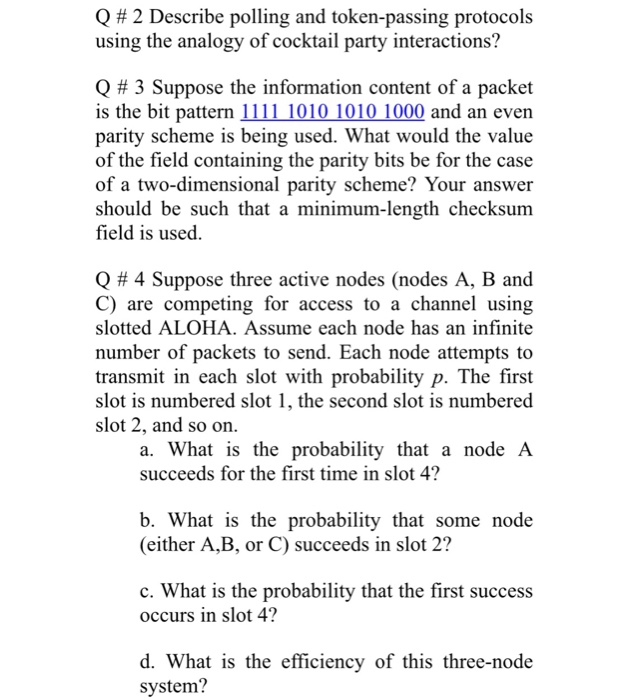
Q # 2 Describe polling and token-passing protocols using the analogy of cocktail party interactions? Q # 3 Suppose the information content of a packet is the bit pattern 1111 1010 1010 1000 and an even parity scheme is being used. What would the value of the field containing the parity bits be for the case of a two-dimensional parity scheme? Your answer should be such that a minimum-length checksum field is used. Q # 4 Suppose three active nodes (nodes A, B and C) are competing for access to a channel using slotted ALOHA. Assume each node has an infinite number of packets to send. Each node attempts to transmit in each slot with probability p. The first slot is numbered slot 1, the second slot is numbered slot 2, and so on a. What is the probability that a node A succeeds for the first time in slot 4? b. What is the probability that some node (either A,B, or C) succeeds in slot 2? c. What is the probability that the first success occurs in slot 4? d. What is the efficiency of this three-node system
Step by Step Solution
There are 3 Steps involved in it

Get step-by-step solutions from verified subject matter experts
 Study Help