







Question: Q.1 Compare your specimen to a standard rectangular tension test specimen (Fig 1 in ASTM-E8). Is your specimen a plate-type or a sheet-type specimen?
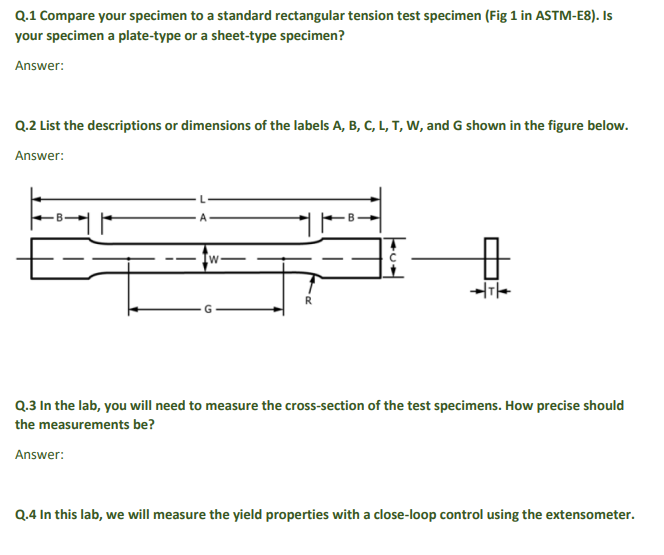
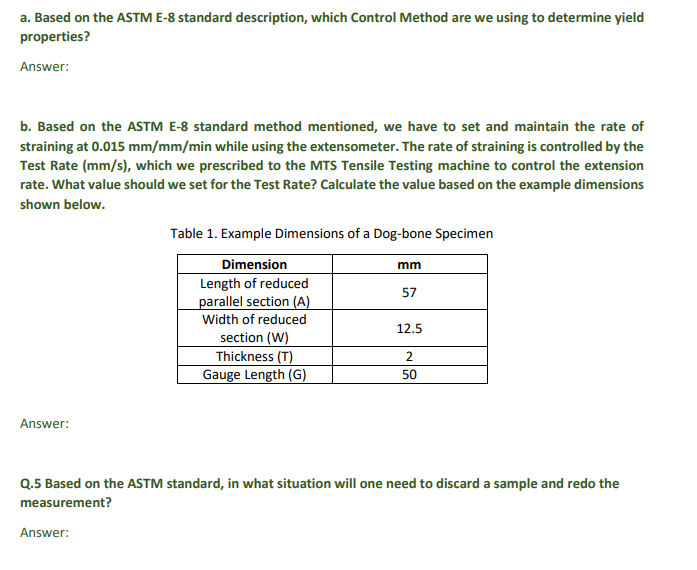
Q.1 Compare your specimen to a standard rectangular tension test specimen (Fig 1 in ASTM-E8). Is your specimen a plate-type or a sheet-type specimen? Answer: Q.2 List the descriptions or dimensions of the labels A, B, C, L, T, W, and G shown in the figure below. Answer: A W Q.3 In the lab, you will need to measure the cross-section of the test specimens. How precise should the measurements be? Answer: Q.4 In this lab, we will measure the yield properties with a close-loop control using the extensometer. a. Based on the ASTM E-8 standard description, which Control Method are we using to determine yield properties? Answer: b. Based on the ASTM E-8 standard method mentioned, we have to set and maintain the rate of straining at 0.015 mm/mm/min while using the extensometer. The rate of straining is controlled by the Test Rate (mm/s), which we prescribed to the MTS Tensile Testing machine to control the extension rate. What value should we set for the Test Rate? Calculate the value based on the example dimensions shown below. Answer: Table 1. Example Dimensions of a Dog-bone Specimen Dimension mm Length of reduced 57 parallel section (A) Width of reduced 12.5 section (W) Thickness (T) Gauge Length (G) 2 50 Q.5 Based on the ASTM standard, in what situation will one need to discard a sample and redo the measurement? Answer:
Step by Step Solution
There are 3 Steps involved in it

Get step-by-step solutions from verified subject matter experts
 Study Help