Question: Q1 what did you learn from this case study? Q2 what are the outcomes? 03 what are challeges for brazil to setting up the business
Q1 what did you learn from this case study?
Q2 what are the outcomes?
03 what are challeges for brazil to setting up the business in saudi arabia and UAE
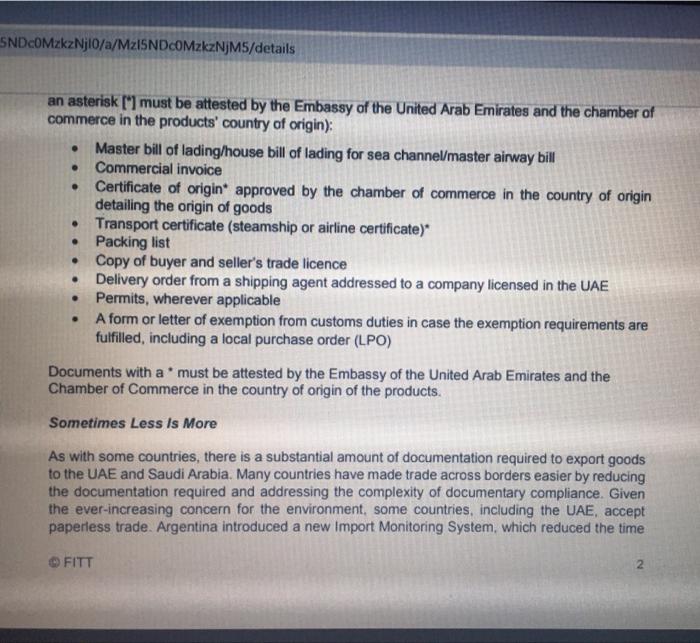
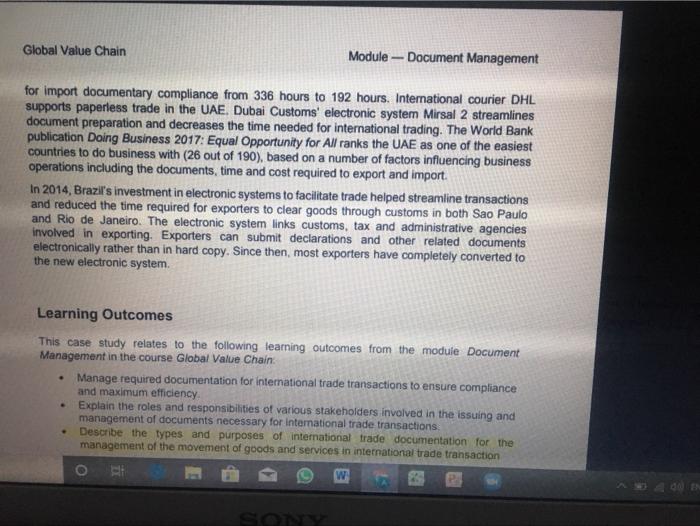
NDCUMZKZN 0/a/MzI5NDCUMZKZNJM5/details Global Value Chain Module - Document Management Made in Brazil, Worn in the Middle East: Exporting Footwear to New Markets I KUSI TOM VALEARIL The Shoes Connection As of 2014, Brazil had the third-largest footwear industry in the world. Brazil's footwear industry is known for its relatively more affordable leather high quality and one-of-a-kind design. With the cost of footwear from Asian countries gradually rising, Brazil's footwear trade has been gradually expanding into new countries. The top countries to which Brazil exports footwear are the U.S., Argentina and France. In 2000, the Brazilian Footwear program was created by the Brazilian Footwear Industry Association (Abicalados), in partnership with the Brazilian Trade and Investments Promotion Agency (Apex-Brasil). This program was designed to increase the import of Brazilian footwear in the following target markets: China, Colombia, France, Italy, Russia, South Africa, United Arab Emirates (UAE) and the U.S. Interestingly, despite the 12.3 percent decline in total international sales from January to August 2015. Brazilian footwear exports to the UAE increased by 21.7 percent. Footwear industries is known for its relatively more affordable leather, high quality and one-of-a-kind design. With the cost of footwear from Asian countries gradually rising. Brazil's footwear trade has been gradually expanding into new countries. The top countries to which Brazil exports footwear are the U.S., Argentina and France. In 2000, the Brazilian Footwear program was created by the Brazilian Footwear Industry Association (Abicalados), in partnership with the Brazilian Trade and Investments Promotion Agency (Apex-Brasil). This program was designed to increase the import of Brazilian footwear in the following target markets: China, Colombia, France, Italy, Russia, South Africa, United Arab Emirates (UAE) and the U.S. Interestingly, despite the 12.3 percent decline in total international sales from January to August 2015, Brazilian footwear exports to the UAE increased by 21.7 percent Footwear industries registered UAE export revenues of USD 15.73 million, shipping 1.3 million pairs. Abicalados' President Heitor Klein points out that the Brazilian Footwear program directed its focus to the UAE as one of the target markets for 2015 and 2016. Abicalados ranks the UAE in the 12 position of largest buyers of footwear from Brazil. At the top of the list is the United States, followed by Argentina, then France. After the UAE, in 13th place, comes Saudi Arabia. I Saudi Arabia has been maintaining stability in imports of Brazilian footwear, which is positive within the context of widespread decline of exports. It's an important market and that, certainly. reaps benefits of the work done in the UAE, a country that operates as a crucial gateway for the Arab market," said Klein m/c/M215NDOMzkzNj10/a/MzI5NDCOMzkzNjM5/details Preparing to Send Brazilian Footwear to the Middle East As Saudi Arabia and the UAE have become important markets for Brazil, Brazilian footwear makers have to become increasingly knowledgeable of the import-export requirements for these countries. I . . . . . The following documents may be required when exporting goods to Saudi Arabia: Certificate of origin authenticated at a local chamber of commerce and translated into Arabic Saudi Arabian customs invoice (in triplicate)-the original invoice must be attested by the agency responsible for trade in the exporting country A bill of lading Insurance documents (if goods are insured by the exporter)-original documents must be accompanied by an Arabic translation Product Conformity Program (PCP) Certificate of Conformity, issued by an approved certification body/authorised inspection agency Irremovable label showing the country of origin Official cargo insurance (if applicable) Letter of undertaking authorizing destination agent to perform customs clearance Detailed packing list The following documents may be required when exporting goods to the UAE (those marked with an asterisk (*) must be attested by the Embassy of the United Arab Emirates and the chamber of commerce in the products country of origin): Master bill of lading/house bill of lading for sea channel/master airwaybill Commercial invoice Certificate of origin approved by the chamber of commerce in the country of origin detailing the origin of goods Transport certificate (steamship or airline certificate) Packing list Copy of buyer and seller's trade licence Delivery order from a shipping agent addressed to a company licensed in the UAE Permits, wherever applicable Almacenamionom cestomach w P . . . I. amplia SNDCOMzkzNj10/a/MzI5NDCOMzkzNjM5/details . an asterisk (*) must be attested by the Embassy of the United Arab Emirates and the chamber of commerce in the products' country of origin): Master bill of lading/house bill of lading for sea channel/master airwaybill Commercial invoice Certificate of origin* approved by the chamber of commerce in the country of origin detailing the origin of goods Transport certificate (steamship or airline certificate)" Packing list Copy of buyer and seller's trade licence Delivery order from a shipping agent addressed to a company licensed in the UAE Permits, wherever applicable A form or letter of exemption from customs duties in case the exemption requirements are fulfilled, including a local purchase order (LPO) Documents with a must be attested by the Embassy of the United Arab Emirates and the Chamber of Commerce in the country of origin of the products. Sometimes Less Is More As with some countries, there is a substantial amount of documentation required to export goods to the UAE and Saudi Arabia. Many countries have made trade across borders easier by reducing the documentation required and addressing the complexity of documentary compliance. Given the ever-increasing concern for the environment, some countries, including the UAE, accept paperless trade. Argentina introduced a new Import Monitoring System, which reduced the time FITT 2 Global Value Chain Module - Document Management for import documentary compliance from 336 hours to 192 hours. International courier DHL supports paperless trade in the UAE. Dubai Customs' electronic system Mirsal 2 streamlines document preparation and decreases the time needed for international trading. The World Bank publication Doing Business 2017: Equal Opportunity for All ranks the UAE as one of the easiest countries to do business with (26 out of 190), based on a number of factors influencing business operations including the documents, time and cost required to export and import. In 2014, Brazil's investment in electronic systems to facilitate trade helped streamline transactions and reduced the time required for exporters to clear goods through customs in both Sao Paulo and Rio de Janeiro. The electronic system links customs, tax and administrative agencies involved in exporting. Exporters can submit declarations and other related documents electronically rather than in hard copy. Since then, most exporters have completely converted to the new electronic system. Learning Outcomes This case study relates to the following learning outcomes from the module Document Management in the course Global Value Chain Manage required documentation for international trade transactions to ensure compliance and maximum efficiency Explain the roles and responsibilities of various stakeholders involved in the issuing and management of documents necessary for international trade transactions Describe the types and purposes of international trade documentation for the management of the movement of goods and services in international trade transaction w NDCUMZKZN 0/a/MzI5NDCUMZKZNJM5/details Global Value Chain Module - Document Management Made in Brazil, Worn in the Middle East: Exporting Footwear to New Markets I KUSI TOM VALEARIL The Shoes Connection As of 2014, Brazil had the third-largest footwear industry in the world. Brazil's footwear industry is known for its relatively more affordable leather high quality and one-of-a-kind design. With the cost of footwear from Asian countries gradually rising, Brazil's footwear trade has been gradually expanding into new countries. The top countries to which Brazil exports footwear are the U.S., Argentina and France. In 2000, the Brazilian Footwear program was created by the Brazilian Footwear Industry Association (Abicalados), in partnership with the Brazilian Trade and Investments Promotion Agency (Apex-Brasil). This program was designed to increase the import of Brazilian footwear in the following target markets: China, Colombia, France, Italy, Russia, South Africa, United Arab Emirates (UAE) and the U.S. Interestingly, despite the 12.3 percent decline in total international sales from January to August 2015. Brazilian footwear exports to the UAE increased by 21.7 percent. Footwear industries is known for its relatively more affordable leather, high quality and one-of-a-kind design. With the cost of footwear from Asian countries gradually rising. Brazil's footwear trade has been gradually expanding into new countries. The top countries to which Brazil exports footwear are the U.S., Argentina and France. In 2000, the Brazilian Footwear program was created by the Brazilian Footwear Industry Association (Abicalados), in partnership with the Brazilian Trade and Investments Promotion Agency (Apex-Brasil). This program was designed to increase the import of Brazilian footwear in the following target markets: China, Colombia, France, Italy, Russia, South Africa, United Arab Emirates (UAE) and the U.S. Interestingly, despite the 12.3 percent decline in total international sales from January to August 2015, Brazilian footwear exports to the UAE increased by 21.7 percent Footwear industries registered UAE export revenues of USD 15.73 million, shipping 1.3 million pairs. Abicalados' President Heitor Klein points out that the Brazilian Footwear program directed its focus to the UAE as one of the target markets for 2015 and 2016. Abicalados ranks the UAE in the 12 position of largest buyers of footwear from Brazil. At the top of the list is the United States, followed by Argentina, then France. After the UAE, in 13th place, comes Saudi Arabia. I Saudi Arabia has been maintaining stability in imports of Brazilian footwear, which is positive within the context of widespread decline of exports. It's an important market and that, certainly. reaps benefits of the work done in the UAE, a country that operates as a crucial gateway for the Arab market," said Klein m/c/M215NDOMzkzNj10/a/MzI5NDCOMzkzNjM5/details Preparing to Send Brazilian Footwear to the Middle East As Saudi Arabia and the UAE have become important markets for Brazil, Brazilian footwear makers have to become increasingly knowledgeable of the import-export requirements for these countries. I . . . . . The following documents may be required when exporting goods to Saudi Arabia: Certificate of origin authenticated at a local chamber of commerce and translated into Arabic Saudi Arabian customs invoice (in triplicate)-the original invoice must be attested by the agency responsible for trade in the exporting country A bill of lading Insurance documents (if goods are insured by the exporter)-original documents must be accompanied by an Arabic translation Product Conformity Program (PCP) Certificate of Conformity, issued by an approved certification body/authorised inspection agency Irremovable label showing the country of origin Official cargo insurance (if applicable) Letter of undertaking authorizing destination agent to perform customs clearance Detailed packing list The following documents may be required when exporting goods to the UAE (those marked with an asterisk (*) must be attested by the Embassy of the United Arab Emirates and the chamber of commerce in the products country of origin): Master bill of lading/house bill of lading for sea channel/master airwaybill Commercial invoice Certificate of origin approved by the chamber of commerce in the country of origin detailing the origin of goods Transport certificate (steamship or airline certificate) Packing list Copy of buyer and seller's trade licence Delivery order from a shipping agent addressed to a company licensed in the UAE Permits, wherever applicable Almacenamionom cestomach w P . . . I. amplia SNDCOMzkzNj10/a/MzI5NDCOMzkzNjM5/details . an asterisk (*) must be attested by the Embassy of the United Arab Emirates and the chamber of commerce in the products' country of origin): Master bill of lading/house bill of lading for sea channel/master airwaybill Commercial invoice Certificate of origin* approved by the chamber of commerce in the country of origin detailing the origin of goods Transport certificate (steamship or airline certificate)" Packing list Copy of buyer and seller's trade licence Delivery order from a shipping agent addressed to a company licensed in the UAE Permits, wherever applicable A form or letter of exemption from customs duties in case the exemption requirements are fulfilled, including a local purchase order (LPO) Documents with a must be attested by the Embassy of the United Arab Emirates and the Chamber of Commerce in the country of origin of the products. Sometimes Less Is More As with some countries, there is a substantial amount of documentation required to export goods to the UAE and Saudi Arabia. Many countries have made trade across borders easier by reducing the documentation required and addressing the complexity of documentary compliance. Given the ever-increasing concern for the environment, some countries, including the UAE, accept paperless trade. Argentina introduced a new Import Monitoring System, which reduced the time FITT 2 Global Value Chain Module - Document Management for import documentary compliance from 336 hours to 192 hours. International courier DHL supports paperless trade in the UAE. Dubai Customs' electronic system Mirsal 2 streamlines document preparation and decreases the time needed for international trading. The World Bank publication Doing Business 2017: Equal Opportunity for All ranks the UAE as one of the easiest countries to do business with (26 out of 190), based on a number of factors influencing business operations including the documents, time and cost required to export and import. In 2014, Brazil's investment in electronic systems to facilitate trade helped streamline transactions and reduced the time required for exporters to clear goods through customs in both Sao Paulo and Rio de Janeiro. The electronic system links customs, tax and administrative agencies involved in exporting. Exporters can submit declarations and other related documents electronically rather than in hard copy. Since then, most exporters have completely converted to the new electronic system. Learning Outcomes This case study relates to the following learning outcomes from the module Document Management in the course Global Value Chain Manage required documentation for international trade transactions to ensure compliance and maximum efficiency Explain the roles and responsibilities of various stakeholders involved in the issuing and management of documents necessary for international trade transactions Describe the types and purposes of international trade documentation for the management of the movement of goods and services in international trade transaction w









 Study Help