







Question: Q1.(a) Explain the difference between a signal and a system. Give two areas of application each for a signal and system. (b) Suppose you have
Q1.(a) Explain the difference between a signal and a system. Give two areas of application each for a signal and system.
(b) Suppose you have been tasked to design an automated system for gas cooker using the concept of feedback. Using functional block diagrams, briefly show how signals and systems could be used to describe the process.
(c) Suppose the voltage signal controlling an LED operation on a mobile phone is defined as below.
Find the frequency, period and phase when the signal is: Q1. [6 marks] [6 marks] [6 marks] [6 marks] (
i) x(t) = 2.5cos(t - T/2 + Tt/4) mV. %3D
(ii) x[n] = 2.5cos(3tn/4 + 6t/4 + Tt/4) mV.
Q2. (a) Suppose the signal y(t) below is applied to the terminals of a system S(t) to produce an output signal z(t). Sketch the following:
(i) a block diagram of the process.
(ii) the input y(t) and its output z (t) = y(-t) with proper labels.
r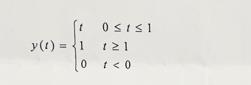
(b) Sketch the signal x[n] = 8[n] - 8[n-3] for n=-3:5 with proper label.
(c) Sketch the signal x(t) = u(t+4) - u(t-4) for t= -6:6 with proper labels
(d) Sketch the discrete signal x[n] =-u[n+3] + 4u[n+1] - 4u[n-2] + [n-4) for the time n=-6:6 and appropriately label the figure.
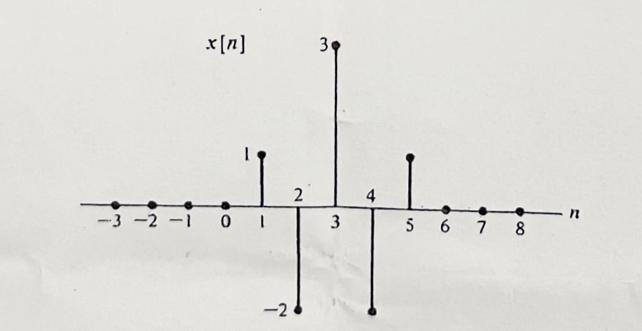
(e) Write an expression in the expanded form for the discrete signal x[n] in the figure below as sums of weighted delayed impulsesr
y(t) = 1 0 0 11 121 t < 0
Step by Step Solution
3.48 Rating (164 Votes )
There are 3 Steps involved in it
Q1 a Difference between a Signal and a System and their Applications A signal can be defined as a physical quantity or a function that carries information It can represent various types of data such a... View full answer

Get step-by-step solutions from verified subject matter experts
 Study Help