Question: Quantitive Business Methods Drawing Graphs When you look at a straight-line graph, there are two obvious features: , the intercept, which shows where the line

Quantitive Business Methods
Quantitive Business Methods Drawing Graphs WhenDrawing Graphs

Quantitive Business Methods Drawing Graphs WhenQuantitive Business Methods Drawing Graphs When

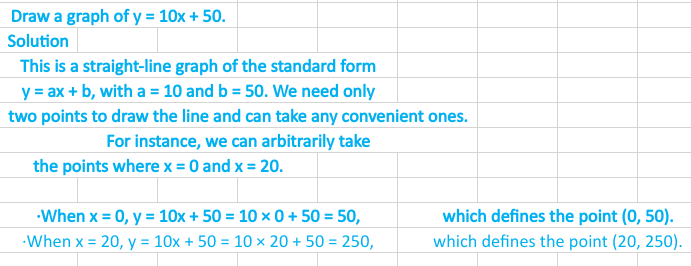
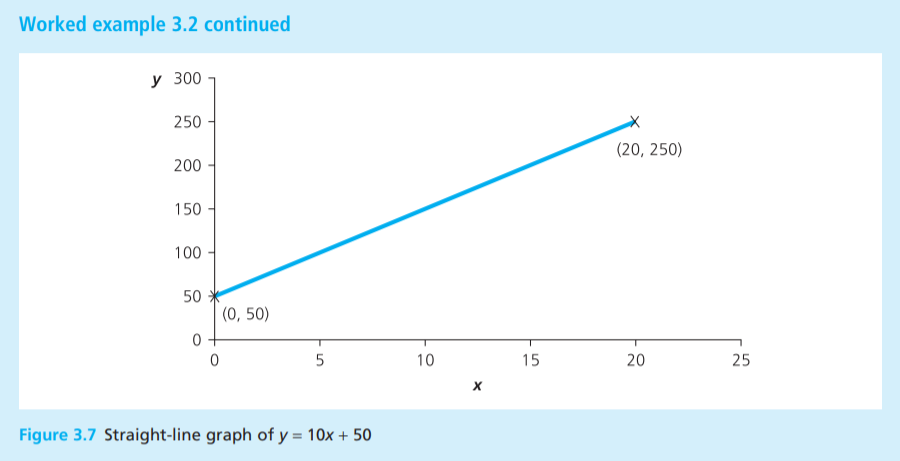
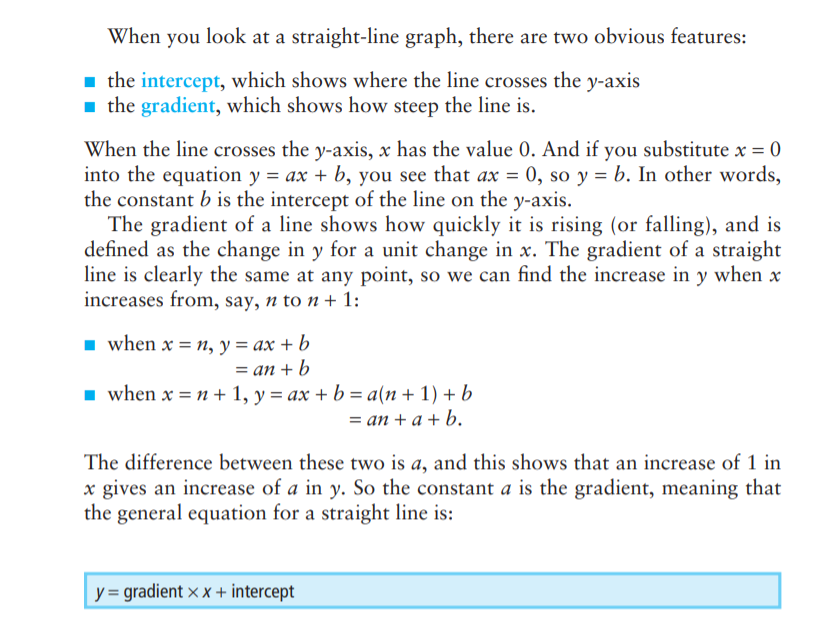
When you look at a straight-line graph, there are two obvious features: , the intercept, which shows where the line crosses the y-axis the gradient, which shows how steep the line is. When the line crosses the y-axis, x has the value 0. And if you substitute x = 0 into the equation y = ax + b, you see that ax = 0, so y = b. In other words, the constant b is the intercept of the line on the y-axis. The gradient of a line shows how quickly it is rising (or falling), and is defined as the change in y for a unit change in x. The gradient of a straight line is clearly the same at any point, so we can find the increase in y when x increases from, say, n to n + 1: when x = n, y = ax + b = an + b 1 when x = n + 1, y = ax + b = a(n + 1) + b = an + a + b. The difference between these two is a, and this shows that an increase of 1 in x gives an increase of a in y. So the constant a is the gradient, meaning that the general equation for a straight line is: y = gradient x x + intercept Draw a graph of y = 10x + 50. Solution This is a straight-line graph of the standard form y = ax + b, with a = 10 and b = 50. We need only two points to draw the line and can take any convenient ones. For instance, we can arbitrarily take the points where x = 0 and x = 20. When x = 0, y = 10x + 50 = 10 x 0 + 50 = 50, When x = 20, y = 10x + 50 = 10 x 20 + 50 = 250, which defines the point (0,50). which defines the point (20, 250). Worked example 3.2 continued y 300 250 (20, 250) 200 150 100 50 * (0, 50) 0 0 5 10 15 20 25 Figure 3.7 Straight-line graph of y = 10x + 50

Step by Step Solution

There are 3 Steps involved in it

1 Expert Approved Answer
Step: 1 Unlock blur-text-image

Question Has Been Solved by an Expert!

Get step-by-step solutions from verified subject matter experts

Step: 2 Unlock
Step: 3 Unlock

Students Have Also Explored These Related General Management Questions!