Question: Quantum Frontiers: To Boldly Go (Case Analysis) Please examine this specific case and complete an analysis. What is the best way to resolve the supply
Quantum Frontiers: To Boldly Go (Case Analysis)
Please examine this specific case and complete an analysis. What is the best way to resolve the supply chain challenges that are faced in the case? What can Cali do with the data to better understand the issues at hand? Can she use the data to make a case for change? What should be changed? How would she know a change would lead to improved lead times? What is the best way forward for QF's supply chain?
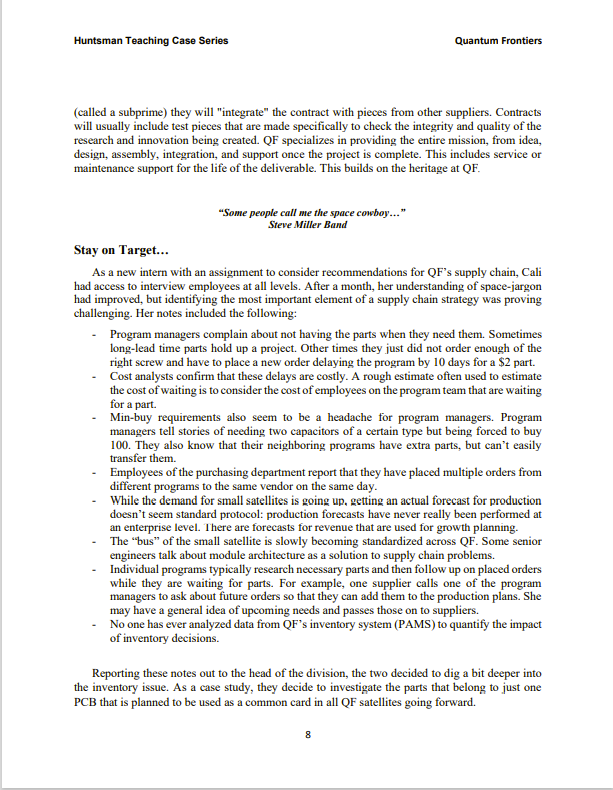
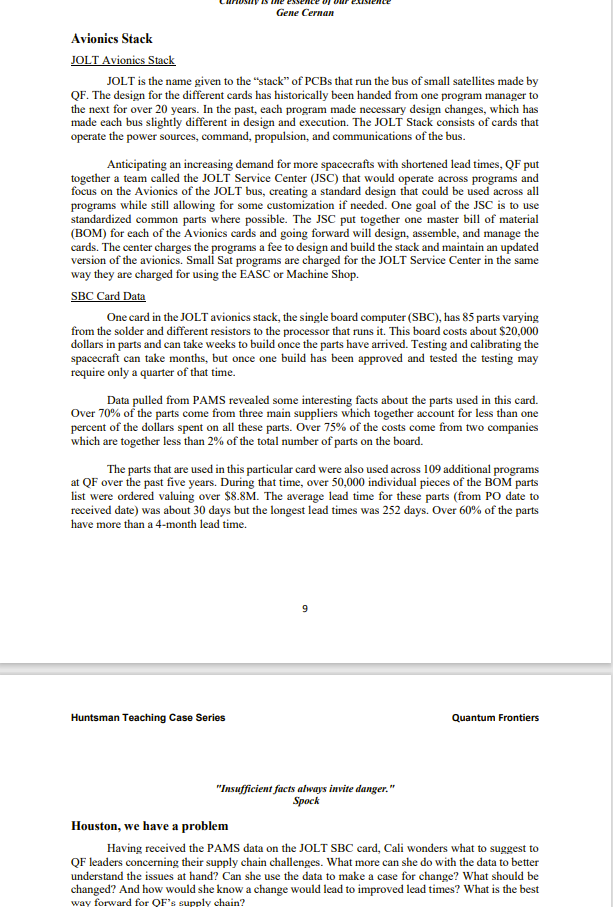
Huntsman Teaching Case Series Quantum Frontiers "Never tell me the odds." Han Solo Small Sat Market Trends and QF's Response By the end of 2019, SF had positioned itself squarely as a reliable small sat provider for government customers. However, changes in the marketplace made QF leaders aware of their need to consider their market position. Smaller commercial providers of small sats began entering the market with promises of cheaper, shorter-lead-time, standardized CubeSats. While QF fit in the market of customized satellites, discussions about these market threats led QF leaders to realize that their customers want mission success, not necessarily customized hardware. If the commercial players could convince government buyers to consider standardized solutions at lower costs, QF might lose much of what they had built over the years. As such, in 2020 the small sat director proposed some aggressive goals: Reduce lead time for small sat build cycles in half. Plan to triple the volume of satellite projects. Reduce costs of satellites in half. Pursue projects of higher class (Class B and A) satellites. "Take your protein pills and put your helmet on." David Bowie Internal Supply Chain Contracting Since most of QF's customers spend federal dollars to pay for products, QF has to compete to win contracts for each project. Obligating federal funds requires stringent oversight governed through the Federal Acquisition Regulation (FAR) and DoD spending through the Defense Federal Acquisition Regulation (DFAR). A government official that has budgetary responsibilities can initiate a request for proposal to complete an aspect of their mission. The contracting office works with program managers, cost analysists, and branch and division leaders to create a bid that includes details about costs, schedules, and deliverables. Different types of contracts are used (see exhibit 12). Typically, it takes 6 to 12 months from the time that a project is proposed to when a contract is firm and work can begin. However, even with a firm contract, the government usually holds the option to cancel contracts at any point. Federal budgets and spending interests often shift with changes in political influence and power. 4 Quantum Frontiers Huntsman Teaching Case Series Programs Each QF project is funded separately as a program. Most employees are assigned to work with multiple programs and allocate their time and expenses to program costs. Program sizes and the team members will vary by program, but small sat program can have anywhere between 10 to 30 members on the program team. The program team is led by a program manager; in addition to daily program direction and leading program employees, program managers also work directly with the customer to provide the deliverable and ensure the mission is successful. Programs are assigned cost analysts, technical writers, engineers, and designers as needed - on bigger programs the bulk of the program teams are engineers. Time and wages are allocated to employees based on their time allocated to their programs. Purchasing and Sub-Contracting Once a contract is secure and the project plan begins to solidify, program managers and cost analysts work with the purchasing and sub-contracting departments to start ordering parts to build the project. If a part is "off-the-shelf" or a standard part that can be purchased from a list of parts offered by a distributor or manufacturer, then the part can be procured directly through purchasing. The purchasing department helps the program create a Purchase Order (PO) using the bill of material (BOM) that includes all the parts required to build the project created from the specifications, plans, and engineering drawings. The purchasing department also ensures that the documentation required by the contract is in place in order to spend the customers money. Once a part is purchased using customer's funds, it is legally owned by the customer. The sub-contracting department is involved if a needed part has to be built uniquely for the project (not off-the-shelf) or if the project leaders decides that a component of the satellite should be built out-of-house. These sub-contracted parts can be subject to many of the same issues of contracting (i.e., bid proposals, contracting types, etc.). The sub-contracting phases could take several weeks or even months just to put a firm contract in place, and it is subject to the oversight of the main contract (called the primary contract) QF has with their customers. Spending federal dollars often requires that purchasing and sub-contracting personnel navigate the primary contractor's requirements in order to ensure audit trails and part traceability. Many contracts specify that parts can only be purchased from trusted and approved vendors and manufactures in order to ensure workmanship quality, avoid counterfeit parts, and to deter the possibility of parts that can be later by controlled by enemies-of-the-state. However, not all contracts have these requirements and there can be a significant cost difference between original equipment manufacturer (OEM) and generic parts especially among general electronic parts (called triple-E, (EEE) parts). Each program purchases their own parts, but projects across programs often use common parts. Additionally, some part manufacturers require a minimum-buy-commitment (min-buy) that is usually much bigger than what one program will need. In these cases, programs are often forced to either buy much more than they need or to negotiate with the vendor to pay a much higher price per part. Finally, some purchased electronic parts are made in large batches by manufacturers; if a program timing doesn't coincide with a batch production timing, the lead times for the next batch could be 6 to 9 months. These long-lead times lead program managers to scramble trying to find 5 Huntsman Teaching Case Series Quantum Frontiers parts from other vendors, programs, or other government contractors - sometimes they can find a solution but often they have to wait until the next batch is manufactured. Parts and sub-contracts are purchased using program funds released by customers at times specified in the contract. Common parts that are used across programs can only be purchased together if they are in the same procurement phase, otherwise parts have to be purchased when there is program-specific funding. There are little overhead operating funds (non-program specific funds) set aside for parts inventory because pre-purchasing parts would require QF to float the cost of parts until the program money is released. Additionally, parts that are bought with a specific program's funds cannot easily be transferred to a different program because contractually the government customer owns the parts once they have been paid for. Transfer of parts between programs can take days of programs managers time and involve multiple levels of contracting officials both at QF and the government - all parties agree that it is best avoided. Savvy program managers may be left waiting for long-lead parts and so have started to figure ways around the program-specific procurement issues. Anecdotally, long-lead-time parts are known across program managers and engineers and so programs ask for money at earlier phases of the contract to begin buying these parts at the onset of projects. Parts are not paid for until after they are received (net 30) and so some managers have found ways to shift ownership of parts between programs before parts are paid for. Additionally, QF leadership has begun to issue small investments for parts that have anticipated long-lead times and may hold up the project if programs have to wait to submit an order until the funds are released. These dedicated stock parts are then owned by QF, not the program, until the program funds can cover them. The risk in these approaches is that a government contracts can be severed without warning and without full payment; if a program manager pre- purchases parts for a program that is cancelled, QF will be stuck with the inventory without promise of repayment by a program contract. Shipping and Receiving When a part arrives as QF, shipping and receiving personnel ensure that parts on the shipping log are included in the shipment. Shipping documents are scanned as an attachment to the Pos. Larger parts are usually picked up by a member of the program. Technical and electronic parts usually go to Quality Assurance (QA) and then are stored in the stockroom. Quality Assurance Quality Assurance checks for workmanship of some received parts and enters smaller electronic parts into a homegrown inventory tracking database called Parts and Material System (PAMS). PAMS allows QA to enter expiry dates and traceability information if the PO indicates that the contract requires it. All employees can look at and use PAMS and have different permissions depending on their needs. Recently the director of QA has expressed concerns for the potential of counterfeit parts entering QF. 6 Quantum Frontiers Huntsman Teaching Case Series Stockroom The stockroom is equipped to store electronic parts that are electrostatic-sensitive and allocates space for each program to securely store parts. The stockroom employees enter data into PAMS and requisition out the materials to programs as requested. Programs can see on PAMS what parts are in the stockroom and once all the parts to build a printed circuit board (PCB) are received into the storeroom, the program can order a kit to be made and sent next door to the Electronic Assembly Service Center (EASC) for surface mounting circuit board production. The stockroom also manages an area of common stock that include parts that designers and engineers use in early prototyping efforts. The use of these materials that are not usually allocated to project specific budgets. These parts include wires, cable, and small hardware (screws and nuts). If a program needs these types of parts for a project, they are asked to order them separately so as not to drain the common stock. Internal Production Testing Facilities To help assemble their project, most programs use internal facilities including the Electronics Assembly Service Center (EASC), the Machine Shop and the Testing facilities. Each of these internal facilities are built to be "Prototype"-like shops in order to work on one or two of an item at a time. These facilities charge their time and parts to the programs for which they are making pieces. The EASC assembles PCBs that go in projects across Quantum Frontiers. Setup times for PCBs can vary from a couple of hours to as long as a week depending on the complexity of the board and the parts used. The primary machine used by the EASC is designed for high production of the same board, so the time to produce one board is usually small compared to the setup time. Having the EASC in-house is paramount to the innovation mission of QF; if initial designs do not function as planned a redesign can be printed fairly quickly. Recently, the EASC has had backlog in requests and meets regularly with program managers to prioritize tasks. The Machine Shop has a variety of machines and tools to form metals with high accuracy and quality. Time for projects in the shop average about one week. Designers work with engineers to submit CAD drawings to the shop for fabrication. Similar to the EASC, the Machine Shop has recently been backlogged with complex and sensitive projects and so it has farmed out some easier and less critical jobs to local metal shops. Before being sent to space, small satellites go through extensive pre-flight testing to make sure the major functions are working properly. Complete subsystems or whole spacecraft are sent to facilities to test performance aspects like communication capabilities, GPS accuracy, proper deployment of solar panels, light and star tracking, etc. Specialized testing labs have been built to test and calibrate each deliverable. These include shake tests, radiation test, sound tests, etc. These labs have been used for decades to ensure mission success. Assembly and Support When all of the pieces have arrived and been fabricated by the internal facilities each program will assemble their piece. Sometimes when a program is a piece of a larger contract 7 Huntsman Teaching Case Series Quantum Frontiers (called a subprime) they will "integrate" the contract with pieces from other suppliers. Contracts will usually include test pieces that are made specifically to check the integrity and quality of the research and innovation being created. QF specializes in providing the entire mission, from idea, design, assembly, integration, and support once the project is complete. This includes service or maintenance support for the life of the deliverable. This builds on the heritage at QF. "Some people call me the space cowboy..." Steve Miller Band Stay on Target... As a new intern with an assignment to consider recommendations for QF's supply chain, Cali had access to interview employees at all levels. After a month, her understanding of space-jargon had improved, but identifying the most important element of a supply chain strategy was proving challenging. Her notes included the following: Program managers complain about not having the parts when they need them. Sometimes long-lead time parts hold up a project. Other times they just did not order enough of the right screw and have to place a new order delaying the program by 10 days for a $2 part. Cost analysts confirm that these delays are costly. A rough estimate often used to estimate the cost of waiting is to consider the cost of employees on the program team that are waiting for a part. Min-buy requirements also seem to be a headache for program managers. Program managers tell stories of needing two capacitors of a certain type but being forced to buy 100. They also know that their neighboring programs have extra parts, but can't easily transfer them. Employees of the purchasing department report that they have placed multiple orders from different programs to the same vendor on the same day. While the demand for small satellites is going up, getting an actual forecast for production doesn't seem standard protocol: production forecasts have never really been performed at an enterprise level. There are forecasts for revenue that are used for growth planning. The "bus" of the small satellite is slowly becoming standardized across QF. Some senior engineers talk about module architecture as a solution to supply chain problems. Individual programs typically research necessary parts and then follow up on placed orders while they are waiting for parts. For example, one supplier calls one of the program managers to ask about future orders so that they can add them to the production plans. She may have a general idea of upcoming needs and passes those on to suppliers. No one has ever analyzed data from OF's inventory system (PAMS) to quantify the impact of inventory decisions. Reporting these notes out to the head of the division, the two decided to dig a bit deeper into the inventory issue. As a case study, they decide to investigate the parts that belong to just one PCB that is planned to be used as a common card in all QF satellites going forward. O on etence Gene Cernan Avionics Stack JOLT Avionics Stack JOLT is the name given to the "stack of PCBs that run the bus of small satellites made by QF. The design for the different cards has historically been handed from one program manager to the next for over 20 years. In the past, each program made necessary design changes, which has made each bus slightly different in design and execution. The JOLT Stack consists of cards that operate the power sources, command, propulsion, and communications of the bus. Anticipating an increasing demand for more spacecrafts with shortened lead times, QF put together a team called the JOLT Service Center (JSC) that would operate across programs and focus on the Avionics of the JOLT bus, creating a standard design that could be used across all programs while still allowing for some customization if needed. One goal of the JSC is to use standardized common parts where possible. The JSC put together one master bill of material (BOM) for each of the Avionics cards and going forward will design, assemble, and manage the cards. The center charges the programs a fee to design and build the stack and maintain an updated version of the avionics. Small Sat programs are charged for the JOLT Service Center in the same way they are charged for using the EASC or Machine Shop SBC Card Data One card in the JOLT avionics stack, the single board computer (SBC), has 85 parts varying from the solder and different resistors to the processor that runs it. This board costs about $20,000 dollars in parts and can take weeks to build once the parts have arrived. Testing and calibrating the spacecraft can take months, but once one build has been approved and tested the testing may require only a quarter of that time. Data pulled from PAMS revealed some interesting facts about the parts used in this card. Over 70% of the parts come from three main suppliers which together account for less than one percent of the dollars spent on all these parts. Over 75% of the costs come from two companies which are together less than 2% of the total number of parts on the board. The parts that are used in this particular card were also used across 109 additional programs at QF over the past five years. During that time, over 50,000 individual pieces of the BOM parts list were ordered valuing over $8.8M. The average lead time for these parts (from PO date to received date) was about 30 days but the longest lead times was 252 days. Over 60% of the parts have more than a 4-month lead time. 9 Huntsman Teaching Case Series Quantum Frontiers "Insufficient facts always invite danger." Spock Houston, we have a problem Having received the PAMS data on the JOLT SBC card, Cali wonders what to suggest to QF leaders concerning their supply chain challenges. What more can she do with the data to better understand the issues at hand? Can she use the data to make a case for change? What should be changed? And how would she know a change would lead to improved lead times? What is the best way forward for OF's supply chain









 Study Help