Question: Question 1 0.5 pts In the decision making process, development of alternatives comes: Before a problem is identified Before criteria weights are assigned O After
Question 1 0.5 pts In the decision makingQuestion 1 0.5 pts In the decision makingQuestion 1 0.5 pts In the decision makingQuestion 1 0.5 pts In the decision makingQuestion 1 0.5 pts In the decision making

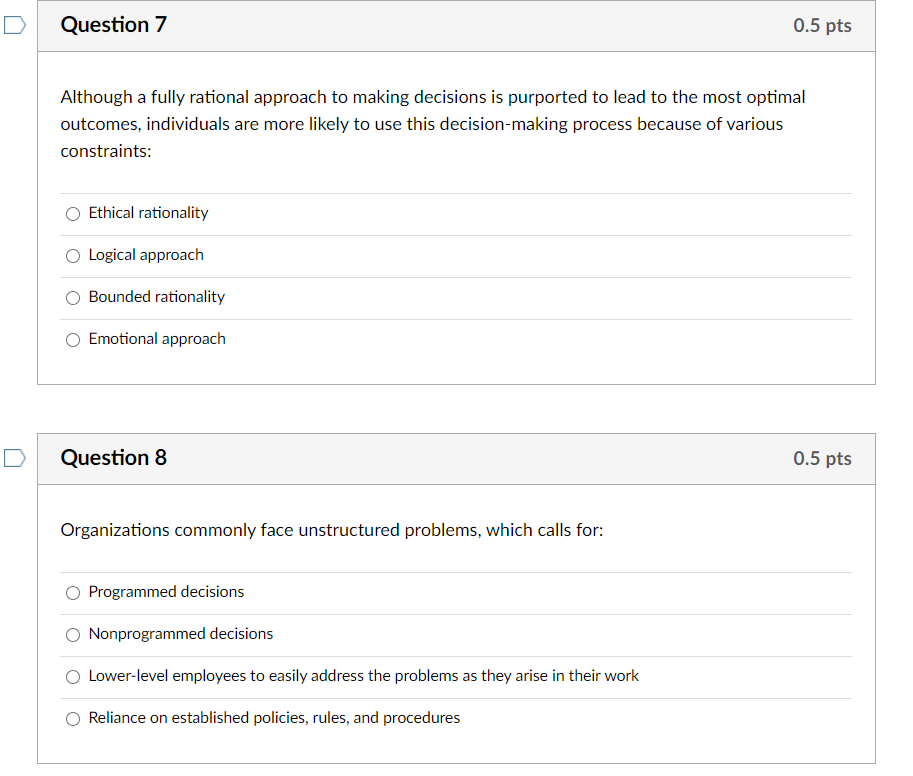
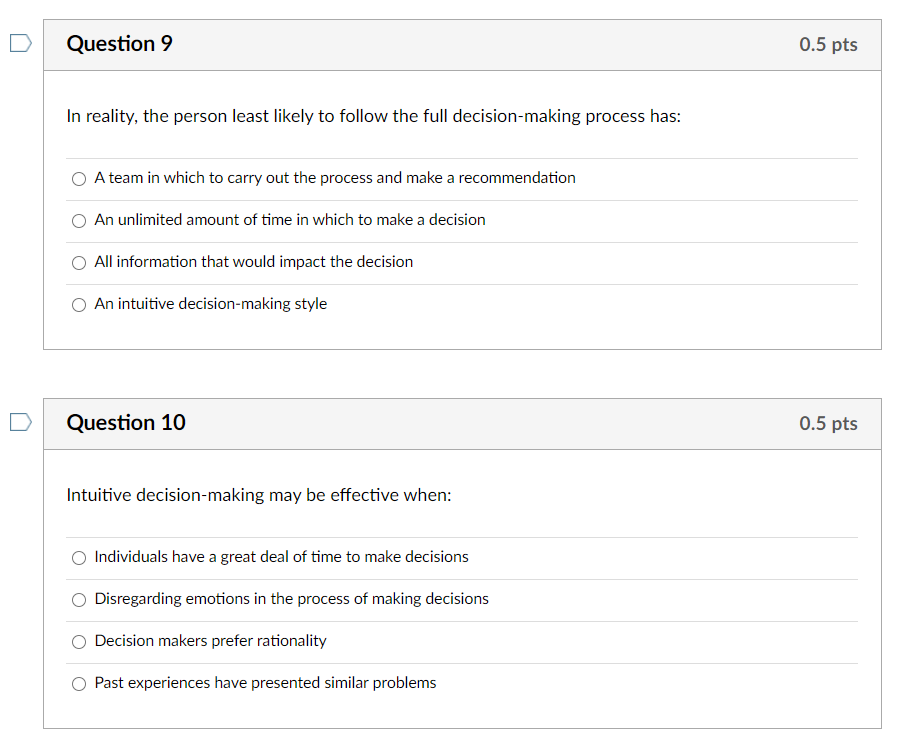
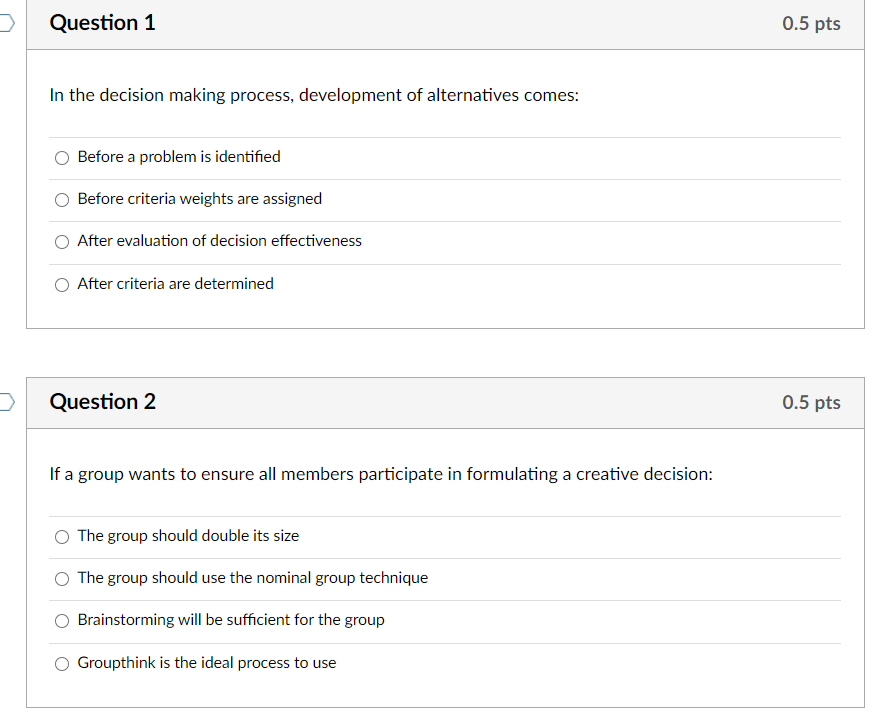
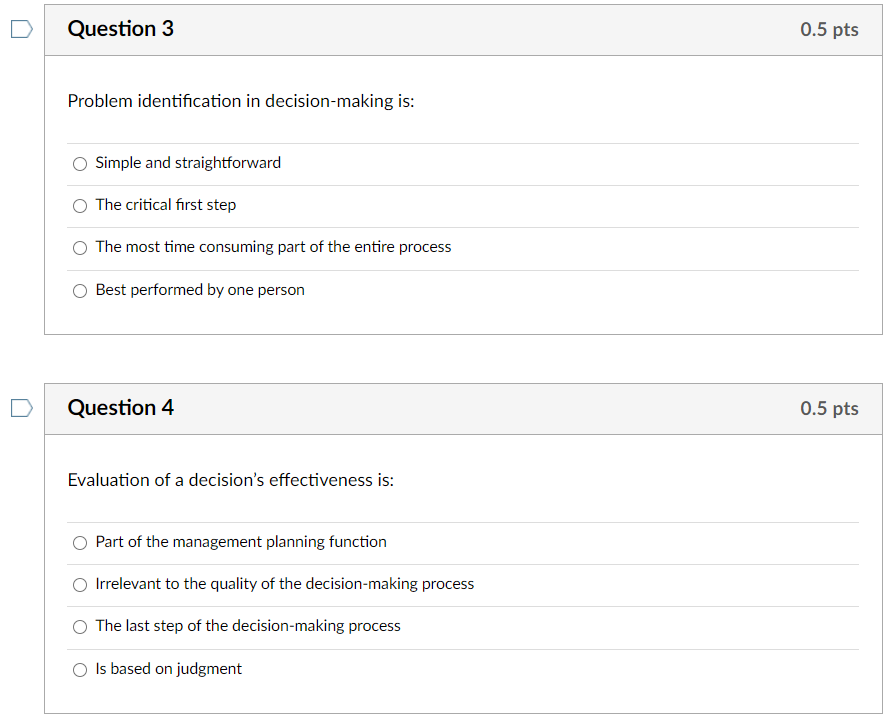
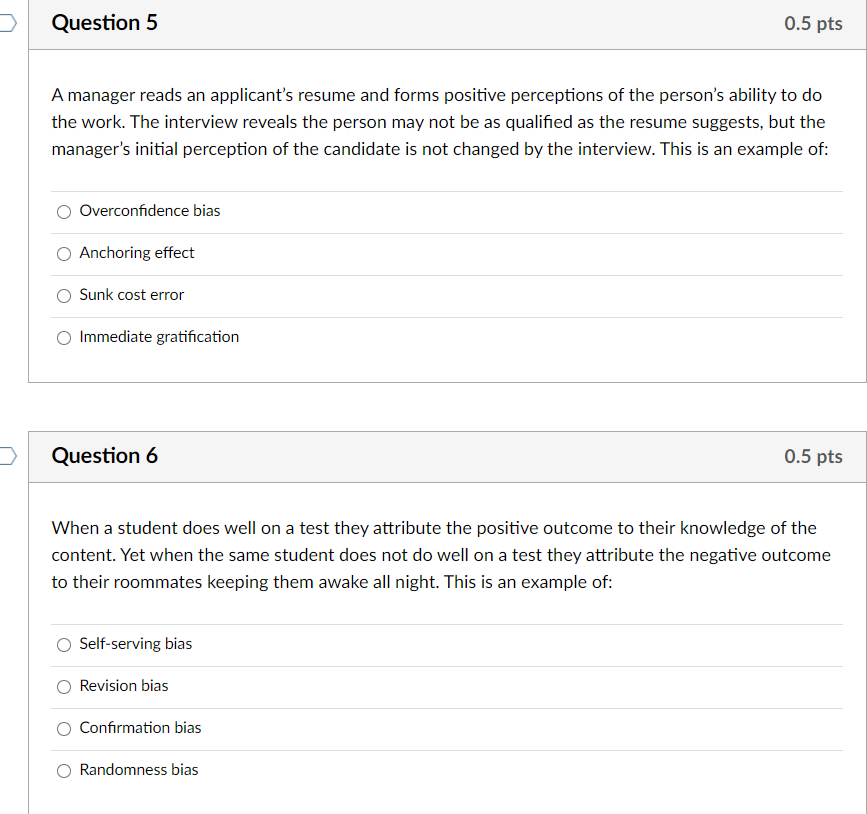
Question 1 0.5 pts In the decision making process, development of alternatives comes: Before a problem is identified Before criteria weights are assigned O After evaluation of decision effectiveness O After criteria are determined Question 2 0.5 pts If a group wants to ensure all members participate in formulating a creative decision: The group should double its size The group should use the nominal group technique Brainstorming will be sufficient for the group Groupthink is the ideal process to use Question 3 0.5 pts Problem identification in decision-making is: Simple and straightforward The critical first step The most time consuming part of the entire process Best performed by one person Question 4 0.5 pts Evaluation of a decision's effectiveness is: Part of the management planning function Irrelevant to the quality of the decision-making process The last step of the decision-making process Is based on judgment Question 5 0.5 pts A manager reads an applicant's resume and forms positive perceptions of the person's ability to do the work. The interview reveals the person may not be as qualified as the resume suggests, but the manager's initial perception of the candidate is not changed by the interview. This is an example of: Overconfidence bias Anchoring effect Sunk cost error Immediate gratification Question 6 0.5 pts When a student does well on a test they attribute the positive outcome to their knowledge of the content. Yet when the same student does not do well on a test they attribute the negative outcome to their roommates keeping them awake all night. This is an example of: Self-serving bias Revision bias Confirmation bias Randomness bias Question 7 0.5 pts Although a fully rational approach to making decisions is purported to lead to the most optimal outcomes, individuals are more likely to use this decision-making process because of various constraints: Ethical rationality Logical approach Bounded rationality Emotional approach Question 8 0.5 pts Organizations commonly face unstructured problems, which calls for: Programmed decisions O Nonprogrammed decisions Lower-level employees to easily address the problems as they arise in their work Reliance on established policies, rules, and procedures Question 9 0.5 pts In reality, the person least likely to follow the full decision-making process has: A team in which to carry out the process and make a recommendation An unlimited amount of time in which to make a decision All information that would impact the decision An intuitive decision-making style Question 10 0.5 pts Intuitive decision-making may be effective when: Individuals have a great deal of time to make decisions Disregarding emotions in the process of making decisions Decision makers prefer rationality Past experiences have presented similar problems
Step by Step Solution

There are 3 Steps involved in it

1 Expert Approved Answer
Step: 1 Unlock blur-text-image

Question Has Been Solved by an Expert!

Get step-by-step solutions from verified subject matter experts

Step: 2 Unlock
Step: 3 Unlock

Students Have Also Explored These Related General Management Questions!