







Question: question 1 1. Let A, B, C be sets. Let (1(3) be the statement .1: E A; let b(:r) be the statement a: E B;
question 1
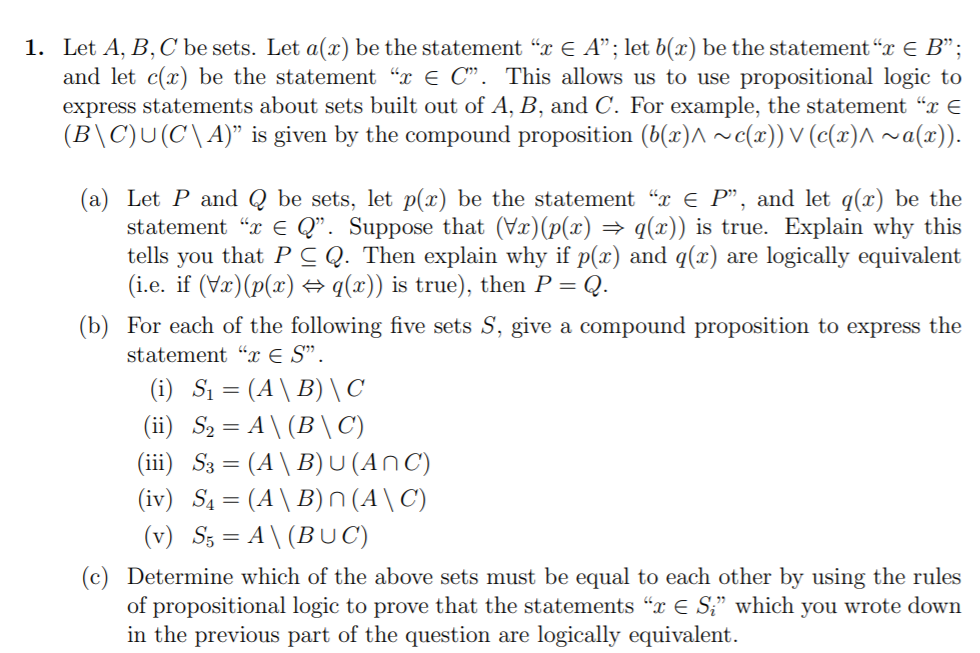
1. Let A, B, C be sets. Let (1(3) be the statement \".1: E A\"; let b(:r) be the statement \"a: E B\"; and let C(56) be the statement \"m E C\". This allows us to use propositional logic to express statements about sets built out of A, B, and C. For example, the statement \":1: E (B\\C) U (C \\ A)\" is given by the compound proposition (b(m)/\\ ~c(:t)) V (c(:r:)/\\ ~a(x)). (a) Let P and Q he sets, let p(3:) be the statement \"a: E P"7 and let q(r) be the statement \"a: E Q\". Suppose that (V$)(p(z) :> q(:r,)) is true. Explain why this tells you that P Q Q. Then explain Why if pfx) and (1(1') are logically equivalent (i.e. if (V$)(p(x) {a} 9(2)) is true), then P = Q. For each of the following ve sets 5', give a compound proposition to express the statement \"I: E S\". (i) 31 = (A\\B)\\C (ii) S2=A\\(B\\C) (iii) 33 = (A \\ B) U (Am 0) (1V) 34 = (A\\B)F1(A\\CJ (V) 55=A\\(BUC) Determine which of the above sets must be equal to each other by using the rules of propositional logic to prove that the statements \"m E 31-\" which you wrote down in the previous part of the question are logically equivalent
Step by Step Solution
There are 3 Steps involved in it

Get step-by-step solutions from verified subject matter experts
 Study Help