Question: Question 1 100 Marks Study the case study and complete the questions that follow: Preston Plant Before the crisis, the quality department was just for
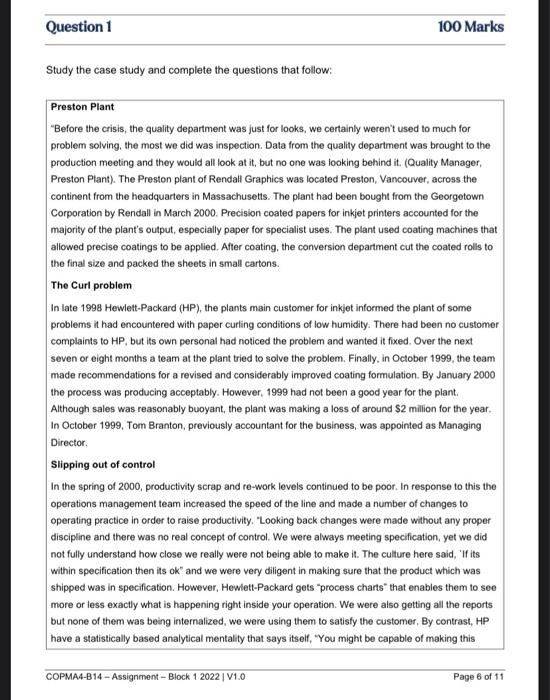
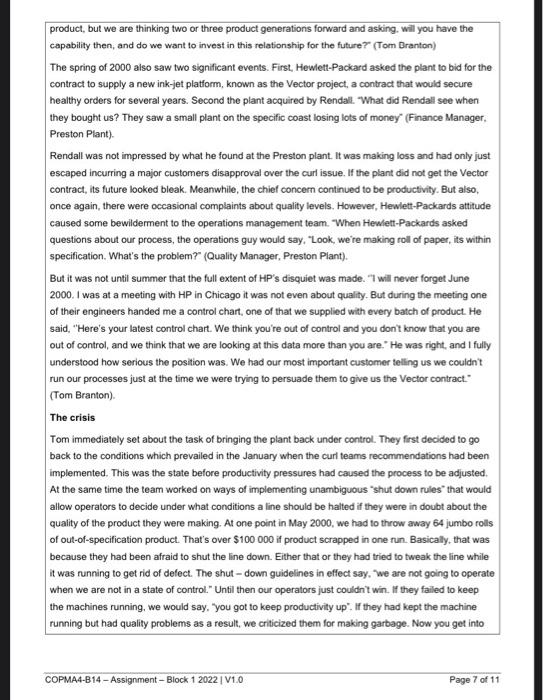
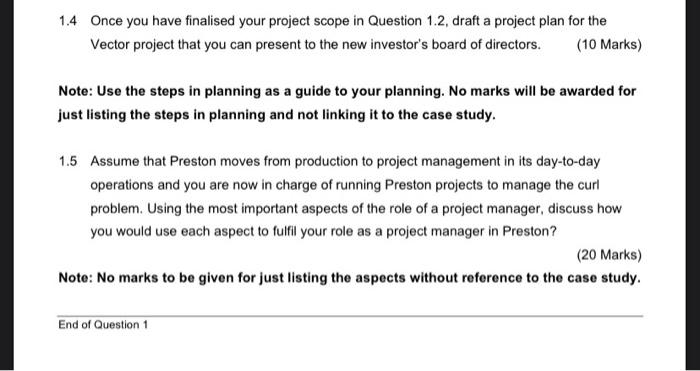
Question 1 100 Marks Study the case study and complete the questions that follow: Preston Plant "Before the crisis, the quality department was just for looks, we certainly weren't used to much for problem solving the most we did was inspection. Data from the quality department was brought to the production meeting and they would all look at it, but no one was looking behind it. (Quality Manager, Preston Plant). The Preston plant of Rendall Graphics was located Preston, Vancouver, across the continent from the headquarters in Massachusetts. The plant had been bought from the Georgetown Corporation by Rendall in March 2000. Precision coated papers for inkjet printers accounted for the majority of the plant's output, especially paper for specialist uses. The plant used coating machines that allowed precise coatings to be applied. After coating, the conversion department cut the coated rolls to the final size and packed the sheets in small cartons. The Curl problem In late 1998 Hewlett-Packard (HP), the plants main customer for inkjet informed the plant of some problems it had encountered with paper curling conditions of low humidity. There had been no customer complaints to HP, but its own personal had noticed the problem and wanted it fixed. Over the next seven or eight months a team at the plant tried to solve the problem. Finally, in October 1999, the team made recommendations for a revised and considerably improved coating formulation. By January 2000 the process was producing acceptably. However, 1999 had not been a good year for the plant. Although sales was reasonably buoyant, the plant was making a loss of around $2 million for the year. In October 1999, Tom Branton, previously accountant for the business, was appointed as Managing Director Slipping out of control In the spring of 2000, productivity scrap and re-work levels continued to be poor. In response to this the operations management team increased the speed of the line and made a number of changes to operating practice in order to raise productivity. "Looking back changes were made without any proper discipline and there was no real concept of control. We were always meeting specification, yet we did not fully understand how close we really were not being able to make it. The culture here said, "If its within specification then its ok" and we were very diligent in making sure that the product which was shipped was in specification. However, Hewlett-Packard gets "process charts that enables them to see more or less exactly what is happening right inside your operation. We were also getting all the reports but none of them was being internalized, we were using them to satisfy the customer, By contrast, HP have a statistically based analytical mentality that says itself, "You might be capable of making this COPMA4-B14 - Assignment -Block 1 2022 V1.0 Page 6 of 11 product, but we are thinking two or three product generations forward and asking, will you have the capability then, and do we want to invest in this relationship for the future? (Tom Branton) The spring of 2000 also saw two significant events. First, Hewlett-Packard asked the plant to bid for the contract to supply a new ink-jet platform, known as the Vector project, a contract that would secure healthy orders for several years. Second the plant acquired by Rendall What did Rendall see when they bought us? They saw a small plant on the specific coast losing lots of money (Finance Manager, Preston Plant). Rendall was not impressed by what he found at the Preston plant. It was making loss and had only just escaped incurring a major customers disapproval over the curl issue. If the plant did not get the Vector contract, its future looked bleak. Meanwhile, the chief concern continued to be productivity. But also, once again, there were occasional complaints about quality levels. However, Hewlett-Packards attitude caused some bewilderment to the operations management team. When Hewlett-Packards asked questions about our process, the operations guy would say, "Look, we're making roll of paper, its within specification. What's the problem?" (Quality Manager, Preston Plant). But it was not until summer that the full extent of HP's disquiet was made. "I will never forget June 2000. I was at a meeting with HP in Chicago it was not even about quality. But during the meeting one of their engineers handed me a control chart, one of that we supplied with every batch of product. He said, "Here's your latest control chart. We think you're out of control and you don't know that you are out of control, and we think that we are looking at this data more than you are." He was right, and I fully understood how serious the position was. We had our most important customer telling us we couldn't run our processes just at the time we were trying to persuade them to give us the Vector contract (Tom Branton). The crisis Tom immediately set about the task of bringing the plant back under control. They first decided to go back to the conditions which prevailed in the January when the curl teams recommendations had been implemented. This was the state before productivity pressures had caused the process to be adjusted. At the same time the team worked on ways of implementing unambiguous shut down rules that would allow operators to decide under what conditions a line should be halted if they were in doubt about the quality of the product they were making. At one point in May 2000, we had to throw away 64 jumbo rolls of Out-of-specification product. That's over $100 000 if product scrapped in one run. Basically, that was because they had been afraid to shut the line down. Either that or they had tried to tweak the line while it was running to get rid of defect. The shut-down guidelines in effect say, we are not going to operate when we are not in a state of control." Until then our operators just couldn't win. If they failed to keep the machines running, we would say, "you got to keep productivity up". If they had kept the machine running but had quality problems as a result, we criticized them for making garbage. Now you get into COPMA4-B14 - Assignment - Block 1 2022 V1.0 Page 7 of 11 1.4 Once you have finalised your project scope in Question 1.2, draft a project plan for the Vector project that you can present to the new investor's board of directors. (10 Marks) Note: Use the steps in planning as a guide to your planning. No marks will be awarded for just listing the steps in planning and not linking it to the case study. 1.5 Assume that Preston moves from production to project management in its day-to-day operations and you are now in charge of running Preston projects to manage the curl problem. Using the most important aspects of the role of a project manager, discuss how you would use each aspect to fulfil your role as a project manager in Preston? (20 Marks) Note: No marks to be given for just listing the aspects without reference to the case study. End of Question 1









 Study Help