





Question: Question 1 2 pts Consider the m-state ergodic CTMP having rate matrix A. The probability transition-function matrix and its derivatives are P(t) and P'(t), respectively.
Question 1 2 pts Consider the m-state ergodic
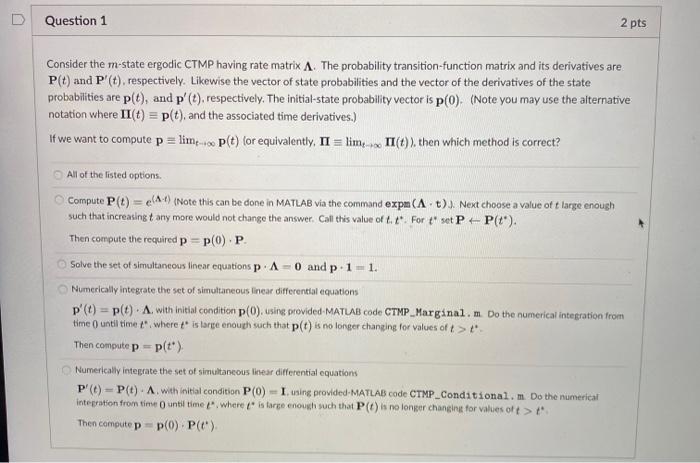
Question 1 2 pts Consider the m-state ergodic CTMP having rate matrix A. The probability transition-function matrix and its derivatives are P(t) and P'(t), respectively. Likewise the vector of state probabilities and the vector of the derivatives of the state probabilities are pt), and p' (t), respectively. The initial-state probability vector is p(o). (Note you may use the alternative notation where II(t) = p(t), and the associated time derivatives.) If we want to compute p = limetopt) for equivalently. II = lime II(t)), then which method is correct? All of the listed options Compute P(t) = e(A-1) (Note this can be done in MATLAB via the command expm (At). Next choose a value of large enough such that increasing t any more would not change the answer. Call this value of t.e* For * set P+-P(t). Then compute the required p = p(0) P. Solve the set of simultaneous linear equations p A - and p.1-1. Numerically integrate the set of simultaneous linear differential equations p' (t) = plt). A with initial condition p(O). using provided MATLAB code CTMP_Marginal.m Do the numerical integration from time until time t, where to is large enough such that p(t) is no longer changing for values of t > Then compute p = plt') Numerically integrate the set of simultaneous linear differential equations P') - P(t). A with initial condition P(0) - 1 using provided MATLAB code CTMP_Conditional.m. Do the numerical integration from time until time t where to store enough such that P() is no longer changing for values oft > Then compute p-p(0) P(e) Question 1 2 pts Consider the m-state ergodic CTMP having rate matrix A. The probability transition-function matrix and its derivatives are P(t) and P'(t), respectively. Likewise the vector of state probabilities and the vector of the derivatives of the state probabilities are pt), and p' (t), respectively. The initial-state probability vector is p(o). (Note you may use the alternative notation where II(t) = p(t), and the associated time derivatives.) If we want to compute p = limetopt) for equivalently. II = lime II(t)), then which method is correct? All of the listed options Compute P(t) = e(A-1) (Note this can be done in MATLAB via the command expm (At). Next choose a value of large enough such that increasing t any more would not change the answer. Call this value of t.e* For * set P+-P(t). Then compute the required p = p(0) P. Solve the set of simultaneous linear equations p A - and p.1-1. Numerically integrate the set of simultaneous linear differential equations p' (t) = plt). A with initial condition p(O). using provided MATLAB code CTMP_Marginal.m Do the numerical integration from time until time t, where to is large enough such that p(t) is no longer changing for values of t > Then compute p = plt') Numerically integrate the set of simultaneous linear differential equations P') - P(t). A with initial condition P(0) - 1 using provided MATLAB code CTMP_Conditional.m. Do the numerical integration from time until time t where to store enough such that P() is no longer changing for values oft > Then compute p-p(0) P(e)

Step by Step Solution

There are 3 Steps involved in it

1 Expert Approved Answer
Step: 1 Unlock blur-text-image

Question Has Been Solved by an Expert!

Get step-by-step solutions from verified subject matter experts

Step: 2 Unlock
Step: 3 Unlock

Students Have Also Explored These Related General Management Questions!