Question: Question 1 6.25 pts Strategy is: The operational level set of actions/ decisions/processes/ activities which successfully answer the questions how is value generated and sustained
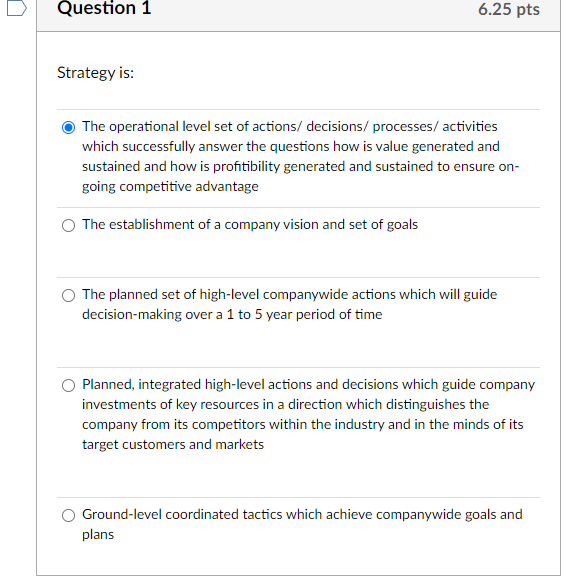
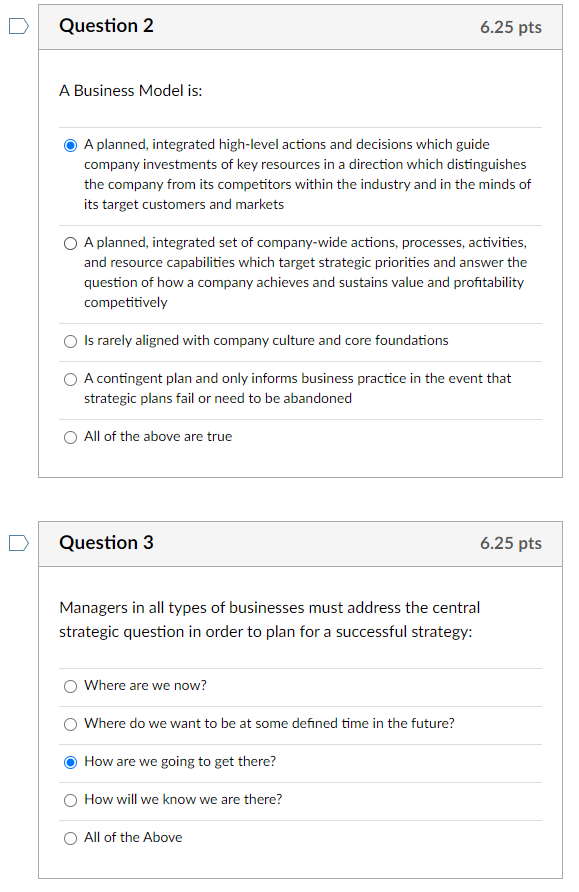
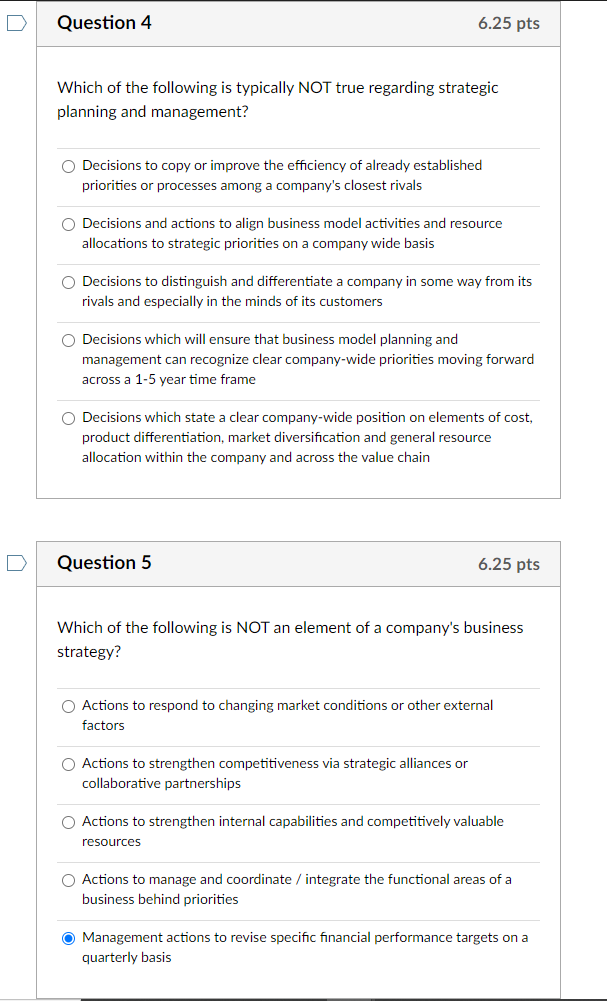
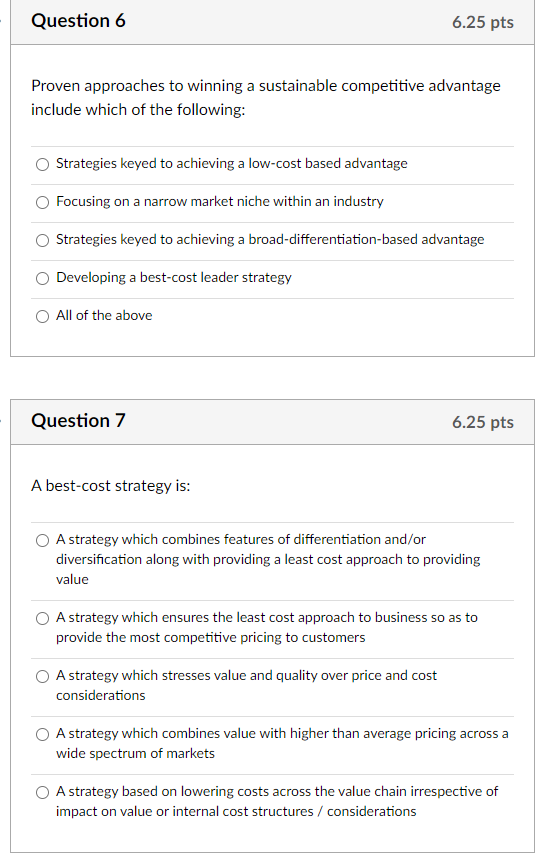
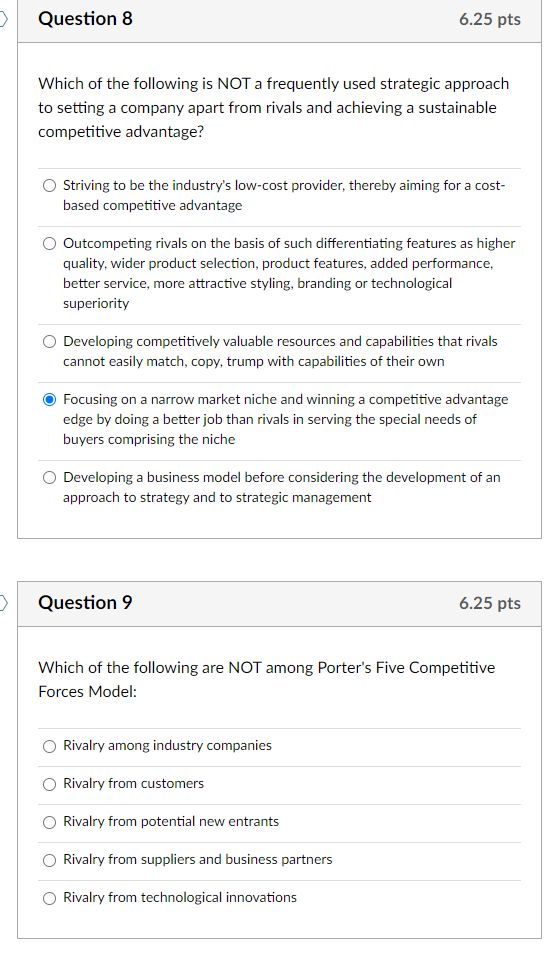
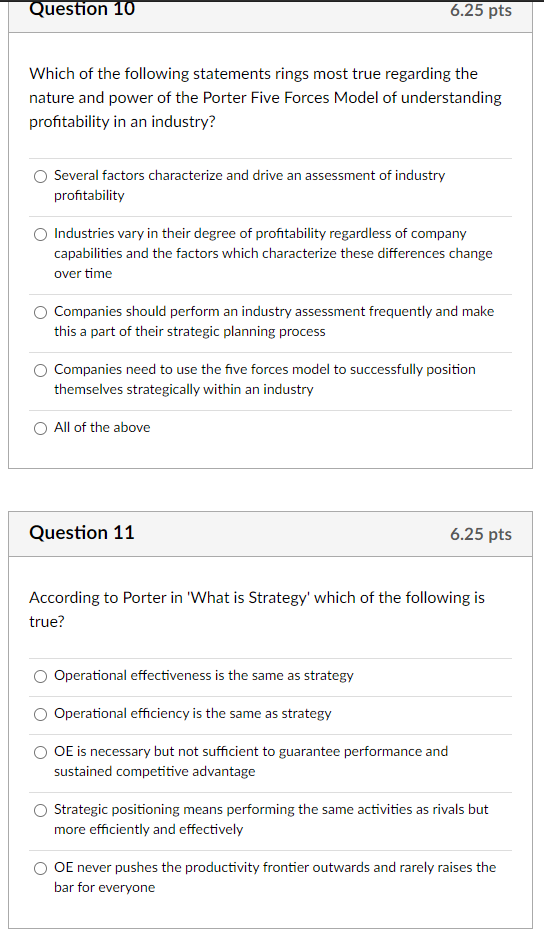
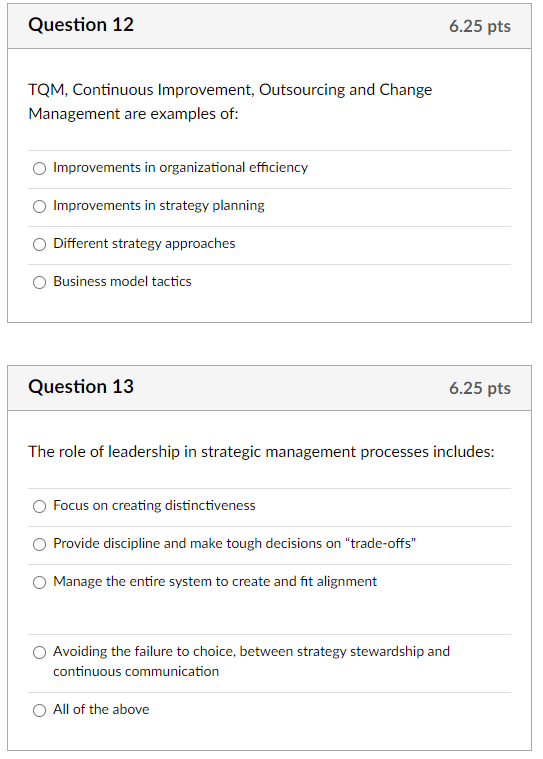
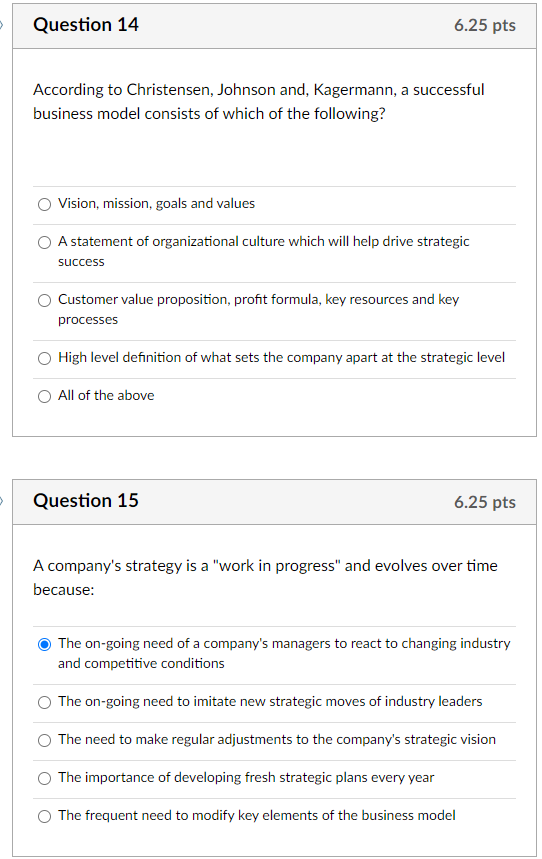
Question 1 6.25 pts Strategy is: The operational level set of actions/ decisions/processes/ activities which successfully answer the questions how is value generated and sustained and how is profitibility generated and sustained to ensure on- going competitive advantage The establishment of a company vision and set of goals The planned set of high-level companywide actions which will guide decision-making over a 1 to 5 year period of time Planned, integrated high-level actions and decisions which guide company investments of key resources in a direction which distinguishes the company from its competitors within the industry and in the minds of its target customers and markets Ground-level coordinated tactics which achieve companywide goals and plans Question 2 6.25 pts A Business Model is: A planned, integrated high-level actions and decisions which guide company investments of key resources in a direction which distinguishes the company from its competitors within the industry and in the minds of its target customers and markets A planned, integrated set of company-wide actions, processes, activities, and resource capabilities which target strategic priorities and answer the question of how a company achieves and sustains value and profitability competitively Is rarely aligned with company culture and core foundations A contingent plan and only informs business practice in the event that strategic plans fail or need to be abandoned All of the above are true Question 3 6.25 pts Managers in all types of businesses must address the central strategic question in order to plan for a successful strategy: Where are we now? Where do we want to be at some defined time in the future? How are we going to get there? How will we know we are there? All of the Above D Question 4 6.25 pts Which of the following is typically NOT true regarding strategic planning and management? O Decisions to copy or improve the efficiency of already established priorities or processes among a company's closest rivals Decisions and actions to align business model activities and resource allocations to strategic priorities on a company wide basis Decisions to distinguish and differentiate a company in some way from its rivals and especially in the minds of its customers O Decisions which will ensure that business model planning and management can recognize clear company-wide priorities moving forward across a 1-5 year time frame Decisions which state a clear company-wide position on elements of cost, product differentiation, market diversification and general resource allocation within the company and across the value chain D Question 5 6.25 pts Which of the following is NOT an element of a company's business strategy? Actions to respond to changing market conditions or other external factors Actions to strengthen competitiveness via strategic alliances or collaborative partnerships Actions to strengthen internal capabilities and competitively valuable resources Actions to manage and coordinate / integrate the functional areas of a business behind priorities Management actions to revise specific financial performance targets on a quarterly basis Question 6 6.25 pts Proven approaches to winning a sustainable competitive advantage include which of the following: Strategies keyed to achieving a low-cost based advantage Focusing on a narrow market niche within an industry Strategies keyed to achieving a broad-differentiation-based advantage Developing a best-cost leader strategy All of the above Question 7 6.25 pts A best-cost strategy is: A strategy which combines features of differentiation and/or diversification along with providing a least cost approach to providing value A strategy which ensures the least cost approach to business so as to provide the most competitive pricing to customers A strategy which stresses value and quality over price and cost considerations A strategy which combines value with higher than average pricing across a wide spectrum of markets A strategy based on lowering costs across the value chain irrespective of impact on value or internal cost structures / considerations Question 8 6.25 pts Which of the following is NOT a frequently used strategic approach to setting a company apart from rivals and achieving a sustainable competitive advantage? Striving to be the industry's low-cost provider, thereby aiming for a cost- based competitive advantage Outcompeting rivals on the basis of such differentiating features as higher quality, wider product selection, product features, added performance, better service, more attractive styling, branding or technological superiority Developing competitively valuable resources and capabilities that rivals cannot easily match, copy, trump with capabilities of their own Focusing on a narrow market niche and winning a competitive advantage edge by doing a better job than rivals in serving the special needs of buyers comprising the niche Developing a business model before considering the development of an approach to strategy and to strategic management > Question 9 6.25 pts Which of the following are NOT among Porter's Five Competitive Forces Model: Rivalry among industry companies Rivalry from customers Rivalry from potential new entrants Rivalry from suppliers and business partners Rivalry from technological innovations Question 10 6.25 pts Which of the following statements rings most true regarding the nature and power of the Porter Five Forces Model of understanding profitability in an industry? Several factors characterize and drive an assessment of industry profitability Industries vary in their degree of profitability regardless of company capabilities and the factors which characterize these differences change over time Companies should perform an industry assessment frequently and make this a part of their strategic planning process Companies need to use the five forces model to successfully position themselves strategically within an industry All of the above Question 11 6.25 pts According to Porter in 'What is Strategy' which of the following is true? Operational effectiveness is the same as strategy Operational efficiency is the same as strategy OE is necessary but not sufficient to guarantee performance and sustained competitive advantage Strategic positioning means performing the same activities as rivals but more efficiently and effectively OE never pushes the productivity frontier outwards and rarely raises the bar for everyone Question 12 6.25 pts TQM, Continuous Improvement, Outsourcing and Change Management are examples of: Improvements in organizational efficiency Improvements in strategy planning Different strategy approaches Business model tactics Question 13 6.25 pts The role of leadership in strategic management processes includes: Focus on creating distinctiveness Provide discipline and make tough decisions on "trade-offs" O Manage the entire system to create and fit alignment Avoiding the failure to choice, between strategy stewardship and continuous communication All of the above Question 14 6.25 pts According to Christensen, Johnson and, Kagermann, a successful business model consists of which of the following? Vision, mission, goals and values A statement of organizational culture which will help drive strategic success Customer value proposition, profit formula, key resources and key processes High level definition of what sets the company apart at the strategic level All of the above Question 15 6.25 pts A company's strategy is a "work in progress" and evolves over time because: The on-going need of a company's managers to react to changing industry and competitive conditions The on-going need to imitate new strategic moves of industry leaders The need to make regular adjustments to the company's strategic vision The importance of developing fresh strategic plans every year The frequent need to modify key elements of the business model Question 1 6.25 pts Strategy is: The operational level set of actions/ decisions/processes/ activities which successfully answer the questions how is value generated and sustained and how is profitibility generated and sustained to ensure on- going competitive advantage The establishment of a company vision and set of goals The planned set of high-level companywide actions which will guide decision-making over a 1 to 5 year period of time Planned, integrated high-level actions and decisions which guide company investments of key resources in a direction which distinguishes the company from its competitors within the industry and in the minds of its target customers and markets Ground-level coordinated tactics which achieve companywide goals and plans Question 2 6.25 pts A Business Model is: A planned, integrated high-level actions and decisions which guide company investments of key resources in a direction which distinguishes the company from its competitors within the industry and in the minds of its target customers and markets A planned, integrated set of company-wide actions, processes, activities, and resource capabilities which target strategic priorities and answer the question of how a company achieves and sustains value and profitability competitively Is rarely aligned with company culture and core foundations A contingent plan and only informs business practice in the event that strategic plans fail or need to be abandoned All of the above are true Question 3 6.25 pts Managers in all types of businesses must address the central strategic question in order to plan for a successful strategy: Where are we now? Where do we want to be at some defined time in the future? How are we going to get there? How will we know we are there? All of the Above D Question 4 6.25 pts Which of the following is typically NOT true regarding strategic planning and management? O Decisions to copy or improve the efficiency of already established priorities or processes among a company's closest rivals Decisions and actions to align business model activities and resource allocations to strategic priorities on a company wide basis Decisions to distinguish and differentiate a company in some way from its rivals and especially in the minds of its customers O Decisions which will ensure that business model planning and management can recognize clear company-wide priorities moving forward across a 1-5 year time frame Decisions which state a clear company-wide position on elements of cost, product differentiation, market diversification and general resource allocation within the company and across the value chain D Question 5 6.25 pts Which of the following is NOT an element of a company's business strategy? Actions to respond to changing market conditions or other external factors Actions to strengthen competitiveness via strategic alliances or collaborative partnerships Actions to strengthen internal capabilities and competitively valuable resources Actions to manage and coordinate / integrate the functional areas of a business behind priorities Management actions to revise specific financial performance targets on a quarterly basis Question 6 6.25 pts Proven approaches to winning a sustainable competitive advantage include which of the following: Strategies keyed to achieving a low-cost based advantage Focusing on a narrow market niche within an industry Strategies keyed to achieving a broad-differentiation-based advantage Developing a best-cost leader strategy All of the above Question 7 6.25 pts A best-cost strategy is: A strategy which combines features of differentiation and/or diversification along with providing a least cost approach to providing value A strategy which ensures the least cost approach to business so as to provide the most competitive pricing to customers A strategy which stresses value and quality over price and cost considerations A strategy which combines value with higher than average pricing across a wide spectrum of markets A strategy based on lowering costs across the value chain irrespective of impact on value or internal cost structures / considerations Question 8 6.25 pts Which of the following is NOT a frequently used strategic approach to setting a company apart from rivals and achieving a sustainable competitive advantage? Striving to be the industry's low-cost provider, thereby aiming for a cost- based competitive advantage Outcompeting rivals on the basis of such differentiating features as higher quality, wider product selection, product features, added performance, better service, more attractive styling, branding or technological superiority Developing competitively valuable resources and capabilities that rivals cannot easily match, copy, trump with capabilities of their own Focusing on a narrow market niche and winning a competitive advantage edge by doing a better job than rivals in serving the special needs of buyers comprising the niche Developing a business model before considering the development of an approach to strategy and to strategic management > Question 9 6.25 pts Which of the following are NOT among Porter's Five Competitive Forces Model: Rivalry among industry companies Rivalry from customers Rivalry from potential new entrants Rivalry from suppliers and business partners Rivalry from technological innovations Question 10 6.25 pts Which of the following statements rings most true regarding the nature and power of the Porter Five Forces Model of understanding profitability in an industry? Several factors characterize and drive an assessment of industry profitability Industries vary in their degree of profitability regardless of company capabilities and the factors which characterize these differences change over time Companies should perform an industry assessment frequently and make this a part of their strategic planning process Companies need to use the five forces model to successfully position themselves strategically within an industry All of the above Question 11 6.25 pts According to Porter in 'What is Strategy' which of the following is true? Operational effectiveness is the same as strategy Operational efficiency is the same as strategy OE is necessary but not sufficient to guarantee performance and sustained competitive advantage Strategic positioning means performing the same activities as rivals but more efficiently and effectively OE never pushes the productivity frontier outwards and rarely raises the bar for everyone Question 12 6.25 pts TQM, Continuous Improvement, Outsourcing and Change Management are examples of: Improvements in organizational efficiency Improvements in strategy planning Different strategy approaches Business model tactics Question 13 6.25 pts The role of leadership in strategic management processes includes: Focus on creating distinctiveness Provide discipline and make tough decisions on "trade-offs" O Manage the entire system to create and fit alignment Avoiding the failure to choice, between strategy stewardship and continuous communication All of the above Question 14 6.25 pts According to Christensen, Johnson and, Kagermann, a successful business model consists of which of the following? Vision, mission, goals and values A statement of organizational culture which will help drive strategic success Customer value proposition, profit formula, key resources and key processes High level definition of what sets the company apart at the strategic level All of the above Question 15 6.25 pts A company's strategy is a "work in progress" and evolves over time because: The on-going need of a company's managers to react to changing industry and competitive conditions The on-going need to imitate new strategic moves of industry leaders The need to make regular adjustments to the company's strategic vision The importance of developing fresh strategic plans every year The frequent need to modify key elements of the business model









 Study Help