







Question: Question 1 Compressible boundary layer with a time-dependent free stream velocity. This problem, for a flat plate at zero angle of attack, is described
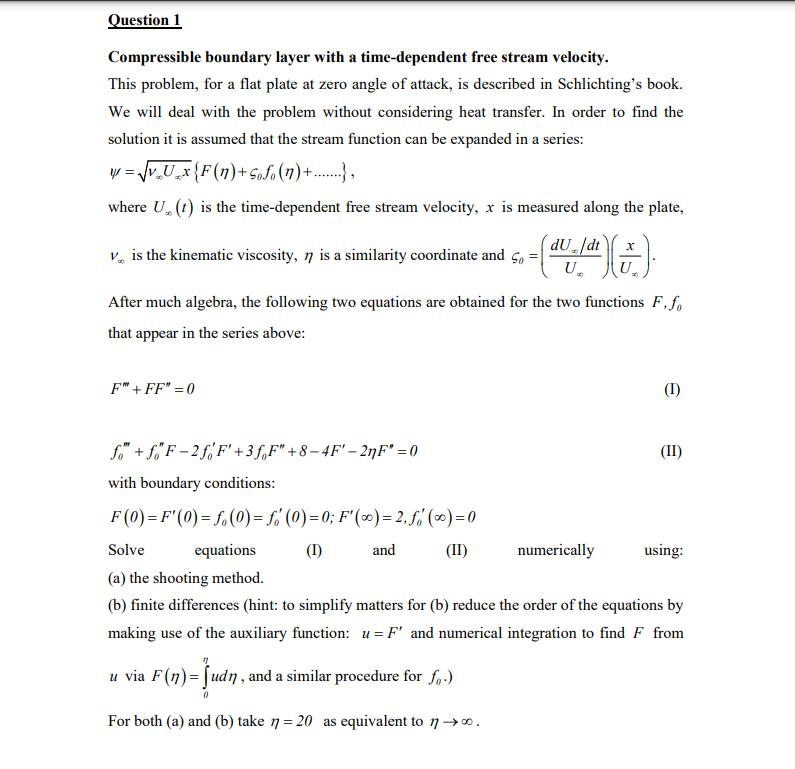
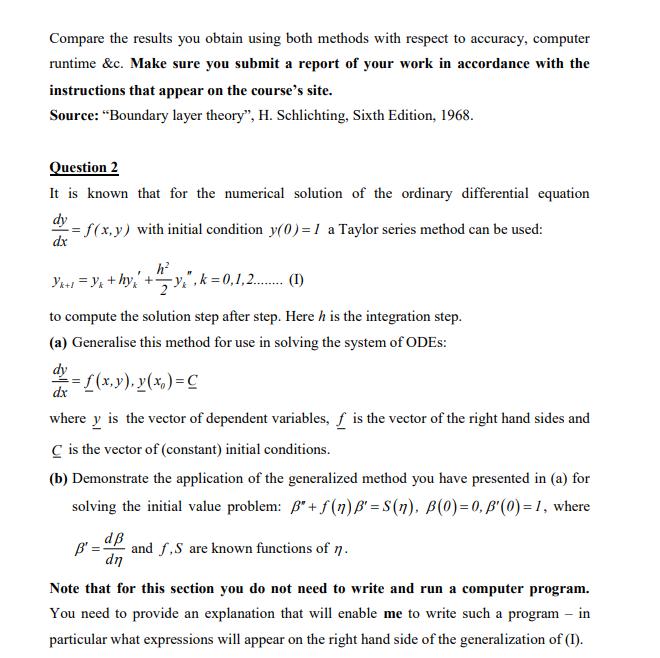
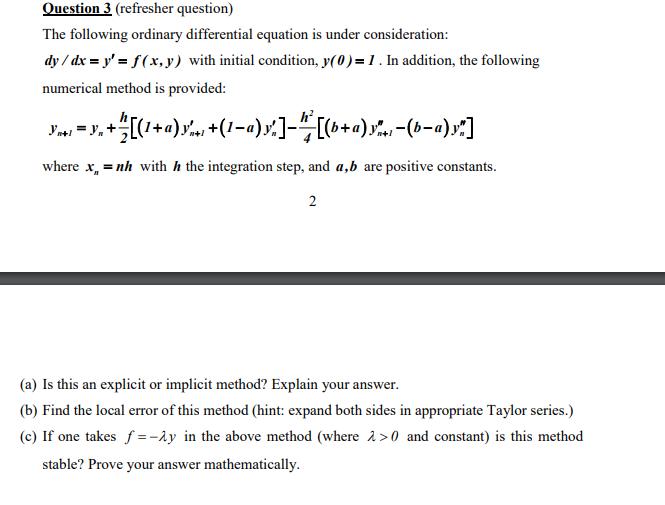
Question 1 Compressible boundary layer with a time-dependent free stream velocity. This problem, for a flat plate at zero angle of attack, is described in Schlichting's book. We will deal with the problem without considering heat transfer. In order to find the solution it is assumed that the stream function can be expanded in a series: y = v_U_x{F(n) + Sofo (17), where U (t) is the time-dependent free stream velocity, x is measured along the plate, dU v is the kinematic viscosity, 7 is a similarity coordinate and So - (du./dr) (+). U After much algebra, the following two equations are obtained for the two functions F,fo that appear in the series above: F"+FF"=0 fo+fF-2fF+3 foF" +8-4F'-2nF" =0 with boundary conditions: F(0)=F'(0)=f(0) = f (0)=0; F'(o)=2, f(x) = 0 (1) and (II) u via F (n)= udn, via u For both (a) and (b) take 77= 20 as equivalent to 17. numerically F(n)= [udn, and a similar procedure for fo.) (1) Solve equations (a) the shooting method. (b) finite differences (hint: to simplify matters for (b) reduce the order of the equations by making use of the auxiliary function: u = F' and numerical integration to find F from e (II) using: Compare the results you obtain using both methods with respect to accuracy, computer runtime &c. Make sure you submit a report of your work in accordance with the instructions that appear on the course's site. Source: "Boundary layer theory", H. Schlichting, Sixth Edition, 1968. Question 2 It is known that for the numerical solution of the ordinary differential equation dy = f(x,y) with initial condition y(0) = 1 a Taylor series method can be used: dx h Y+1=Y+hy+ Yk=0,1,2 (1) to compute the solution step after step. Here h is the integration step. (a) Generalise this method for use in solving the system of ODES: dy == f(x,y), y(x) = C dx where y is the vector of dependent variables, f is the vector of the right hand sides and C is the vector of (constant) initial conditions. (b) Demonstrate the application of the generalized method you have presented in (a) for solving the initial value problem: "+ f(n) B' = S(n), B(0)=0, B'(0)=1, where B' and f,S are known functions of n. d dn Note that for this section you do not need to write and run a computer program. You need to provide an explanation that will enable me to write such a program - in particular what expressions will appear on the right hand side of the generalization of (I). Question 3 (refresher question) The following ordinary differential equation is under consideration: dy/dx=y' = f(x, y) with initial condition, y(0) = 1. In addition, the following numerical method is provided: + " [(1 + a) y' ,, + (1-a) y] [(b+a)-(b-a)y] where x =nh with h the integration step, and a,b are positive constants. 2 (a) Is this an explicit or implicit method? Explain your answer. (b) Find the local error of this method (hint: expand both sides in appropriate Taylor series.) (c) If one takes f= -Ay in the above method (where 2>0 and constant) is this method stable? Prove your answer mathematically.
Step by Step Solution
3.30 Rating (153 Votes )
There are 3 Steps involved in it
Question 1 Compressible boundary layer with a timedependent free stream velocity ... View full answer

Get step-by-step solutions from verified subject matter experts
 Study Help