



Question: The downwash angle at zero angle of attack and the rate of change of downwash with angle of attack can be determined experimentally by
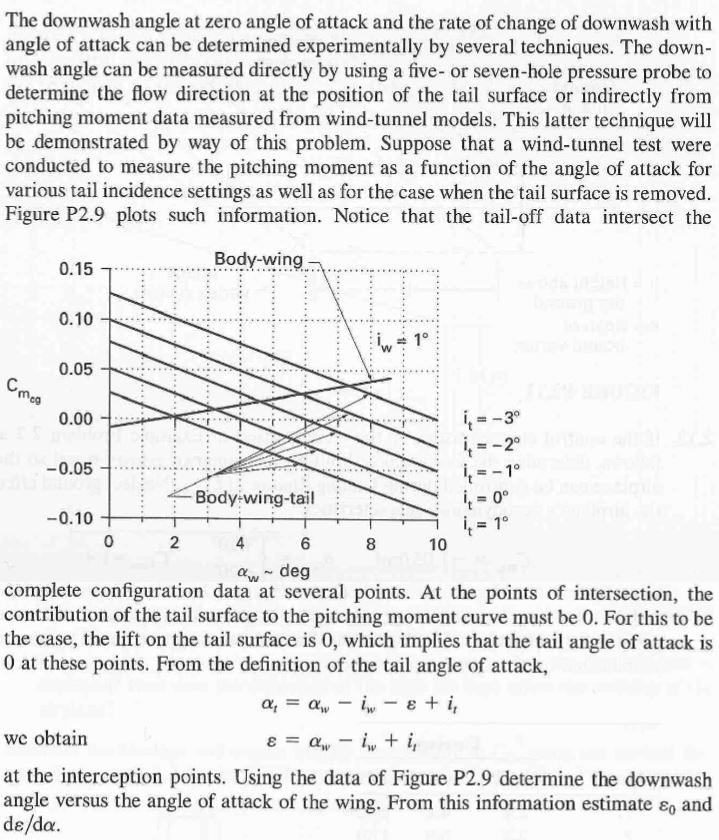
The downwash angle at zero angle of attack and the rate of change of downwash with angle of attack can be determined experimentally by several techniques. The down- wash angle can be measured directly by using a five- or seven-hole pressure probe to determine the flow direction at the position of the tail surface or indirectly from pitching moment data measured from wind-tunnel models. This latter technique will be demonstrated by way of this problem. Suppose that a wind-tunnel test were conducted to measure the pitching moment as a function of the angle of attack for various tail incidence settings as well as for the case when the tail surface is removed. Figure P2.9 plots such information. Notice that the tail-off data intersect the Body-wing 0.15 0.10 1 0.05 i = -3 i, =-2 0.00 -0.05 =-1 i, = 0 = 1 Body-wing-tail -0.10 2 4 6 8 10 aw - deg complete configuration data at several points. At the points of intersection, the contribution of the tail surface to the pitching moment curve must be 0. For this to be the case, the lift on the tail surface is 0, which implies that the tail angle of attack is 0 at these points. From the definition of the tail angle of attack, a, = a, - i, - e + i, we obtain 8 = a, - i, + i, %3D at the interception points. Using the data of Figure P2.9 determine the downwash angle versus the angle of attack of the wing. From this information estimate , and de/da.
Step by Step Solution
3.53 Rating (156 Votes )
There are 3 Steps involved in it
Answer Given LabhSin ce d 0 at the points of inteasection the contaibuttona... View full answer

Get step-by-step solutions from verified subject matter experts