







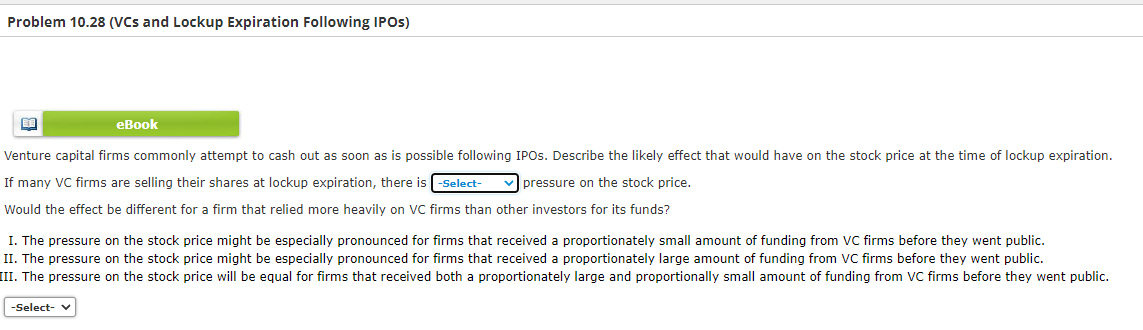
Question: Question 1: Question 2: Question 3: Problem 10.28 (VCs and Lockup Expiration Following IPOs) eBook Venture capital firms commonly attempt to cash out as soon
Question 1:
 Question 2:
 Question 3:
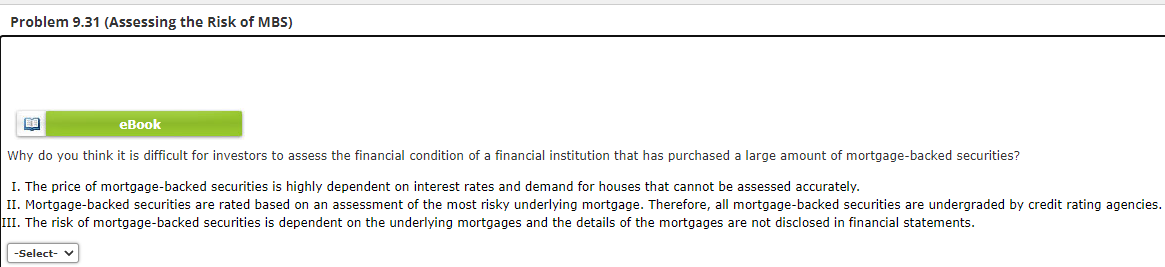
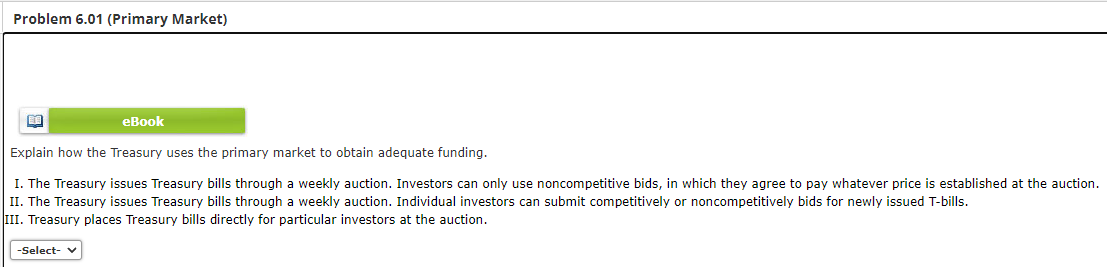
Problem 10.28 (VCs and Lockup Expiration Following IPOs) eBook Venture capital firms commonly attempt to cash out as soon as is possible following IPOs. Describe the likely effect that would have on the stock price at the time of lockup expiration. If many VC firms are selling their shares at lockup expiration, there is -Select- pressure on the stock price. Would the effect be different for a firm that relied more heavily on VC firms than other investors for its funds? I. The pressure on the stock price might be especially pronounced for firms that received a proportionately small amount of funding from VC firms before they went public. II. The pressure on the stock price might be especially pronounced for firms that received a proportionately large amount of funding from VC firms before they went public. III. The pressure on the stock price will be equal for firms that received both a proportionately large and proportionally small amount of funding from VC firms before they went public. -Select- Problem 6.01 (Primary Market) eBook Explain how the Treasury uses the primary market to obtain adequate funding. I. The Treasury issues Treasury bills through a weekly auction. Investors can only use noncompetitive bids, in which they agree to pay whatever price is established at the auction. II. The Treasury issues Treasury bills through a weekly auction. Individual investors can submit competitively or noncompetitively bids for newly issued T-bills. III. Treasury places Treasury bills directly for particular investors at the auction. -Select- Problem 9.31 (Assessing the Risk of MBS) eBook Why do you think it is difficult for investors to assess the financial condition of a financial institution that has purchased a large amount of mortgage-backed securities? I. The price of mortgage-backed securities is highly dependent on interest rates and demand for houses that cannot be assessed accurately. II. Mortgage-backed securities are rated based on an assessment of the most risky underlying mortgage. Therefore, all mortgage-backed securities are undergraded by credit rating agencies. III. The risk of mortgage-backed securities is dependent on the underlying mortgages and the details of the mortgages are not disclosed in financial statements. -Select- Problem 10.28 (VCs and Lockup Expiration Following IPOs) eBook Venture capital firms commonly attempt to cash out as soon as is possible following IPOs. Describe the likely effect that would have on the stock price at the time of lockup expiration. If many VC firms are selling their shares at lockup expiration, there is -Select- pressure on the stock price. Would the effect be different for a firm that relied more heavily on VC firms than other investors for its funds? I. The pressure on the stock price might be especially pronounced for firms that received a proportionately small amount of funding from VC firms before they went public. II. The pressure on the stock price might be especially pronounced for firms that received a proportionately large amount of funding from VC firms before they went public. III. The pressure on the stock price will be equal for firms that received both a proportionately large and proportionally small amount of funding from VC firms before they went public. -Select- Problem 6.01 (Primary Market) eBook Explain how the Treasury uses the primary market to obtain adequate funding. I. The Treasury issues Treasury bills through a weekly auction. Investors can only use noncompetitive bids, in which they agree to pay whatever price is established at the auction. II. The Treasury issues Treasury bills through a weekly auction. Individual investors can submit competitively or noncompetitively bids for newly issued T-bills. III. Treasury places Treasury bills directly for particular investors at the auction. -Select- Problem 9.31 (Assessing the Risk of MBS) eBook Why do you think it is difficult for investors to assess the financial condition of a financial institution that has purchased a large amount of mortgage-backed securities? I. The price of mortgage-backed securities is highly dependent on interest rates and demand for houses that cannot be assessed accurately. II. Mortgage-backed securities are rated based on an assessment of the most risky underlying mortgage. Therefore, all mortgage-backed securities are undergraded by credit rating agencies. III. The risk of mortgage-backed securities is dependent on the underlying mortgages and the details of the mortgages are not disclosed in financial statements. -Select
Step by Step Solution
There are 3 Steps involved in it

Get step-by-step solutions from verified subject matter experts
 Study Help