Question: QUESTION 12 5 points Save Answer 12) Assume that the shadow price of a non-binding S constraint is 5. This implies that: A) if the
QUESTION 12 5 points Save Answer 12) Assume thatQUESTION 12 5 points Save Answer 12) Assume thatQUESTION 12 5 points Save Answer 12) Assume thatQUESTION 12 5 points Save Answer 12) Assume thatQUESTION 12 5 points Save Answer 12) Assume that

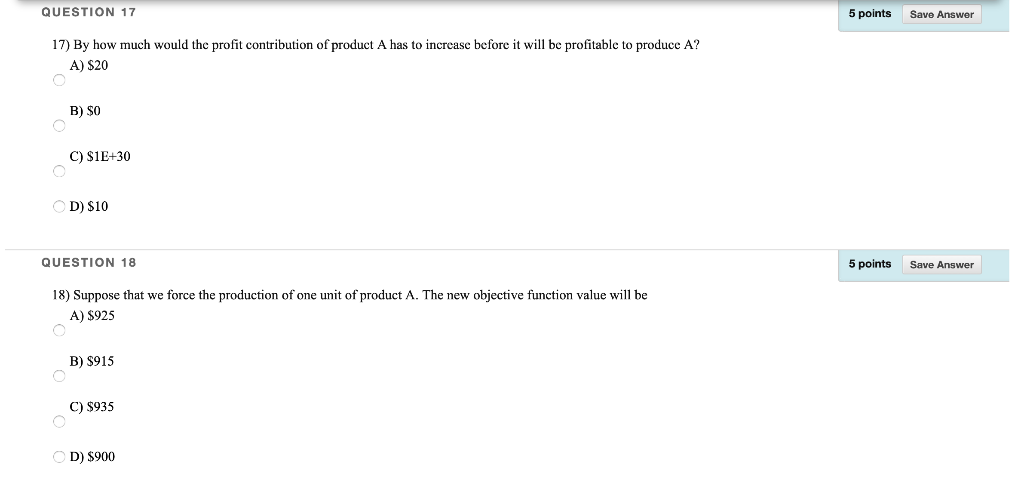
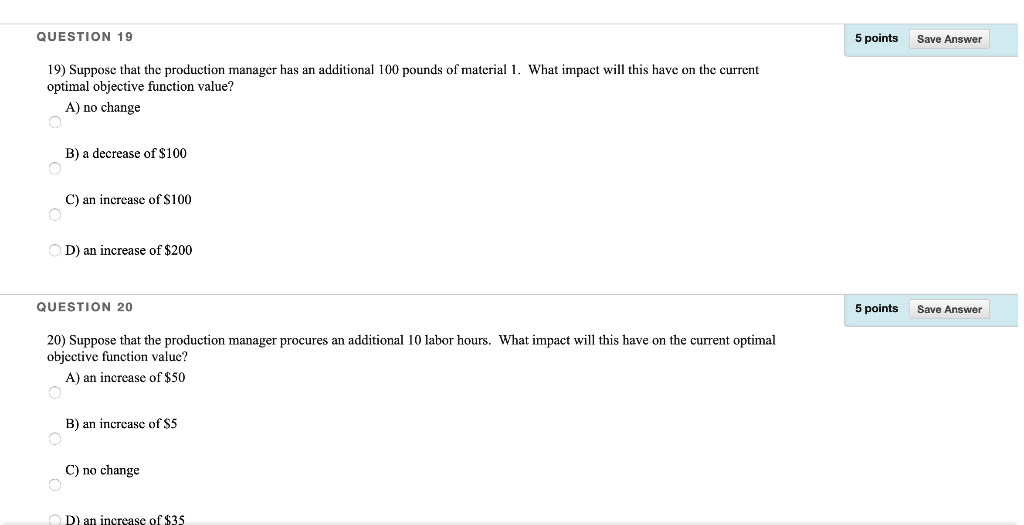
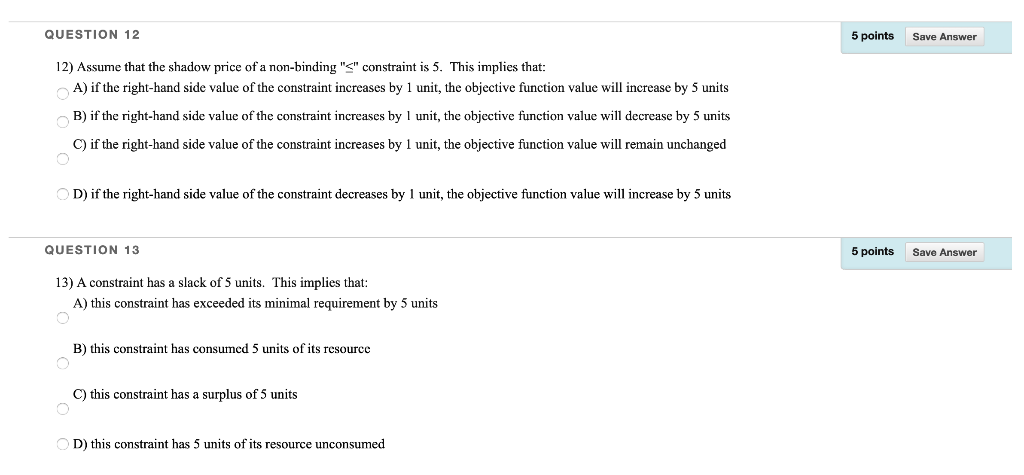
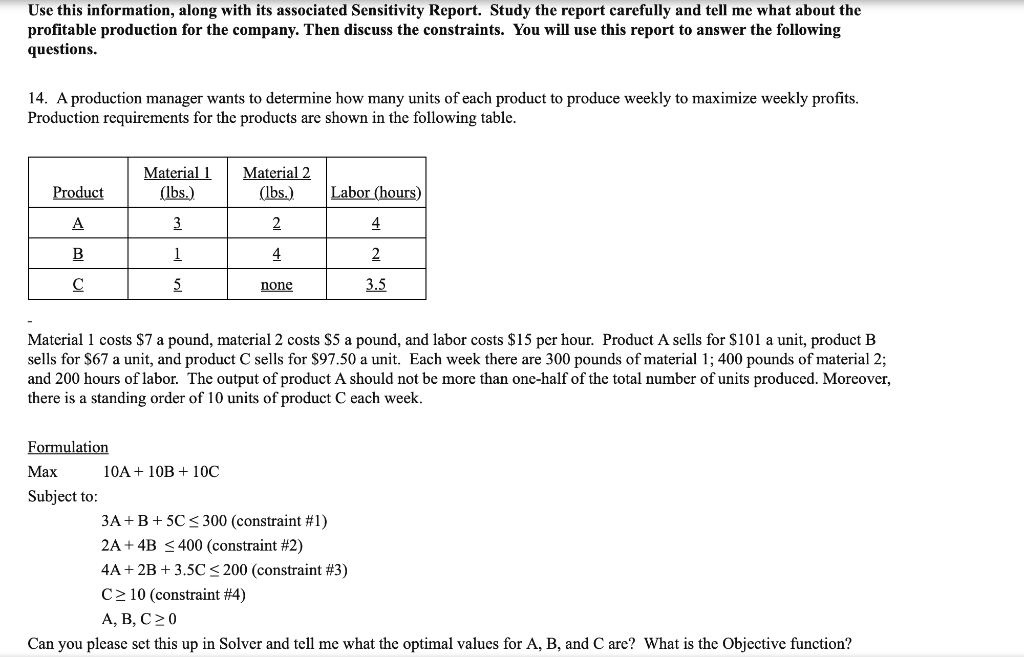
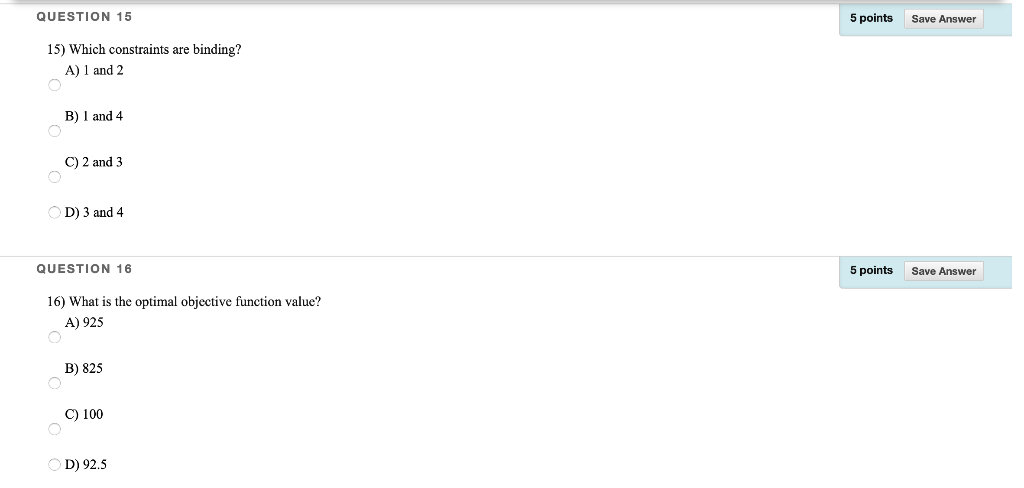
QUESTION 12 5 points Save Answer 12) Assume that the shadow price of a non-binding "S" constraint is 5. This implies that: A) if the right-hand side value of the constraint increases by 1 unit, the objective function value will increase by 5 units B) if the right-hand side value of the constraint increases by 1 unit, the objective function value will decrease by 5 units C) if the right-hand side value of the constraint increases by 1 unit, the objective function value will remain unchanged O OD) if the right-hand side value of the constraint decreases by 1 unit, the objective function value will increase by 5 units QUESTION 13 5 points Save Answer 13) A constraint has a slack of 5 units. This implies that: A) this constraint has exceeded its minimal requirement by 5 units O B) this constraint has consumed 5 units of its resource C) this constraint has a surplus of 5 units OD) this constraint has 5 units of its resource unconsumed Use this information, along with its associated Sensitivity Report. Study the report carefully and tell me what about the profitable production for the company. Then discuss the constraints. You will use this report to answer the following questions. 14. A production manager wants to determine how many units of each product to produce weekly to maximize weekly profits. Production requirements for the products are shown in the following table. Material 1 (lbs.) Product Material 2 (lbs.) Labor (hours) A 3 2 4 B 1 4 2 5 none 3.5 Material 1 costs $7 a pound, material 2 costs $5 a pound, and labor costs $15 per hour. Product A sells for $101 a unit, product B sells for $67 a unit and product C sells for $97.50 a unit. Each week there are 300 pounds of material 1; 400 pounds of material 2; and 200 hours of labor. The output of product A should not be more than one-half of the total number of units produced. Moreover, there is a standing order of 10 units of product C each week. Formulation Max 10A + 10B + 10C Subject to: 3A+B + 5C 10 (constraint #4) A, B, C 0 Can you please set this up in Solver and tell me what the optimal values for A, B, and Care? What is the Objective function? QUESTION 15 5 points Save Answer 15) Which constraints are binding? A) 1 and 2 B) 1 and 4 C) 2 and 3 D) 3 and 4 QUESTION 16 5 points Save Answer 16) What is the optimal objective function value? A) 925 B) 825 C) 100 D) 92.5 QUESTION 17 5 points Save Answer 17) By how much would the profit contribution of product A has to increase before it will be profitable to produce A? A) $20 B) $0 C) $1E+30 OD) $10 QUESTION 18 5 points Save Answer 18) Suppose that we force the production of one unit of product A. The new objective function value will be A) $925 B) $915 C) $935 D) $900 QUESTION 19 5 points Save Answer 19) Suppose that the production manager has an additional 100 pounds of material 1. What impact will this have on the current optimal objective function value? A) no change B) a decrease of $100 C) an increase of $100 OD an increase of $200 QUESTION 20 5 points Save Answer 20) Suppose that the production manager procures an additional 10 labor hours. What impact will this have on the current optimal objective function value? A) an increase of $50 B) an increase of $5 C) no change D) an increase of $35
Step by Step Solution

There are 3 Steps involved in it

1 Expert Approved Answer
Step: 1 Unlock blur-text-image

Question Has Been Solved by an Expert!

Get step-by-step solutions from verified subject matter experts

Step: 2 Unlock
Step: 3 Unlock

Students Have Also Explored These Related General Management Questions!