





Question: Question 1-3 below, do not need to answer those. This question is based on the scenario described in Question 1, Question 2 and Question 3.
Question 1-3 below, do not need to answer those.
Question 1-3 below, do not need to answer those.
Question 1-3 below, do not need to answer those.Question 1-3 below, do not need to answer those.Question 1-3 below, do not need to answer those.

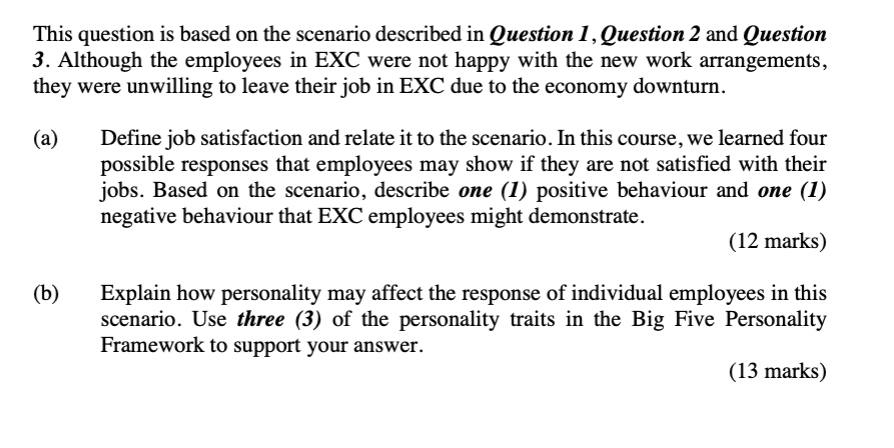
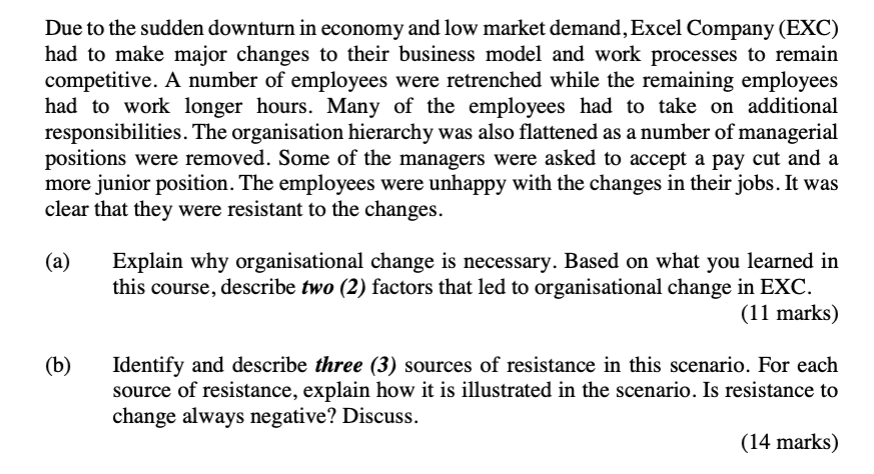
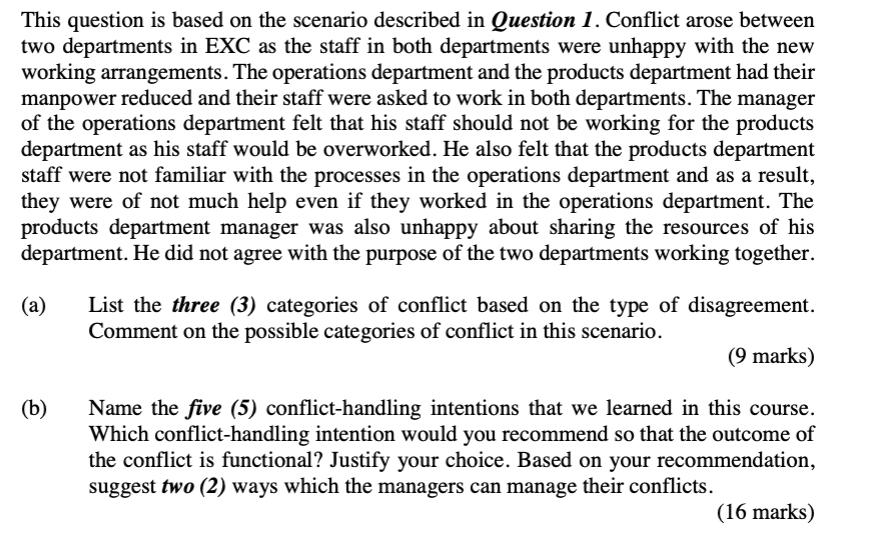
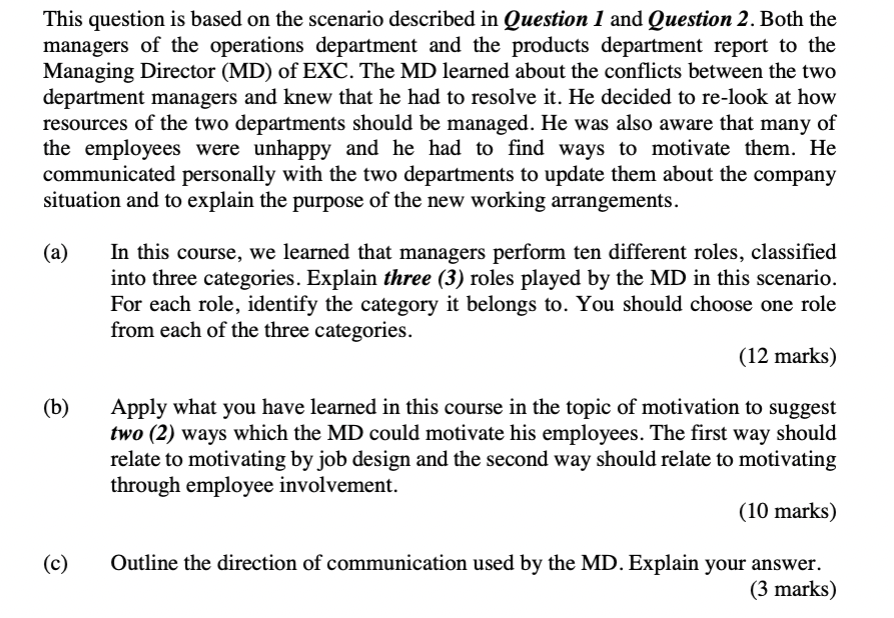
This question is based on the scenario described in Question 1, Question 2 and Question 3. Although the employees in EXC were not happy with the new work arrangements, they were unwilling to leave their job in EXC due to the economy downturn. (a) Define job satisfaction and relate it to the scenario. In this course, we learned four possible responses that employees may show if they are not satisfied with their jobs. Based on the scenario, describe one (1) positive behaviour and one (1) negative behaviour that EXC employees might demonstrate. (12 marks) (b) Explain how personality may affect the response of individual employees in this scenario. Use three (3) of the personality traits in the Big Five Personality Framework to support your answer. (13 marks) Due to the sudden downturn in economy and low market demand, Excel Company (EXC) had to make major changes to their business model and work processes to remain competitive. A number of employees were retrenched while the remaining employees had to work longer hours. Many of the employees had to take on additional responsibilities. The organisation hierarchy was also flattened as a number of managerial positions were removed. Some of the managers were asked to accept a pay cut and a more junior position. The employees were unhappy with the changes in their jobs. It was clear that they were resistant to the changes. (a) Explain why organisational change is necessary. Based on what you learned in this course, describe two (2) factors that led to organisational change in EXC. (11 marks) (b) Identify and describe three (3) sources of resistance in this scenario. For each source of resistance, explain how it is illustrated in the scenario. Is resistance to change always negative? Discuss. (14 marks) This question is based on the scenario described in Question 1. Conflict arose between two departments in EXC as the staff in both departments were unhappy with the new working arrangements. The operations department and the products department had their manpower reduced and their staff were asked to work in both departments. The manager of the operations department felt that his staff should not be working for the products department as his staff would be overworked. He also felt that the products department staff were not familiar with the processes in the operations department and as a result, they were of not much help even if they worked in the operations department. The products department manager was also unhappy about sharing the resources of his department. He did not agree with the purpose of the two departments working together. (a) List the three (3) categories of conflict based on the type of disagreement. Comment on the possible categories of conflict in this scenario. (9 marks) (b) Name the five (5) conflict-handling intentions that we learned in this course. Which conflict-handling intention would you recommend so that the outcome of the conflict is functional? Justify your choice. Based on your recommendation, suggest two (2) ways which the managers can manage their conflicts. (16 marks) This question is based on the scenario described in Question 1 and Question 2. Both the managers of the operations department and the products department report to the Managing Director (MD) of EXC. The MD learned about the conflicts between the two department managers and knew that he had to resolve it. He decided to re-look at how resources of the two departments should be managed. He was also aware that many of the employees were unhappy and he had to find ways to motivate them. He communicated personally with the two departments to update them about the company situation and to explain the purpose of the new working arrangements. (a) In this course, we learned that managers perform ten different roles, classified into three categories. Explain three (3) roles played by the MD in this scenario. For each role, identify the category it belongs to. You should choose one role from each of the three categories. (12 marks) (b) Apply what you have learned in this course in the topic of motivation to suggest two (2) ways which the MD could motivate his employees. The first way should relate to motivating by job design and the second way should relate to motivating through employee involvement. (10 marks) (c) Outline the direction of communication used by the MD. Explain your

Step by Step Solution

There are 3 Steps involved in it

1 Expert Approved Answer
Step: 1 Unlock blur-text-image

Question Has Been Solved by an Expert!

Get step-by-step solutions from verified subject matter experts

Step: 2 Unlock
Step: 3 Unlock

Students Have Also Explored These Related General Management Questions!