





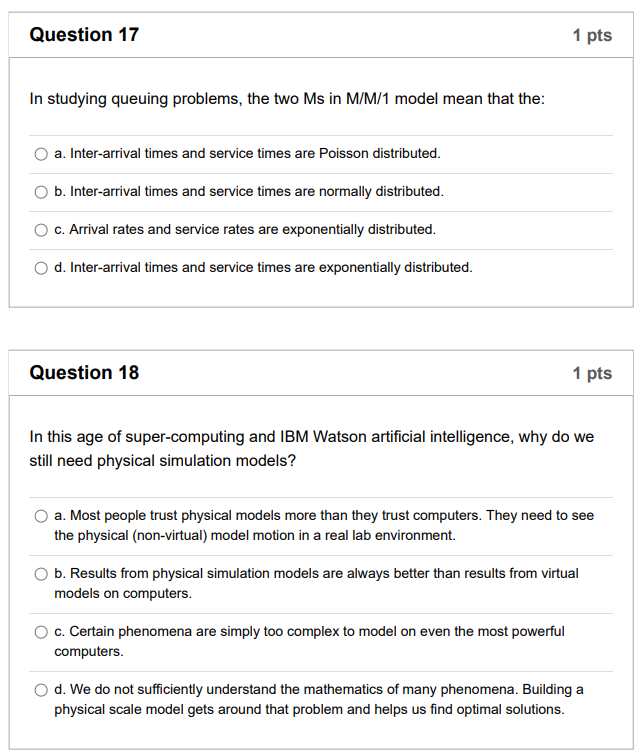
Question: Question 17 1 pts In studying queuing problems, the two Ms in M/M/1 model mean that the o a. Inter-arrival times and service times are
Question 17 1 pts In studying queuing problems,Question 17 1 pts In studying queuing problems,

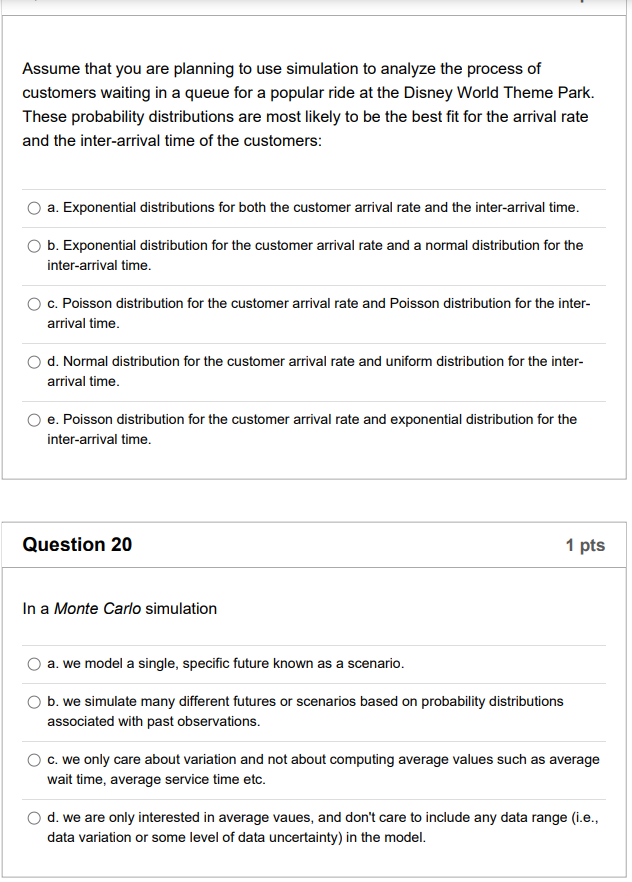
Question 17 1 pts In studying queuing problems, the two Ms in M/M/1 model mean that the o a. Inter-arrival times and service times are Poisson distributed. b. Inter-arrival times and service times are normally distributed. c. Arrival rates and service rates are exponentially distributed. d. Inter-arrival times and service times are exponentially distributed. Question 18 1 pts In this age of super-computing and IBM Watson artificial intelligence, why do we still need physical simulation models? a. Most people trust physical models more than they trust computers. They need to see the physical (non-virtual) model motion in a real lab environment. b. Results from physical simulation models are always better than results from virtual models on computers. c. Certain phenomena are simply too complex to model on even the most powerful computers. d. We do not sufficiently understand the mathematics of many phenomena. Building a physical scale model gets around that problem and helps us find optimal solutions. Assume that you are planning to use simulation to analyze the process of customers waiting in a queue for a popular ride at the Disney World Theme Park. These probability distributions are most likely to be the best fit for the arrival rate and the inter-arrival time of the customers: a. Exponential distributions for both the customer arrival rate and the inter-arrival time. b. Exponential distribution for the customer arrival rate and a normal distribution for the inter-arrival time. C. Poisson distribution for the customer arrival rate and Poisson distribution for the inter- arrival time. d. Normal distribution for the customer arrival rate and uniform distribution for the inter- arrival time. e. Poisson distribution for the customer arrival rate and exponential distribution for the inter-arrival time. Question 20 1 pts In a Monte Carlo simulation a. we model a single, specific future known as a scenario. b. we simulate many different futures or scenarios based on probability distributions associated with past observations. C. We only care about variation and not about computing average values such as average wait time, average service time etc. d. we are only interested in average vaues, and don't care to include any data range (i.e., data variation or some level of data uncertainty) in the model

Step by Step Solution

There are 3 Steps involved in it

1 Expert Approved Answer
Step: 1 Unlock blur-text-image

Question Has Been Solved by an Expert!

Get step-by-step solutions from verified subject matter experts

Step: 2 Unlock
Step: 3 Unlock

Students Have Also Explored These Related General Management Questions!