







Question: Question 1(Multiple Choice Worth 6 points) (06.04 MC) Let n(x) = [ (-4(1 + 1)2 + 4)dy. Where does h(x) have a relative maximum? O-2
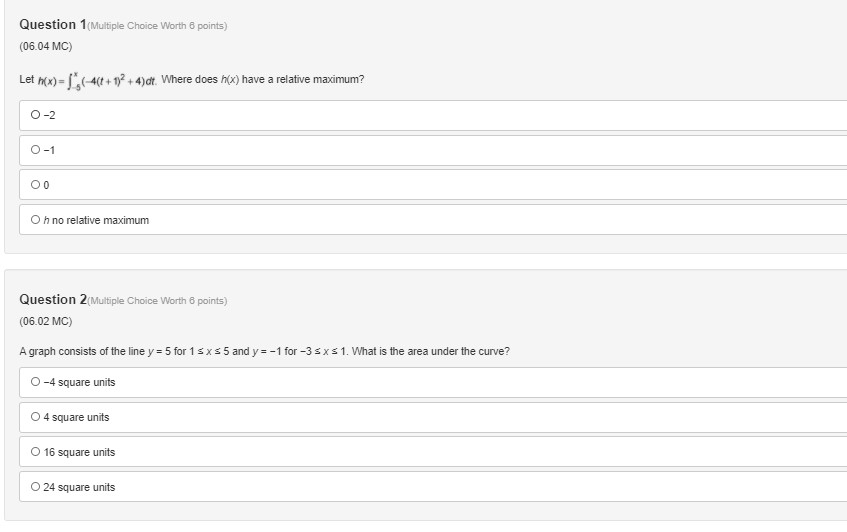
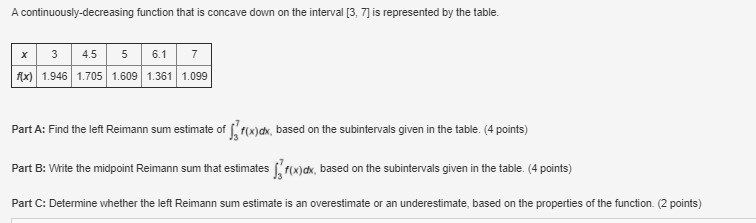
Question 1(Multiple Choice Worth 6 points) (06.04 MC) Let n(x) = [" (-4(1 + 1)2 + 4)dy. Where does h(x) have a relative maximum? O-2 O-1 O0 Oh no relative maximum Question 2(Multiple Choice Worth 6 points) (06.02 MC) A graph consists of the line y = 5 for 1 s x s 5 and y= -1 for -3 s x $ 1. What is the area under the curve? O -4 square units O 4 square units O 16 square units O 24 square unitsA continuously-decreasing function that is concave down on the interval [3, 7] is represented by the table. 3 4.5 5 6.1 7 f(x) 1.946 1.705 1.609 1.361 1.099 Part A: Find the left Reimann sum estimate of ( r(xjo, based on the subintervals given in the table. (4 points) Part B: Write the midpoint Reimann sum that estimates ['r(x)dx, based on the subintervals given in the table. (4 points) Part C: Determine whether the left Reimann sum estimate is an overestimate or an underestimate, based on the properties of the function. (2 points)
Step by Step Solution
There are 3 Steps involved in it

Get step-by-step solutions from verified subject matter experts
 Study Help