



Question: Question 1-Variance analysis (70 points) Ybrew is a beer company that sells three types of local beers in Maastricht. To produce these beers, Ybrew needs
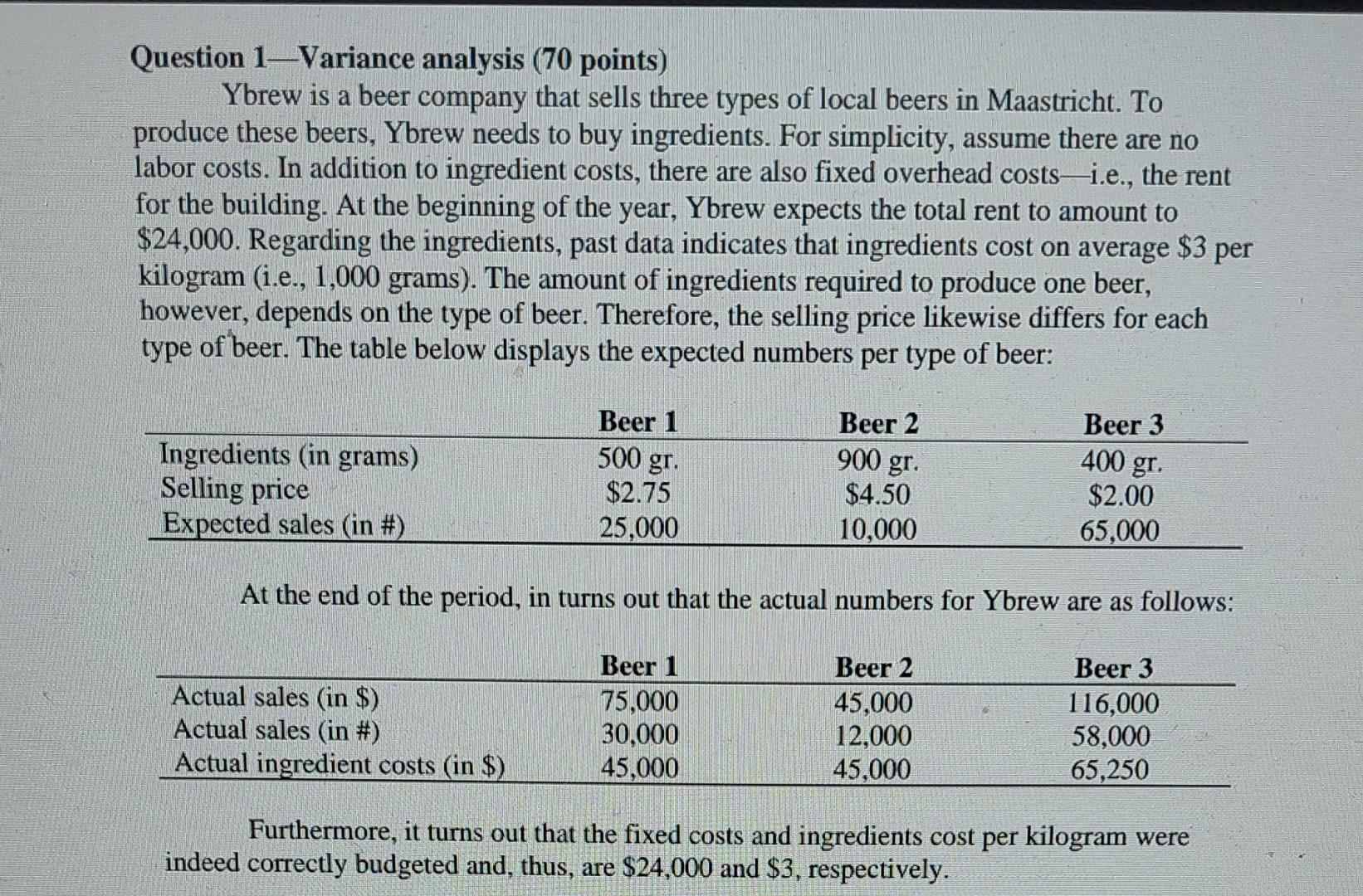
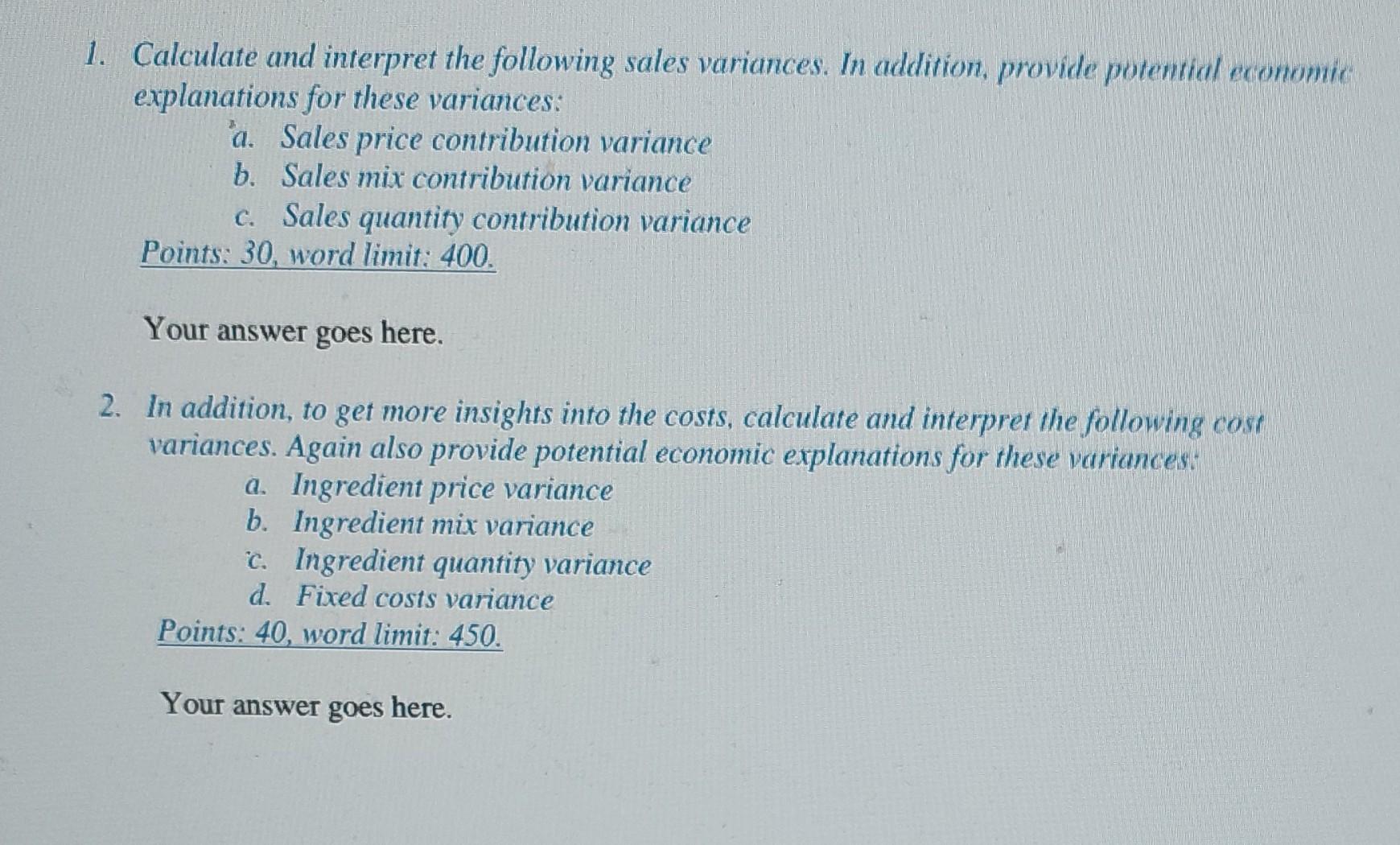
Question 1-Variance analysis (70 points) Ybrew is a beer company that sells three types of local beers in Maastricht. To produce these beers, Ybrew needs to buy ingredients. For simplicity, assume there are no labor costs. In addition to ingredient costs, there are also fixed overhead costs - i.e., the rent for the building. At the beginning of the year, Ybrew expects the total rent to amount to $24,000. Regarding the ingredients, past data indicates that ingredients cost on average $3 per kilogram (i.e., 1,000 grams). The amount of ingredients required to produce one beer, however, depends on the type of beer. Therefore, the selling price likewise differs for each type of beer. The table below displays the expected numbers per type of beer: At the end of the period, in turns out that the actual numbers for Ybrew are as follows: Furthermore, it turns out that the fixed costs and ingredients cost per kilogram were indeed correctly budgeted and, thus, are $24,000 and $3, respectively. 1. Calculate and interpret the following sales variances. In addition, provide potential economic explanations for these variances: a. Sales price contribution variance b. Sales mix contribution variance c. Sales quantity contribution variance Points: 30, word limit: 400 . Your answer goes here. 2. In addition, to get more insights into the costs, calculate and interpret the following cost variances. Again also provide potential economic explanations for these variances: a. Ingredient price variance b. Ingredient mix variance c. Ingredient quantity variance d. Fixed costs variance Points: 40, word limit: 450. Your answer goes here. Question 1-Variance analysis (70 points) Ybrew is a beer company that sells three types of local beers in Maastricht. To produce these beers, Ybrew needs to buy ingredients. For simplicity, assume there are no labor costs. In addition to ingredient costs, there are also fixed overhead costs - i.e., the rent for the building. At the beginning of the year, Ybrew expects the total rent to amount to $24,000. Regarding the ingredients, past data indicates that ingredients cost on average $3 per kilogram (i.e., 1,000 grams). The amount of ingredients required to produce one beer, however, depends on the type of beer. Therefore, the selling price likewise differs for each type of beer. The table below displays the expected numbers per type of beer: At the end of the period, in turns out that the actual numbers for Ybrew are as follows: Furthermore, it turns out that the fixed costs and ingredients cost per kilogram were indeed correctly budgeted and, thus, are $24,000 and $3, respectively. 1. Calculate and interpret the following sales variances. In addition, provide potential economic explanations for these variances: a. Sales price contribution variance b. Sales mix contribution variance c. Sales quantity contribution variance Points: 30, word limit: 400 . Your answer goes here. 2. In addition, to get more insights into the costs, calculate and interpret the following cost variances. Again also provide potential economic explanations for these variances: a. Ingredient price variance b. Ingredient mix variance c. Ingredient quantity variance d. Fixed costs variance Points: 40, word limit: 450. Your answer goes here
Step by Step Solution
There are 3 Steps involved in it

Get step-by-step solutions from verified subject matter experts