







Question: Question 2 1 - 2 8 Explain to me each question and what E Coli is for complementation and what E Coli is for combination?
Question
Explain to me each question and what E Coli is for complementation and what E Coli is for combination?
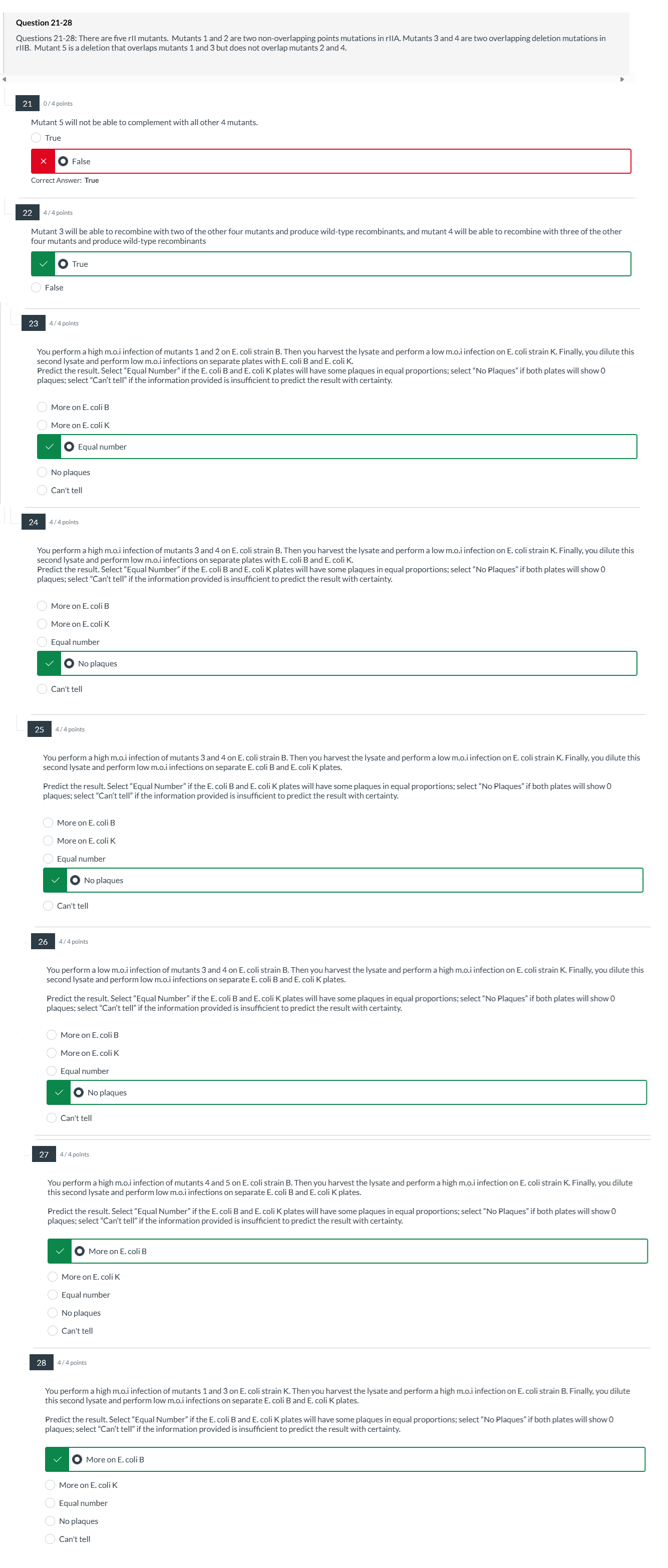
Questions : There are five rII mutants. Mutants and are two nonoverlapping points mutations in rIIA. Mutants and are two overlapping deletion mutations in
rIIB. Mutant is a deletion that overlaps mutants and but does not overlap mutants and
points
Mutant will not be able to complement with all other mutants.
True
O False
Correct Answer: True
points
Mutant will be able to recombine with two of the other four mutants and produce wildtype recombinants, and mutant will be able to recombine with three of the other
four mutants and produce wildtype recombinants
True
False
points
You perform a high moi infection of mutants and on E coli strain B Then you harvest the lysate and perform a low moi infection on E coli strain K Finally, you dilute this
second lysate and perform low moi infections on separate plates with E coli B and E coli K
plaques; select "Can't tell" if the information provided is insufficient to predict the result with certainty.
More on E coli B
More on E coli K
O Equal number
No plaques
Can't tell
points
You perform a high moi infection of mutants and on E coli strain B Then you harvest the lysate and perform a low moi infection on E coli strain K Finally, you dilute this
second lysate and perform low moi infections on separate plates with E coli B and E coli K
plaques; select "Can't tell" if the information provided is insufficient to predict the result with certainty.
More on Ecoli B
More on E coli K
Equal number
O No plaques
Can't tell
points
You perform a high moi infection of mutants and on E coli strain B Then you harvest the lysate and perform a low moi infection on E coli strain K Finally, you dilute this
second lysate and perform low moi infections on separate E coli B and E coli K plates.
Predict the result. Select "Equal Number" if the E coli B and E coli K plates will have some plaques in equal proportions; select No Plaques" if both plates will show
plaques; select "Can't tell" if the information provided is insufficient to predict the result with certainty.
More on E coli B
More on E coli K
Equal number
O No plaques
Can't tell
You perform a low moi infection of mutants and on E coli strain B Then you harvest the lysate and perform a high moi infection on E coli strain K Finally, you dilute this
second lysate and perform low moi infections on separate E coli B and E coli K plates
Predict the result. Select "Equal Number" if the E coli B and E coli K plates will have some plaques in equal proportions; select No Plaques" if both plates will show
More on E coli B
More on E coliK
Equal number
No plaques
Can't tell
points
You perform a high moi infection of mutants and on E coli strain B Then you harvest the lysate and perform a high moi infection on E coli strain K Finally, you dilute
this second lysate and perform low moi infections on separate E coli B and E coli K plates.
Predict the result. Select "Equal Number" if the E coli B and E coli K plates will have some plaques in equal proportions; select No Plaques" if both plates will show
plaques; select "Can't tell" if the information provided is insufficient to predict the result with certainty.
More on E coli B
More on E coliK
Equal number
No plaques
Can't tell
You perform a high moi infection of mutants and on E coli strain K Then you harvest the lysate and perform a high moi infection on E coli strain B Finally, you dilute
this second lysate and perform low moi infections on separate E coli B and E coli K plates.
Predict the result. Select "Equal Number" if the E coli B and E coli K plates will have some plaques in equal proportions; select No Plaques" if both plates will show
plaques; select "Can't tell" if the information provided is insufficient to
plaques; select "Can't tell" if the information provided is insufficient to predict the result with certainty.
More on E coli B
More on E coli K
Equal number
No plaques
Can't tell
Step by Step Solution
There are 3 Steps involved in it
1 Expert Approved Answer
Step: 1 Unlock

Question Has Been Solved by an Expert!
Get step-by-step solutions from verified subject matter experts
Step: 2 Unlock
Step: 3 Unlock
 Study Help