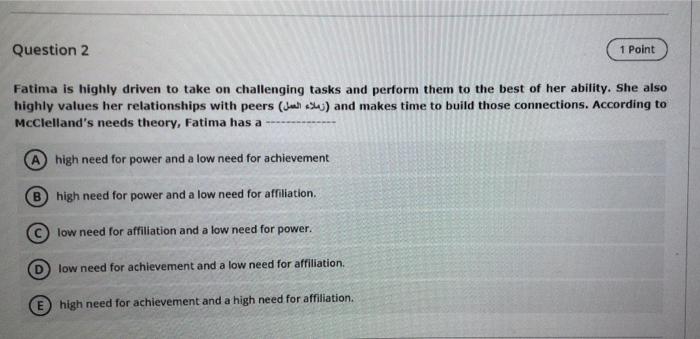
Question: Question 2 1 Point Fatima is highly driven to take on challenging tasks and perform them to the best of her ability. She also highly
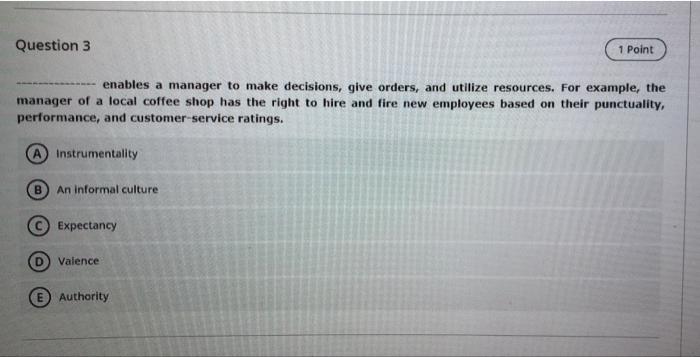
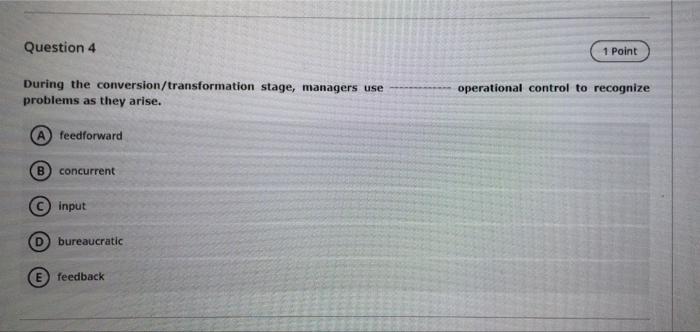
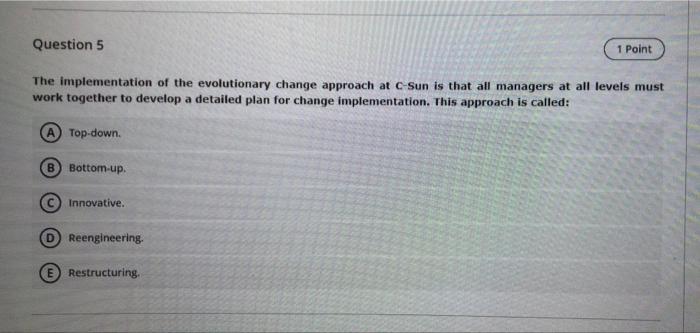
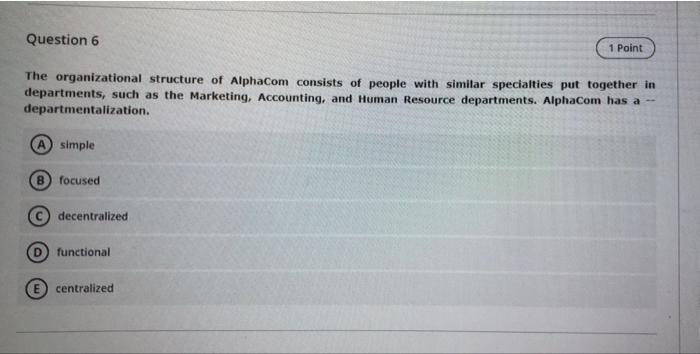
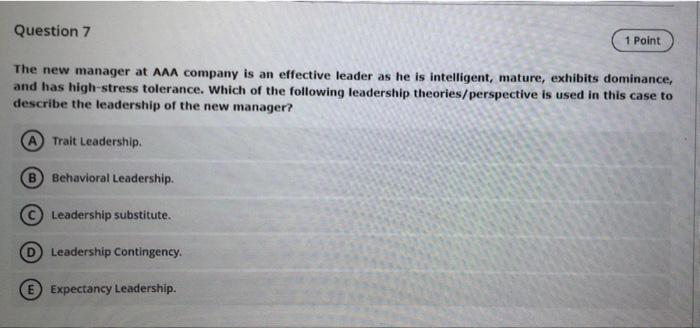
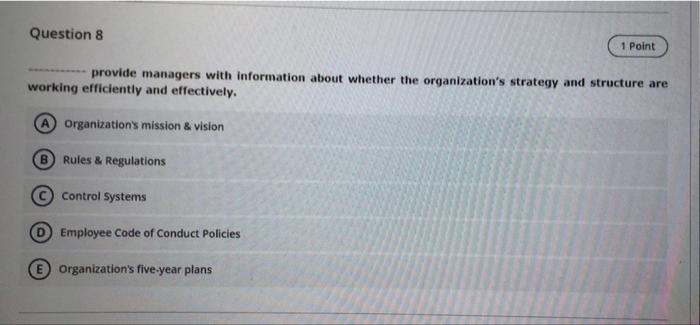
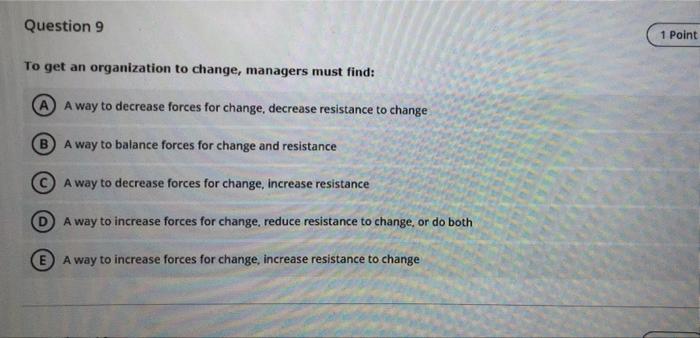
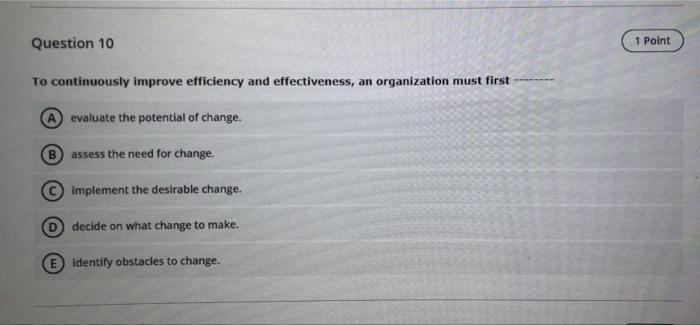
Question 2 1 Point Fatima is highly driven to take on challenging tasks and perform them to the best of her ability. She also highly values her relationships with peers (Jaunu) and makes time to build those connections. According to McClelland's needs theory, Fatima has a high need for power and a low need for achievement B high need for power and a low need for affiliation low need for affiliation and a low need for power. low need for achievement and a low need for affiliation high need for achievement and a high need for affiliation. Question 3 1 Point enables a manager to make decisions, give orders, and utilize resources. For example, the manager of a local coffee shop has the right to hire and fire new employees based on their punctuality, performance, and customer service ratings. A) Instrumentality B An informal culture Expectancy Valence Authority Question 4 1 Point During the conversion/transformation stage, managers use problems as they arise. operational control to recognize feedforward B concurrent input bureaucratic feedback Question 5 1 Point The implementation of the evolutionary change approach at c Sun is that all managers at all levels must work together to develop a detailed plan for change implementation. This approach is called: A Top-down Bottom-up. Innovative Reengineering E Restructuring Question 6 1 Point The organizational structure of AlphaCom consists of people with similar specialties put together in departments, such as the Marketing, Accounting, and Human Resource departments. AlphaCom has a - departmentalization. A simple focused decentralized functional E centralized Question 7 1 Point The new manager at AAA company is an effective leader as he is intelligent, mature, exhibits dominance, and has high-stress tolerance. Which of the following leadership theories/perspective is used in this case to describe the leadership of the new manager? A Trait Leadership B Behavioral Leadership. Leadership substitute. D Leadership Contingency. Expectancy Leadership. Question 8 1 Point provide managers with information about whether the organization's strategy and structure are working efficiently and effectively. A Organization's mission & Vision B Rules & Regulations Control Systems Employee Code of Conduct Policies Organization's five-year plans Question 9 1 Point To get an organization to change, managers must find: A A way to decrease forces for change, decrease resistance to change A way to balance forces for change and resistance A way to decrease forces for change, increase resistance A way to increase forces for change, reduce resistance to change or do both 6 A way to increase forces for change, increase resistance to change Question 10 1 Point To continuously improve efficiency and effectiveness, an organization must first evaluate the potential of change. B assess the need for change. implement the desirable change. D decide on what change to make. E identify obstacles to change









 Study Help