







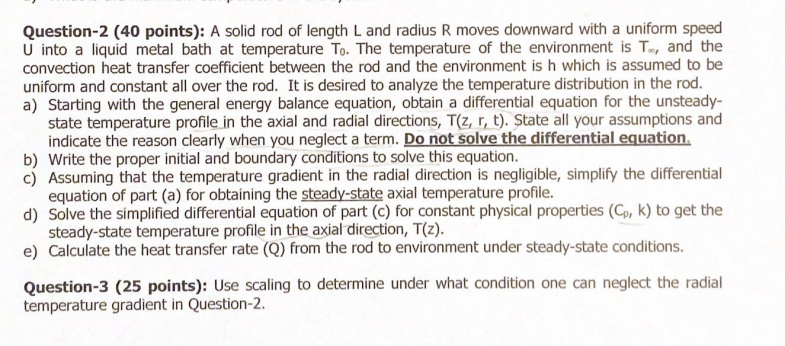
Question: Question - 2 ( 4 0 points ) : A solid rod of length ( L ) and radius ( R
Question points: A solid rod of length L and radius R moves downward with a uniform speed U into a liquid metal bath at temperature T The temperature of the environment is Tinfty and the convection heat transfer coefficient between the rod and the environment is h which is assumed to be uniform and constant all over the rod. It is desired to analyze the temperature distribution in the rod.
a Starting with the general energy balance equation, obtain a differential equation for the unsteadystate temperature profile in the axial and radial directions, Tz r t State all your assumptions and indicate the reason clearly when you neglect a term. Do not solve the differential equation.
b Write the proper initial and boundary conditions to solve this equation.
c Assuming that the temperature gradient in the radial direction is negligible, simplify the differential equation of part a for obtaining the steadystate axial temperature profile.
d Solve the simplified differential equation of part c for constant physical properties leftCp kright to get the steadystate temperature profile in the axial direction, mathrmTmathrmz
e Calculate the heat transfer rate mathrmQ from the rod to environment under steadystate conditions.
Question points: Use scaling to determine under what condition one can neglect the radial temperature gradient in Question
Step by Step Solution
There are 3 Steps involved in it
1 Expert Approved Answer
Step: 1 Unlock

Question Has Been Solved by an Expert!
Get step-by-step solutions from verified subject matter experts
Step: 2 Unlock
Step: 3 Unlock
 Study Help